The query what is land crypto can point to several very different things. It may describe a unique virtual parcel represented by a non-fungible token, a fungible token associated with a virtual-world project, or an unrelated asset that happens to use LAND as a name or ticker. The shared word is useful for branding and conversation, but it does not make the underlying contracts, units, or rights interchangeable.
That distinction matters because land crypto is often discussed with a real-estate metaphor. In a virtual world, LAND normally refers to a platform-defined digital object and the permissions that platform connects to it. A platform token is instead a quantity of interchangeable units with its own rules. Neither label, by itself, identifies a real-world parcel, a title record, or a general claim on a project's activity.
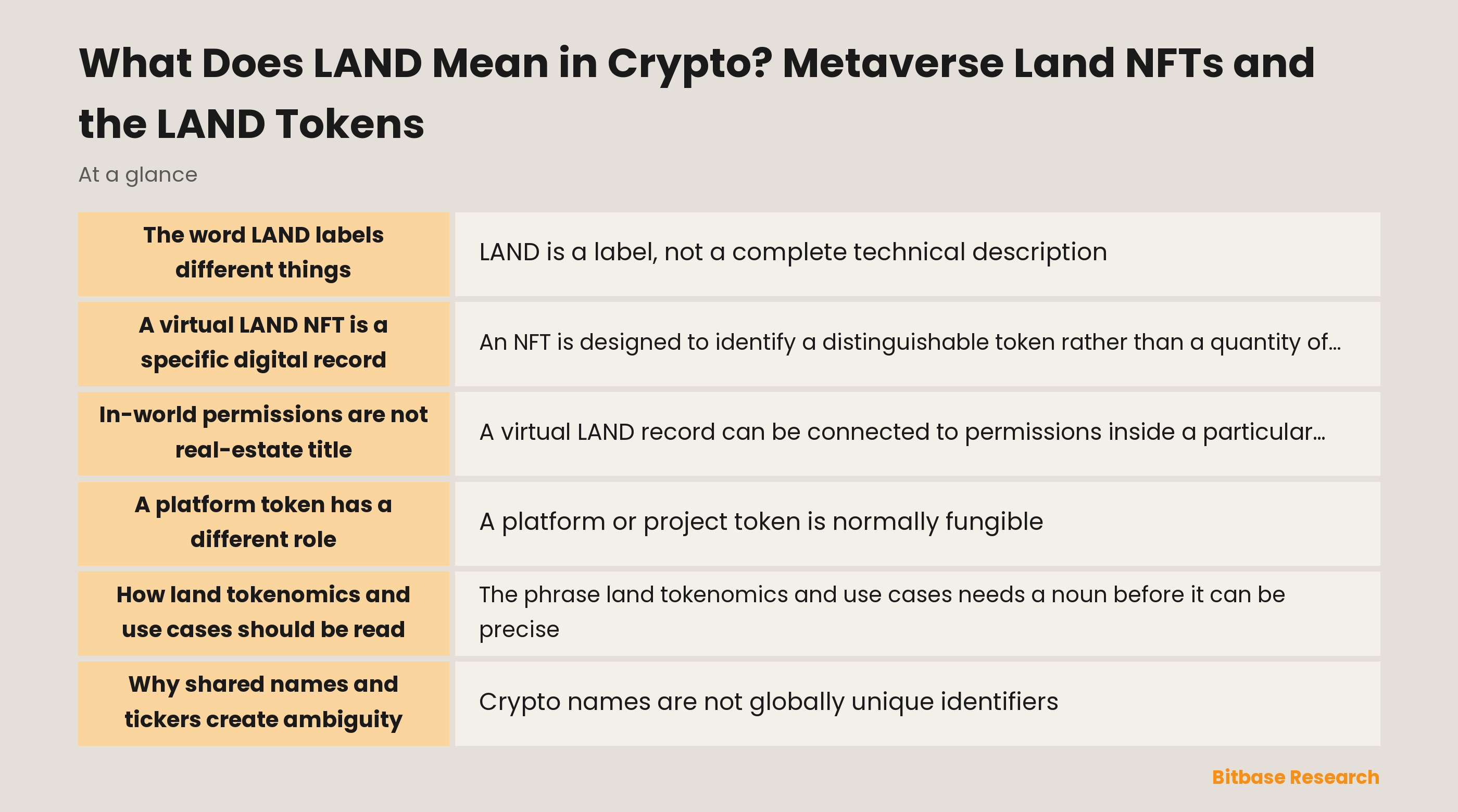
The word LAND labels different things
LAND is a label, not a complete technical description. One project can use it for a collection of virtual parcels, while another can use it for a fungible token or a feature name. Outside those projects, an unrelated issuer can reuse the same word or ticker. Capital letters do not settle the question: they may indicate a brand style, a token symbol, a collection name, or simply emphasis in a sentence.
The useful starting point is the object being named. A parcel NFT has an individual identifier and normally represents one distinct place in one application's map. A platform token has a balance measured in units that are intended to be interchangeable with other units of the same token. An unrelated same-name asset belongs to neither category merely because a screen or discussion calls it LAND.
This is also why a search result or ticker alone is incomplete context. A sound description connects the name to an issuing project, a token standard or contract type, the relevant network, and the role defined by the application. Until those details are present, LAND is best treated as an ambiguous term rather than the name of one universal crypto asset.
A virtual LAND NFT is a specific digital record
An NFT is designed to identify a distinguishable token rather than a quantity of identical units. ERC-721, a widely used Ethereum interface standard, models that distinction through individual token identifiers and ownership records. A virtual-world LAND NFT can use that pattern to associate one token with a particular coordinate, parcel, or grouped area in that world's map.
Official project materials show how this category can work without making it universal. Decentraland's protocol documentation describes LAND as a non-fungible token associated with a coordinate on its map. The Sandbox documentation separately labels LAND as an ERC-721 asset. These examples demonstrate a class of virtual-world records; they do not mean that every project called LAND uses the same map, contract, feature set, or governance design.
The meaning of a parcel also depends on the surrounding application. A coordinate becomes useful because an explorer, map, content system, and rule set interpret it together. The NFT can identify the parcel within that system, but it does not turn a coordinate into a portable section of the internet. If the application's rules or presentation change, the in-world meaning attached to the record can change as well.
In-world permissions are not real-estate title
A virtual LAND record can be connected to permissions inside a particular service or protocol. For example, a platform may recognize a token holder or an authorized collaborator as able to change the content shown at a coordinate. That is a rule about the virtual environment's operation. It is separate from a government land register, a conveyance of physical space, or a title to real-world real estate.
Project documentation can make this separation visible. Decentraland's materials distinguish the LAND or Estate token from permission to edit a scene: an authorized participant can have content-editing capability without being given control of the token itself. That design helps explain why a virtual parcel should be described in terms of platform permissions rather than collapsed into a single broad notion of ownership.
No virtual-world label automatically creates a real-world property interest, a lease, a revenue entitlement, or a guarantee about what an audience will see. It instead signals the current relationship among a specific record, its smart-contract logic, and the platform systems that interpret it. Calling the object land is a convenient metaphor, not proof that all features of physical real estate apply.
A platform token has a different role
A platform or project token is normally fungible: one unit is designed to be interchangeable with another unit of the same contract. Its role may concern a platform's internal accounting, participation mechanisms, governance processes, access rules, or other functions stated by that project. The token's name can resemble LAND, or it can have a different name while operating beside a LAND NFT collection.
The Sandbox provides a clear class example of the distinction. Its official materials describe LAND as an ERC-721 virtual-world asset and SAND as a separate platform token with functions in the ecosystem. The important point is structural, not promotional: an individual LAND NFT and a quantity of SAND are not the same type of record, even when a platform describes both in nearby documentation.
This distinction also prevents a common category error. The fungible token may have tokenomics, while the parcel NFT has collection rules, map placement, metadata, and platform permissions. A project can connect those systems, but connection is not identity. Describing one of them as though it automatically carries the properties of the other obscures the contract-level difference.
How land tokenomics and use cases should be read
The phrase land tokenomics and use cases needs a noun before it can be precise. If it refers to a fungible project token, tokenomics usually means the rules around its issuance, distribution, supply changes, allocation structure, and protocol-defined functions. The relevant use cases then concern what the project says units of that token can do within its systems.
If the phrase refers instead to virtual LAND NFTs, the more relevant questions concern the collection and world design. Those can include how individual parcels are identified, how coordinates relate to a map, whether parcels can be grouped, what metadata is associated with them, and which in-world permissions the platform recognizes. These are not the same analytical categories as fungible-token supply mechanics.
Use cases are also not automatic outcome claims. A platform can attach a defined function to a token or parcel, such as participation in a feature or association with an in-world location, while the actual experience remains dependent on the platform's software, rules, and continuing support. Product documentation can change, so a feature described for one project should not be converted into a permanent or universal expectation.
Why shared names and tickers create ambiguity
Crypto names are not globally unique identifiers. A project name, ticker, collection label, and smart-contract name can overlap with other names, sometimes even across different token types. The ERC-721 standard itself notes that a contract name or symbol does not by itself determine which contract is canonical. The same practical limitation applies even more strongly when comparing independent projects.
That creates three separate possibilities whenever LAND appears in a description. It may mean a particular virtual-world NFT collection; it may mean a fungible asset issued by a project; or it may mean an unrelated token or ticker with a similar label. None of those possibilities can be inferred from capitalization, a logo, or a short snippet of text alone.
The missing context is factual rather than stylistic. A complete statement identifies the project, distinguishes a unique NFT record from a fungible unit, and explains the relevant platform role. It also leaves room for the possibility that no connection exists at all. This approach reduces false equivalence without assuming that one use of LAND is more legitimate or important than another.
A disciplined way to interpret LAND references
The most reliable interpretation starts by separating identity, function, and scope. Identity asks which project and contract class the term refers to. Function asks whether the object is a unique parcel record, a fungible platform unit, or something else. Scope asks which application's map, permissions, and rules give the object meaning.
With those layers separated, a virtual LAND NFT can be described as a record tied to a particular virtual world, and a platform token can be described as a distinct fungible unit governed by its own design. The explanation remains accurate even if both appear in the same ecosystem, because it does not merge a coordinate-based NFT with a balance-based token.
Clear terminology also keeps the real-estate metaphor in proportion. A digital parcel can matter inside a virtual environment without becoming a real-estate title or a general revenue claim. LAND therefore means something only after its project context and technical role are named. That is the key to answering what is land crypto without treating every LAND label as one interchangeable asset.
Disclaimer: This article is educational content from Bitbase Academy, provided for information only. It does not constitute investment, trading, tax, or financial advice. Crypto assets are volatile; assess your own risk. Written as of August 2026; refer to the latest official information.
References
[1] ERC-721: Non-Fungible Token Standard eips.ethereum.org
[2] ADR-102: Decentraland Protocol for Explorers adr.decentraland.org
[3] LAND Manager | Decentraland Docs docs.decentraland.org
[4] LAND | English Documentation docs.sandbox.game
[5] SAND | English Documentation docs.sandbox.game