A crypto community can look large, busy, or suddenly quiet depending on the number someone happens to see. Those impressions are useful starting points, but they compress many different behaviours into one visible signal. A membership total describes accounts attached to a space. A message total describes recorded events. A return rate describes a relationship between periods. None of those observations, alone or together, establishes whether a project is sound, valuable, or trustworthy. A careful reading begins by naming what was counted, where it was counted, and when the observation occurred. It then keeps the unanswered parts visible instead of letting a neat-looking number stand in for community quality.
Member count is a starting point, not a verdict
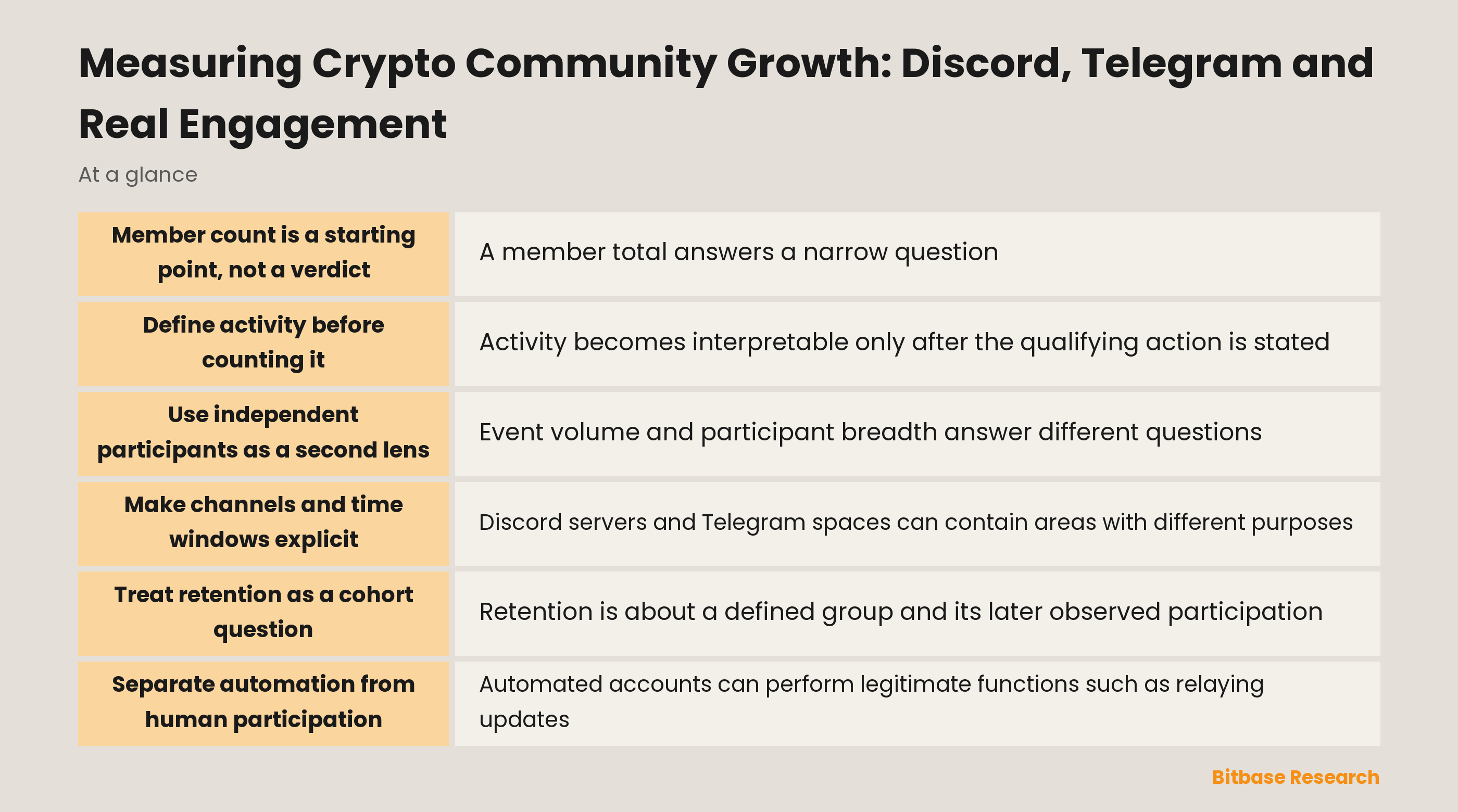
A member total answers a narrow question: how many accounts the relevant surface reports at a stated moment. On Discord, some available member and presence fields are expressly described as approximate. In Telegram, a chat member count is also a platform-defined count rather than a census of people who are reading, contributing, or paying attention at that instant. An account may have joined long ago, muted a channel, left notifications off, or never posted. The total can still be useful for describing the observed size of a membership pool, provided its date, source, and scope remain attached to the number.
A change in that total is not automatically a change in participation. New joins, departures, inactive accounts, pending access states, and differences in what a surface includes can all affect the figure. A larger total can coexist with fewer current contributors, while a stable total can contain a lively exchange among a smaller group of regulars. For that reason, membership is best treated as a baseline denominator or a context field. It should not be promoted into a verdict about real engagement, project quality, or the motives of the accounts behind it.
Define activity before counting it
Activity becomes interpretable only after the qualifying action is stated. A message, reply, reaction, attendance signal, or moderation event may each be recorded differently and may express a different kind of involvement. The phrase crypto discord activity metric is therefore incomplete until it says which observed action counts, whether system-generated events are included, which channels are covered, and which period is being summarized. A count that combines unlike actions can be descriptive, but it should not be mistaken for a single measure of attention or commitment.
The meaning of an action also depends on the setting. A support-oriented channel may produce many short exchanges because people are resolving questions, while an announcement channel may have few participant messages by design. A busy hour can follow news, a scheduled discussion, or a moderation event without representing the typical pace of the surrounding weeks. Defining activity does not create a universal measure of real engagement. It creates a reproducible description of an observed action, which gives readers a clearer basis for comparison and a clearer view of what the count leaves out.
Use independent participants as a second lens
Event volume and participant breadth answer different questions. An independent-participant count can describe the distinct observed accounts that performed a specified qualifying action inside a stated channel scope and time window. Read beside the event total, it can show whether recorded activity came from many observed accounts or was concentrated among fewer observed accounts. That distinction helps prevent a large event total from being read as if it necessarily reflected broad participation. It remains an account-level observation, however, because available records may not reveal whether accounts correspond one-for-one with people.
This lens needs the same care as a membership total. A discussion channel, a voice-related area, and an announcement feed invite different kinds of interaction, so their independent-participant figures are not interchangeable. Repeated contributions from regular participants may be meaningful within a conversation, yet they do not make the number of distinct observed accounts grow. Conversely, a wide set of one-time contributors does not by itself indicate that they will return. The useful question is not which pattern deserves the highest score, but what pattern the defined observation actually captures.
Make channels and time windows explicit
Discord servers and Telegram spaces can contain areas with different purposes, permissions, and visibility. A broad announcement stream, a general discussion area, and a topical conversation can each produce a different activity shape even when they belong to the same overall community. Reporting an aggregate without its channel scope can hide that difference. A metric tied to a stated set of channels makes it possible to understand whether it represents the whole accessible space, a conversational subset, or a single type of interaction.
Time windows deserve the same precision. A daily observation, a weekly observation, and a monthly observation do not merely change the size of a number; they change the question being answered. A short window can reveal a temporary burst, while a longer window can include participants who arrived on different days and never overlapped. Dates, boundaries, and time-zone treatment should stay consistent when figures are compared. Without that context, an apparent increase or decrease may be a difference in timing rather than a meaningful change in participation.
Treat retention as a cohort question
Retention is about a defined group and its later observed participation. A simple cohort can be described as the observed accounts that performed a qualifying action during a starting period, followed by the share of that same defined group that performed the same or another stated qualifying action during a later period. This differs from membership growth because it follows a fixed starting group rather than every account visible at the end. It also differs from total activity because the same active accounts can generate many events without showing whether earlier participants returned.
The cohort definition matters as much as the resulting percentage. A starting period, qualifying action, later period, channel scope, and treatment of unavailable data all shape the interpretation. A return after a long absence may be useful to describe separately from an immediate continuation, because those behaviours answer different questions. Retention cannot explain why people came back, why others did not, or whether the community is healthy. It only records a bounded pattern of repeat observed participation under the chosen definition.
Separate automation from human participation
Automated accounts can perform legitimate functions such as relaying updates, organizing messages, or supporting moderation. Their output may be regular and highly visible, which means an event total can mix automated and human actions. Some available data labels an account as a bot, while other attributes may be unavailable or ambiguous. A clear measurement notes whether known automated activity is included, excluded, separately described, or not distinguishable in the available data. That choice changes the meaning of an activity total and should travel with the figure.
Unknown does not mean deceptive, and a familiar activity pattern does not prove that an account is human or automated. Publicly visible data can be incomplete, account identities can be uncertain, and classifications can change with the information available. It is more accurate to preserve those limits than to turn a metric into an accusation. When automation is relevant, separate descriptions make the observation easier to read without implying that one segment is more authentic, more valuable, or more important than the other.
Read the metrics together and keep their limits visible
A compact community-growth observation can place a membership total beside its date and scope, an activity total beside its action definition, an independent-participant count beside the same window, and a retention result beside its cohort definition. It can also state the covered channels and the treatment of known automation. These fields do not need to become a single score. Their value is that they expose the different questions a reader would otherwise collapse into a single impression. Comparable measurements require comparable definitions, not just similar-looking totals.
For anyone asking how to monitor crypto community growth, the useful outcome is a disciplined description rather than a ranking. The available measures can show patterns in a defined slice of observed activity, but they cannot prove human identity, intent, legitimacy, safety, future outcomes, or project quality. Platform permissions, privacy boundaries, channel design, and missing context also limit what can be seen. Keeping those limits alongside the numbers makes community measurement more honest and makes it harder to mistake visible engagement for a complete picture.
Disclaimer: This article is educational content from Bitbase Academy, provided for information only. It does not constitute investment, trading, tax, or financial advice. Crypto assets are volatile; assess your own risk. Written as of August 2026; refer to the latest official information.
References
[1] Discord Developer Documentation: Guild Resource docs.discord.com
[2] Telegram Bot API core.telegram.org
[3] Safadi, Lalor and Berente: Bots in Online Communities aisel.aisnet.org
[4] Joyce and Kraut: Continued Participation academic.oup.com