Memetic premium is a descriptive label for the part of a digital asset's observed valuation that seems tied to shared attention, familiar symbols, and a story that people can recognize and repeat. It is not a separate line item, a fixed amount, or a measure of underlying worth. The question what is memetic premium in crypto therefore concerns how social meaning can sit alongside technical design, market structure, and other information. The related question why do crypto memes move prices is best understood as a question about mechanisms, not a claim that a meme produces a known outcome.
What memetic premium means
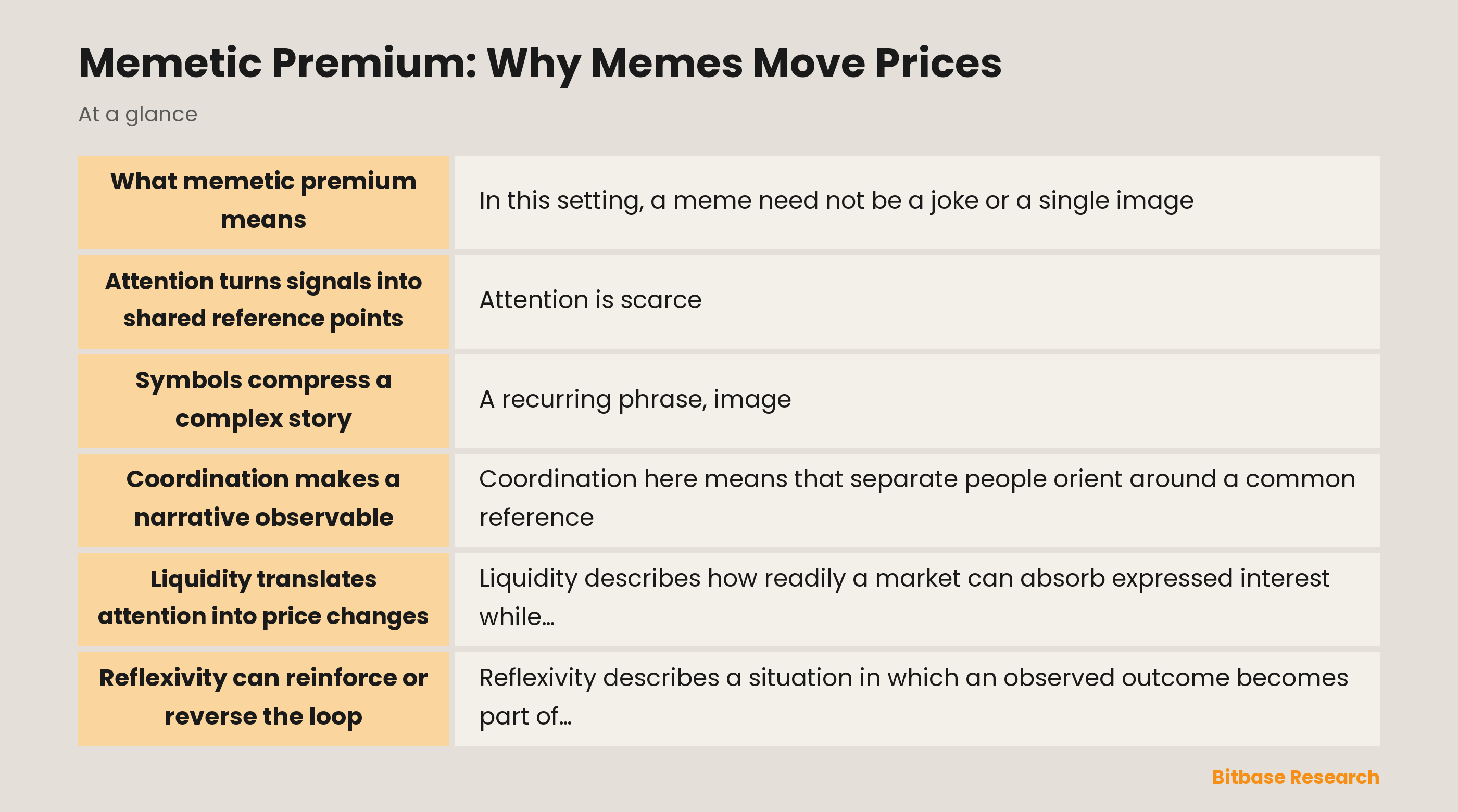
In this setting, a meme need not be a joke or a single image. It can be a phrase, visual motif, short story, gesture, or recurring comparison. Its defining feature is compression: it lets a complicated collection of claims travel in a small cultural package. People may attach different meanings to the same package, so repetition does not make any one interpretation true.
Premium is a comparative word. It points to an observed gap between attention-shaped interpretations and a broader set of possible considerations such as design, usage, rules, available information, and market conditions. Because those considerations are neither complete nor weighted by a universal formula, the premium cannot be cleanly isolated. It is a lens for describing a situation, not an objective surcharge.
This distinction keeps the term from doing more work than it can. A visible narrative may coexist with material changes, unrelated news, or changing market conditions. An observer can notice that a symbol is prominent without knowing why it became prominent or whether the prominence will persist. The label describes a relationship worth examining rather than a verdict about quality or a path for prices.
Attention turns signals into shared reference points
Attention is scarce. An item that repeatedly appears in conversations, search behavior, headlines, or visual culture becomes easier to recall and easier to treat as a common reference point. That availability can affect what people notice first and what they decide needs an explanation. Attention itself is not the same as agreement, demand, utility, or lasting interest.
Repeated exposure also synchronizes some audiences in time. People encountering the same compressed message may become aware that others are encountering it too. This shared awareness can make a narrative feel socially important even when individual interpretations vary. Reach metrics capture only fragments of this process, because they usually cannot show whether a message was understood, trusted, ignored, or merely seen.
Studies of historic digital-asset data have examined relationships among search interest, word-of-mouth activity, user growth, and market variables. Some found feedback patterns in particular samples. Such work supports attention as an observable part of a wider system, but it does not turn a count of posts or searches into a universal causal explanation. The direction, timing, and meaning of an association remain conditional.
Symbols compress a complex story
A recurring phrase, image, or character can package a dense story into something that can be recognized almost instantly. The symbol may stand in for beliefs about novelty, belonging, technology, cultural mood, or a future imagined by a community. That efficiency gives the symbol reach, but it does not preserve every qualification that a longer explanation would contain.
Compression lowers the effort needed to repeat a narrative. It can also remove context, uncertainty, and disagreement from view. Two people can repeat the same symbol while relying on very different assumptions, or while treating it as entertainment rather than information. The speed of copying a sign is therefore different from the depth of understanding behind it.
Symbols can also make an audience visible to itself. Seeing a familiar cue in many places can create a sense of affiliation and a sense that a story is widely shared. Yet recognizability is not evidence that a claim has been tested, that the audience is large, or that the meanings attached to the symbol are stable. A compact sign can gather attention without resolving the facts it abbreviates.
Coordination makes a narrative observable
Coordination here means that separate people orient around a common reference. They may use the same words, notice the same visual cue, or discuss the same event, even if they disagree about its importance. This is coordination of attention and language, not proof of agreement, organized control, governance, or shared intent.
Shared references can create a layer of common knowledge: people know a signal, and may know that other people know it. That layer helps explain why a brief phrase can matter socially beyond its literal content. It does not show who is behind the message, how many independent people are involved, or whether apparent activity is organic, duplicated, automated, or contested.
Visibility is also uneven. A narrative can be intense inside one channel, language, or group and nearly absent elsewhere. What looks like broad coordination from a narrow data source may be a local concentration of attention. Observing the pattern requires separating message volume from audience composition, repeated exposure from endorsement, and public discussion from any conclusion about market-wide belief.
Liquidity translates attention into price changes
Liquidity describes how readily a market can absorb expressed interest while maintaining available quotes. A recorded market price is produced when available quotes are matched under that market's rules. Attention does not by itself create such a price. It becomes relevant only through many intervening conditions, including what information is available, how participants interpret it, and what quotes are present at a given moment.
Where depth is limited or conditions are fragmented, a similar change in attention can be associated with more visible quote changes than it would be in a deeper setting. That observation does not determine direction or durability. It simply shows that market structure affects how strongly any new interpretation, information, or shift in expressed interest may appear in recorded prices.
Price formation also includes inventories, time delays, fees, market rules, competing information, and the distribution of attention across participants. A quote can change before discussion becomes visible, after it becomes visible, or for reasons unrelated to it. There is no fixed sequence in which a meme becomes attention, attention becomes coordination, and coordination becomes a lasting price change.
Reflexivity can reinforce or reverse the loop
Reflexivity describes a situation in which an observed outcome becomes part of the information that people interpret next. A price movement can make a symbol more noticeable, and the increased notice can change the context in which later messages are read. The outcome is not outside the narrative; it can become one of the narrative's inputs.
That loop may sometimes appear self-reinforcing, because visibility, discussion, and market observations can echo one another. It can also pause, fragment, meet a competing story, or reverse as interpretations change. Reflexivity is a description of mutual influence, not a promise that repetition will continue or that a feedback cycle will have one direction.
The recursive character of the loop can make causes look simpler than they are. A later surge of messages may be read as the original source of a change even when it partly reflects a response to earlier price information, news, or shifting conditions. Separating initial triggers, reactions, and later retellings is difficult, especially when timestamps, audiences, and data sources are incomplete.
Where the mechanism breaks down
The mechanism has clear limits. Measures of attention may sample only one language, one platform, or the most vocal accounts. They can miss quiet audiences, duplicate messages, automated activity, and offline discussion. A high count is not a measure of independent conviction, and a low count is not proof that a subject has no relevance. The data often describe visibility more reliably than meaning.
The relationship can also break when a message loses credibility, when attention shifts, when liquidity conditions change, when different audiences attach incompatible meanings, or when new information changes the frame. None of these boundaries needs a dramatic event. Small changes in context can alter how a symbol is read, whether it is repeated, and how much weight observers give it.
Memetic premium is most useful when it keeps several layers distinct: what is visible, what is repeated, what is shared, and what is recorded in market prices. It cannot allocate a precise portion of value to culture or identify a future price path. Treating it as a mechanism map rather than a score preserves the difference between a contagious narrative and the many conditions surrounding a market outcome.
Disclaimer: This article is educational content from Bitbase Academy, provided for information only. It does not constitute investment, trading, tax, or financial advice. Crypto assets are volatile; assess your own risk. Written as of August 2026; refer to the latest official information.
References
[1] Shiller: Narrative Economics aeaweb.org
[2] Garcia et al.: Feedback Cycles in the Bitcoin Economy pubmed.ncbi.nlm.nih.gov
[3] Kristoufek: Bitcoin, Google Trends and Wikipedia nature.com
[4] SEC Investor Alert: Social Media and Investing sec.gov