An asset can have one economic story while appearing in several technical forms. A token originally issued on one network may be represented on another network through a bridge. A separate route may create a different representation, contract address, redemption path, or pool of inventory. That is why the phrase bridge liquidity needs more context than a single asset name. It describes liquidity associated with a particular representation, network, and route rather than a single pool that automatically follows an asset everywhere.
This is a conceptual guide to the terms behind liquidity fragmentation. It is not a recommendation to move assets, choose a bridge, or treat any representation as interchangeable. Contract terms, verification arrangements, and settlement conditions remain specific to each system.
One economic asset can have several on-chain representations
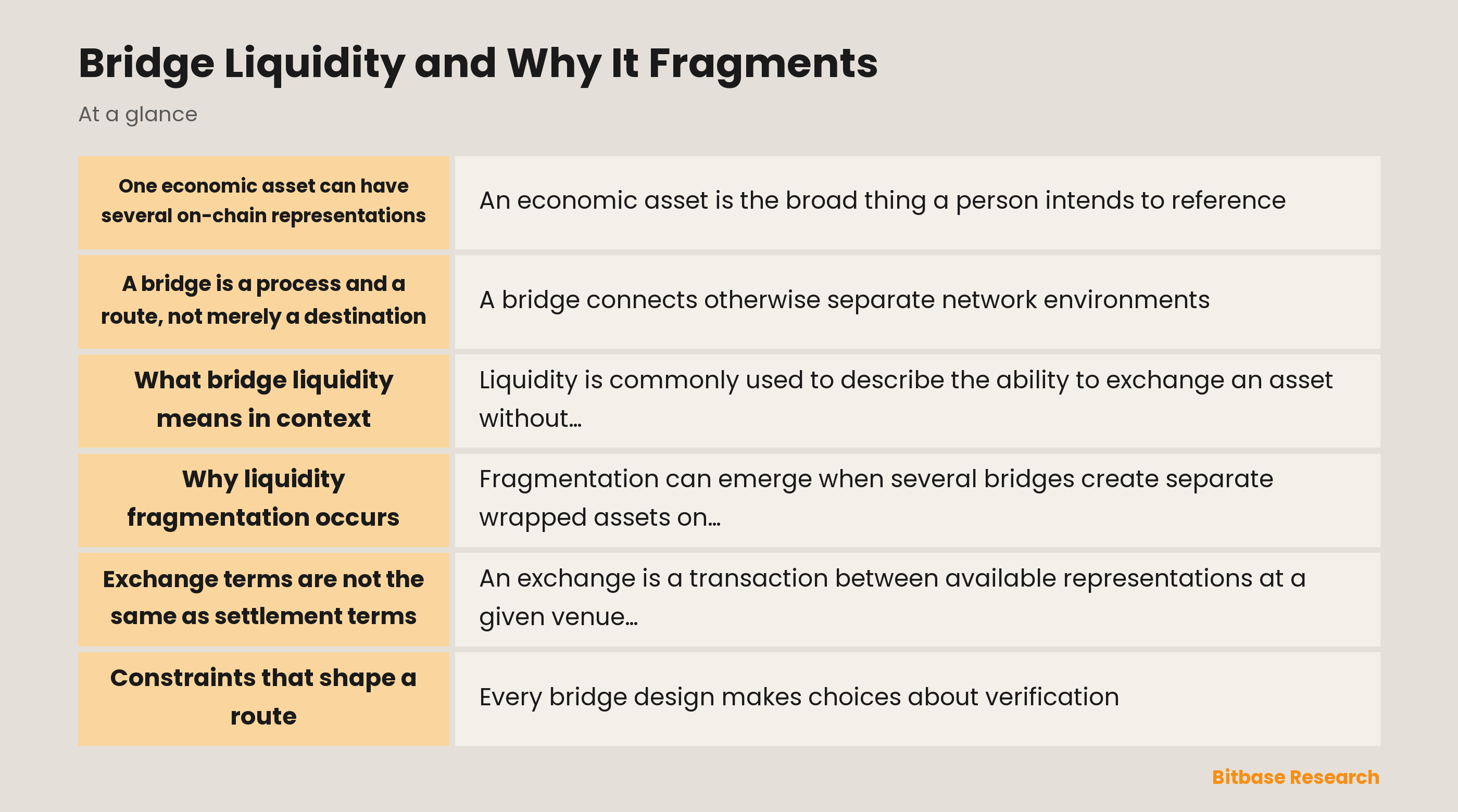
An economic asset is the broad thing a person intends to reference: for example, a unit issued on one ledger or a claim associated with an issuer. A blockchain, however, does not automatically see the state of every other blockchain. When value is represented on a second network, that second network needs an on-chain object and a rule for relating it to something elsewhere.
One common pattern is lock and mint. Units are locked under a mechanism on a source network and a corresponding token is created on the destination network. Another pattern is burn and mint, where a representation is removed on one network before a representation is created on another. A third broad pattern can match parties across networks rather than create a new representation. These labels describe mechanisms, not a promise that all resulting assets have identical claims or settlement behavior.
The phrase canonical asset is contextual. It often refers to the representation regarded by a network, issuer, or protocol as the primary one for a particular relationship. The phrase does not create a universal hierarchy across every network. A token may be native on its issuance network, while a destination network recognizes a particular bridged representation as its standard route from that source. The relevant question is therefore “canonical according to which system and relationship?”
A wrapped asset is a representation whose value relationship depends on an arrangement outside the destination token contract itself. The arrangement may involve locked units, a verification process, a custodian, a mint-and-burn system, or another rule set. Two wrapped assets with the same label can still have different contracts, issuers, collateral arrangements, or redemption assumptions. Their shared economic reference alone does not merge their on-chain liquidity.
A bridge is a process and a route, not merely a destination
A bridge connects otherwise separate network environments. In a simplified asset transfer, it records or verifies an event on a source network and then permits a corresponding action on a destination network. The process can involve smart contracts, validators, proofs, relayers, liquidity providers, or combinations of these components. The exact arrangement determines what is checked and where the representation comes from.
A route is the specific path through this arrangement. It can be described by the source network, destination network, bridge mechanism, asset representation, and the rules that connect them. Two routes may arrive at the same destination network yet produce different token contracts. Conversely, the same contract can be reachable through different operational paths. Treating all routes as one invisible pipe hides the distinctions that matter for accounting and settlement.
Routes can also have intermediate steps. A route might first convert one representation to another, then transfer a message, then create or release an asset. Each step introduces a dependency: an input representation, a verification condition, a destination contract, and a settlement rule. The route is therefore part of the asset’s practical identity on the destination network.
What bridge liquidity means in context
Liquidity is commonly used to describe the ability to exchange an asset without a large effect on the terms of exchange. In a multi-network setting, bridge liquidity has at least two layers. The first concerns whether a route can complete its promised settlement process under its stated rules. The second concerns whether a particular destination representation can be exchanged in a market or pool.
Those layers are related but not identical. A route may have a mechanism for creating or releasing a representation while the destination representation has little activity in a particular exchange venue. A representation may have active exchange activity but depend on a separate route or issuer arrangement for conversion back to another form. Neither observation establishes a general conclusion about reliability, value, or suitability.
Route-based designs can also rely on inventory. Instead of creating a new token for every movement, a system may release inventory already positioned on a destination network and replenish it through later settlement. In that model, available inventory, accounting limits, and settlement timing can affect the route. The important point is not a current quantity; it is that liquidity can belong to the route’s structure as well as to a token market.
Why liquidity fragmentation occurs
Liquidity fragmentation occurs when activity that refers to a similar economic asset is distributed across distinct representations, contracts, networks, pools, or routes. Each location can have its own balances, accounting rules, participants, and conversion conditions. The activity is not automatically combined simply because names or symbols resemble one another.
Fragmentation can emerge when several bridges create separate wrapped assets on the same destination network. It can also arise when one representation exists on multiple networks, each with separate local exchange activity. Even a single bridge design can introduce distinct paths if it supports several settlement mechanisms or asset contracts.
The effect is structural rather than moral. Separate locations may present separate quoted exchange terms because their local supply, demand, and conversion constraints differ. A path between them may require an additional conversion or settlement event. Thus, observing a price difference or differing exchange terms does not by itself show an error; it can reflect that the assets are distinct on-chain objects with different route dependencies.
Exchange terms are not the same as settlement terms
An exchange is a transaction between available representations at a given venue or pool. Settlement is the process by which a bridge or related mechanism recognizes a source event and completes a destination action. These concepts can be connected but should not be collapsed into one.
For example, a destination representation may be exchanged locally without immediately invoking the source network. That exchange changes who holds the destination token, not necessarily the bridge’s source-side accounting. In the other direction, a return path may require a particular representation, a particular message format, or a verification condition before a release or burn can occur. The contractual meaning of the token and the route’s settlement rules therefore matter alongside local exchange terms.
This distinction also helps explain why an asset’s displayed symbol is insufficient information. A symbol does not identify a contract, source relationship, issuer arrangement, or route. A complete description needs to name the network and the particular token contract or mechanism under discussion.
Constraints that shape a route
Every bridge design makes choices about verification, finality, execution, and governance. A destination action can depend on evidence that a source-chain event occurred and that the system considers it final enough for the intended rule. A route can also depend on message delivery, contract execution, or inventory accounting. Delays, failed execution, paused components, and differences between network rules are examples of constraints that can separate an intended transfer from a completed settlement.
The terms finality and verification are especially important. Finality is a property a system uses to decide when a source event should be treated as sufficiently settled for a downstream action. Verification is the process by which destination-side logic or its designated actors check the evidence required by the design. The evidence, actors, and failure handling differ across implementations.
These are not instructions for evaluating a live route. They are categories for reading technical documentation: what event is recognized, who or what verifies it, what representation is created or released, and what conditions apply if an expected action does not complete.
Risk boundaries and a practical vocabulary
Bridge systems combine dependencies that would not exist in a transfer confined to one ledger. A smart contract can contain an implementation error. A verification arrangement can have assumptions about validators, proofs, or operators. A wrapped asset can depend on a custody, collateral, or accounting relationship. A route can fail to complete as expected because its source and destination conditions are not the same. These are conceptual risk categories, not conclusions about any named bridge.
The vocabulary supports clearer descriptions. “Native asset” identifies a network of issuance. “Canonical asset” identifies a relationship defined by a particular system. “Wrapped asset” identifies a representation linked to an external arrangement. “Bridge” identifies the cross-network mechanism. “Route” identifies the specific path and conditions. “Bridge liquidity” identifies liquidity related to that path or representation. “Liquidity fragmentation” identifies the separation of activity among these different locations.
Keeping the terms separate avoids a common shortcut: assuming that one asset name implies one fungible pool of liquidity and one settlement process. In a multi-network environment, the representation and route are part of the facts that give an asset its operational meaning. This article is not a recommendation; it is a framework for describing those distinctions without assuming that they disappear.
Disclaimer: This article is educational content from Bitbase Academy, provided for information only. It does not constitute investment, trading, tax, or financial advice. Crypto assets are volatile; assess your own risk. Written as of August 2026; refer to the latest official information.
References
[1] Ethereum.org: Bridges ethereum.org
[2] ERC-5164: Cross-Chain Execution eips.ethereum.org
[3] ERC-7786: Cross-Chain Messaging Gateway eips.ethereum.org
[4] Optimism documentation: Standard Bridge docs.optimism.io