Cash-and-carry and funding-rate arbitrage are labels for relative-value structures that pair a spot exposure with an offsetting derivative exposure. Their appeal comes from a simple intuition: if two instruments reference the same asset, opposite price sensitivity may reduce the effect of a broad market move. That intuition is useful, but incomplete. The instruments can use different reference prices, settlement rules, collateral, trading hours, and risk engines. A position can therefore look directionally balanced while still being exposed to basis changes, funding reversals, liquidity gaps, margin calls, custody failures, or operational delays. This article treats both structures as mechanisms for understanding those residual risks, not as recipes for obtaining a return.
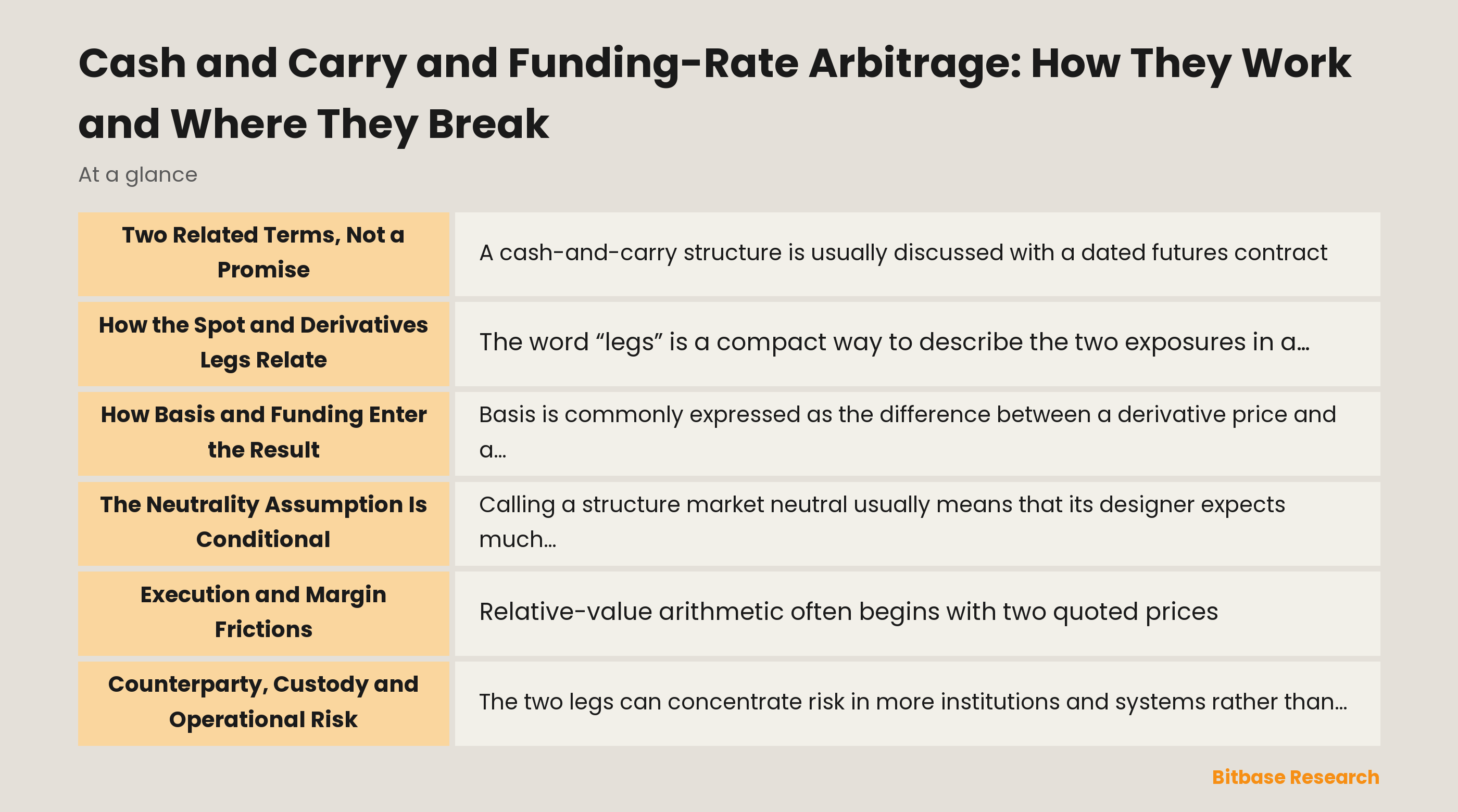
Two Related Terms, Not a Promise
A cash-and-carry structure is usually discussed with a dated futures contract. It combines an exposure to the underlying asset with an opposite-side futures exposure whose contract has a stated expiry or settlement process. In the conventional positive-basis description, the spot asset and the dated future are intended to offset much of one another's outright price movement while the initial difference between their prices remains economically important. The phrase cash and carry trade crypto is often used loosely for this relationship in digital-asset markets, even though the relevant asset, custody arrangement, contract specification, and settlement reference can differ materially from one case to another.
Funding-rate arbitrage describes a related but distinct relationship involving perpetual derivatives. A perpetual contract does not rely on a fixed expiry to pull its price toward a settlement value. Instead, its rules may include periodic payments between long and short position holders when the contract is above or below a designated reference. The expression funding rate arbitrage risks matters because a visible payment is not the whole economic result. The payment can change sign, its calculation can change with the contract rules, and the positions surrounding it can acquire losses or constraints before any theoretical alignment occurs.
How the Spot and Derivatives Legs Relate
The word “legs” is a compact way to describe the two exposures in a relative-value structure. One leg concerns the asset in the spot or cash market; the other concerns a derivative whose value references that asset through a contract. An offsetting relationship is an economic description, not proof that the legs are interchangeable. A spot holding can involve delivery, wallet or custodian control, and a market-specific price. A dated future or perpetual can instead be cash-settled, margined in a particular collateral asset, and valued against a stated index or mark-price methodology.
Those distinctions determine what is actually being offset. Contract multiplier, quote currency, collateral currency, index constituents, calculation time, expiry convention, and settlement method can all make a seemingly matched pair imperfect. A spot market may trade continuously while a clearing or settlement process uses a scheduled reference window. A derivative may be marked against an index rather than the last displayed trade. If the two legs respond to different inputs at a stressed moment, their prices can move apart even when both are described with the same asset name. The residual is called basis risk in a broad sense, and it does not disappear merely because the notional labels look similar.
How Basis and Funding Enter the Result
Basis is commonly expressed as the difference between a derivative price and a spot or cash reference price. For a dated contract, that difference can reflect time to expiry, implied financing, supply and demand for the contract, expected settlement conditions, and market frictions. It can be positive or negative and may change long before expiry. A dated contract's final settlement is governed by its own terms, so convergence is a contract-specific process rather than a universal guarantee that every venue's displayed spot price will meet every futures price at a single moment.
A funding rate is not the same thing as a fixed coupon. Under a perpetual contract's rules, it is generally a transfer between sides of the contract that depends on a current premium or discount and other defined inputs. Its contribution to the result depends on the position's applicable notional, the rate, the timing convention, and any intervening changes in the position or collateral. A rate that is positive at one observation can later be lower, zero, or negative. The cash flow can therefore move in the opposite direction from the one associated with the original premise, while price differences, execution costs, and margin effects continue to accumulate.
The Neutrality Assumption Is Conditional
Calling a structure market neutral usually means that its designer expects much of the asset's directional price sensitivity to offset. It does not mean that the account value cannot change. The expectation depends on exposure ratios staying aligned, both legs remaining open, the reference asset continuing to behave as assumed, and each pricing mechanism continuing to operate. A hedge can be imperfect because the derivative and the spot asset track different prices, because a benchmark is calculated at a different time, or because a product event changes the economic meaning of one leg without changing the other.
The assumption is also temporal. A dated future has an expiry and settlement path; a perpetual has a sequence of funding events and a mark-price process. Carrying costs, availability of collateral, settlement timing, and asset transfer constraints can change during the life of either structure. A basis may narrow, widen, or reverse before a dated contract settles. Funding may reverse while the spot-perpetual spread remains volatile. Describing the pair as neutral can obscure these paths, even though the path is where a margin requirement, an interrupted transfer, or a forced reduction may turn an intended offset into a realized loss.
Execution and Margin Frictions
Relative-value arithmetic often begins with two quoted prices, but executable prices can be less favorable than displayed prices. Bid-ask spreads, limited depth, partial fills, price movement between legs, contract-size increments, and order-processing delays can create a mismatch at the moment the relationship is established or changed. Fees, financing charges, withdrawal constraints, and conversion costs are also separate from the quoted basis or funding payment. None needs to be large in isolation to matter; their combined effect can exceed a small spread or can make a theoretical result impossible to realize at the relevant time.
Margin adds a different source of path dependence. Futures and perpetuals commonly use collateral and a mark-price process to calculate unrealized profit and loss, maintenance requirements, and liquidation conditions. A profitable economic thesis at a later date does not prevent adverse interim marks, collateral shortfalls, or a closeout under the contract's rules. Gains on one leg may be inaccessible, delayed, held in a different form of collateral, or simply not available where the other leg needs margin. The structure may thus face a liquidity problem even when its long-run price relationship appears favorable in a static calculation.
Counterparty, Custody and Operational Risk
The two legs can concentrate risk in more institutions and systems rather than fewer. A trading venue, clearing arrangement, broker, custodian, wallet provider, bank rail, stablecoin issuer, and index administrator may each sit somewhere in the chain, depending on the product. Their terms and controls determine who holds assets, how collateral is valued, when transfers can be paused, and what happens during a dispute or disruption. Counterparty exposure is not erased by putting two prices on opposite sides of a spreadsheet; it remains tied to the ability of the relevant parties and infrastructure to perform as specified.
Custody and operations introduce risks that a price chart cannot show. Private-key compromise, credential loss, phishing, address mistakes, network congestion, blockchain reorganization, software defects, scheduled maintenance, and service outages can prevent an intended action or delay information. Interfaces can report a balance, order status, or mark at a moment that does not match another system's state. Legal, tax, identity, access, and geographic restrictions can also affect availability, but their application depends on the person, entity, product, and jurisdiction. These factors are reasons to distinguish a conceptual price relationship from a guaranteed ability to maintain or close a position.
Why Neither Structure Is Risk-Free Income
The word arbitrage can suggest that a spread is automatically free of risk. In practice, an observed basis or funding payment may compensate for bearing liquidity, financing, balance-sheet, counterparty, operational, model, and tail risks that are difficult to see in a single quote. It can also reflect a short-lived imbalance that disappears before it can be expressed, or persist because market participants value different settlement, custody, or collateral characteristics. No pricing relationship converts variable market and operational conditions into a guaranteed outcome, and no “neutral” label removes the possibility of loss.
The most useful way to read cash-and-carry and funding-rate relationships is therefore to separate their components: the spot-and-derivative price difference, any contractual payment, all execution and carrying costs, the margin path, and the ability of the surrounding infrastructure to function. That separation explains why results can diverge from a simplified spread calculation without implying that a particular venue, contract, or method is preferable. It also keeps the focus on the central educational point: these structures can reduce one kind of exposure while leaving many others intact.
Disclaimer: This article is educational content from Bitbase Academy, provided for information only. It does not constitute investment, trading, tax, or financial advice. Crypto assets are volatile; assess your own risk. Written as of August 2026; refer to the latest official information.
References
[1] CME Group: How to trade Micro Bitcoin futures cmegroup.com
[2] Coinbase Help: Funding rates (International Derivatives) help.coinbase.com
[3] CFTC: Understand the Risks of Virtual Currency Trading cftc.gov
[4] Deribit Support: Futures Mark Prices support.deribit.com