
CPI and payroll reports are scheduled moments when a large amount of economic information becomes public at once. For crypto markets, the useful question is not whether a release has a predetermined bullish or bearish meaning. It is how new information differs from what participants had already expected, how that information is interpreted alongside revisions and other signals, and how those conditions can be measured without confusing volatility with direction.
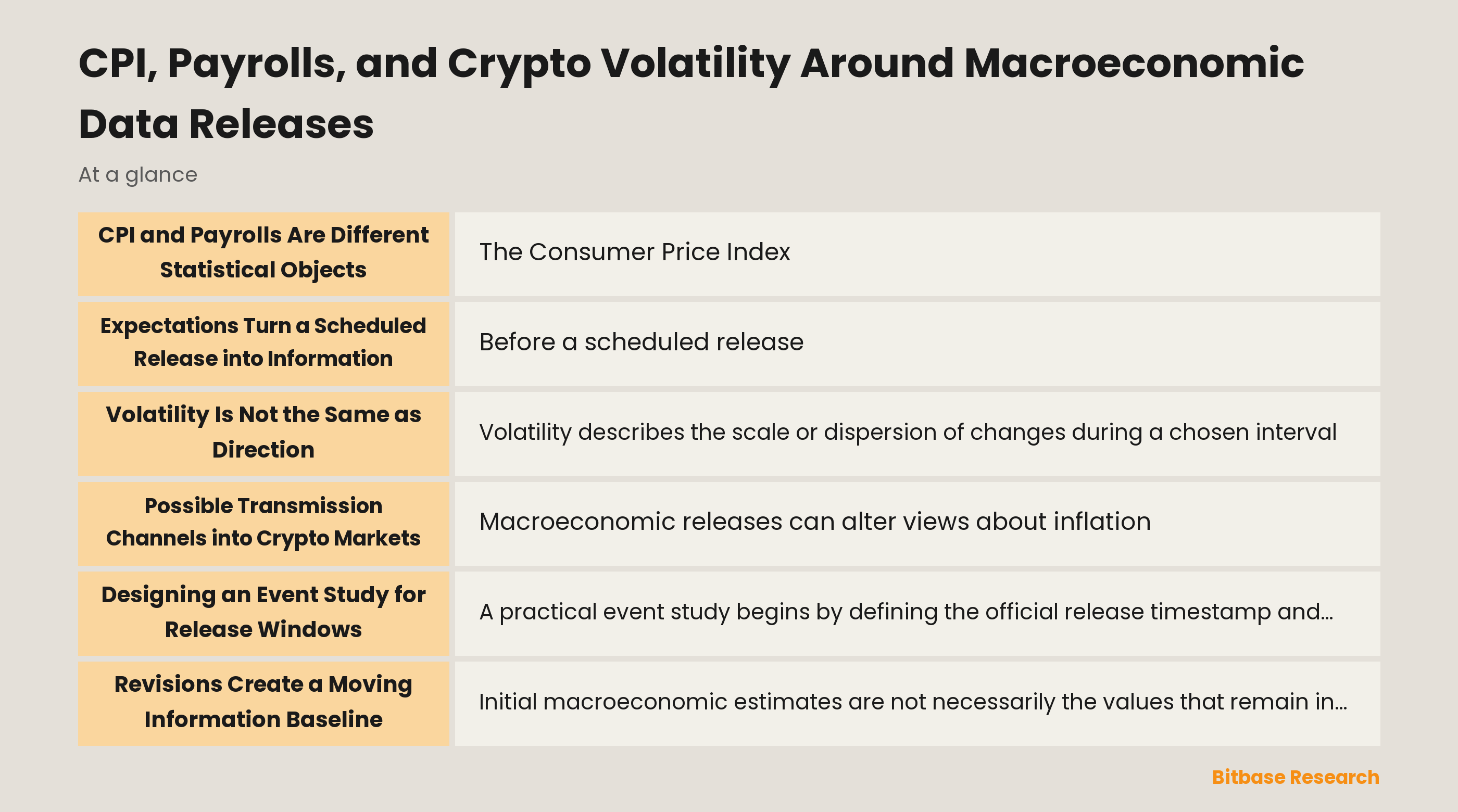
1. CPI and Payrolls Are Different Statistical Objects
The Consumer Price Index, or CPI, is a statistical measure built from observed prices for a defined basket of goods and services. It can be discussed through overall and component measures, and through adjusted or unadjusted series. Those distinctions matter because a release can contain several figures that describe different parts of price change. Treating every CPI release as a single, self-explanatory inflation signal removes information that may matter to interpretation.
Nonfarm payrolls are a different kind of statistic. They are an estimate of employment change derived from an establishment survey and released within a broader employment report. That broader package can also contain information about hours, earnings, unemployment, labor-force measures, and prior-period revisions. A headline payroll number is therefore not a complete description of labor-market conditions, nor is it identical to a household-based measure of employment.
Both releases are estimates published on a schedule, but their construction, revision process, and surrounding components differ. CPI is principally about measured price changes in a basket; payrolls are principally about measured employment in surveyed establishments. A careful discussion begins by preserving that difference. It also recognizes that an observed market response may reflect several details in the same release package rather than the label “CPI” or “payrolls” alone.
2. Expectations Turn a Scheduled Release into Information
Before a scheduled release, market participants may have forecasts, ranges of views, and narratives about what the data could show. In an event-study framework, the most relevant new information is often the difference between the published figure and a pre-release expectation. This difference is commonly called a surprise. It is not a claim that the expectation was correct, and it does not make the released estimate final or error-free.
The meaning of a surprise depends on context. A deviation in an overall CPI measure, a component measure, employment growth, wages, or an earlier revision can each be interpreted through different economic questions. The same numerical surprise can also be viewed differently when participants focus on inflation persistence, labor demand, policy expectations, or the reliability of the underlying measurement. Labels such as “strong” or “weak” conceal those competing interpretations.
Expectations also explain why a widely anticipated release can produce limited immediate movement while a less anticipated detail can coincide with more activity. The release time is known in advance, but the exact content and its relation to prior beliefs are not. That distinction makes scheduled data useful for research: it creates a timestamped information event. It does not make the event a deterministic trigger for any asset’s next move.
3. Volatility Is Not the Same as Direction
Volatility describes the scale or dispersion of changes during a chosen interval. Direction describes whether the value at the end of that interval is above or below its starting point. These are separate concepts. A market can experience rapid movement in both directions and finish near where it began, producing substantial intrawindow volatility without a clear net direction. It can also move modestly but persistently in one direction with limited short-window volatility.
This distinction matters when people ask about the cpi impact on crypto prices. The phrase can describe at least two different research questions: whether price levels move in a consistent direction after a release, and whether the amount of movement becomes unusually large around the release time. An answer to one question does not answer the other. A chart that shows a large candle, for example, cannot by itself identify the underlying surprise or establish a stable directional relation.
Short-window behavior can also reflect changing quoted spreads, order-book depth, or the speed at which different participants process information. Those conditions may amplify, reverse, or offset initial moves. Measuring both absolute movement and signed movement helps prevent an analyst from describing every active release window as evidence of one directional story. It also keeps a neutral article from turning a measurement concept into a prediction.
4. Possible Transmission Channels into Crypto Markets
Macroeconomic releases can alter views about inflation, economic activity, financing conditions, or the path of policy variables. Those revised views may be reflected across currencies, rates, equities, and other risk-sensitive instruments. Crypto assets can be exposed to the same information environment through participants who operate across markets, through derivatives and collateral relationships, or through broad changes in willingness to bear uncertainty. These are possible channels, not causal guarantees.
Crypto market structure adds further complexity. Trading occurs across multiple venues and time zones, with varying liquidity, contract designs, and reference prices. A release may coincide with changes in order flow on one venue before another venue incorporates similar information. Stablecoin conversion, futures basis, options positioning, exchange-specific rules, and automated execution systems can all affect how an information shock appears in recorded prices or volume.
Because these mechanisms can operate together, an observed response should not be assigned to one macro variable without checking alternatives. A CPI or payroll release may arrive alongside revisions, speeches, risk events, protocol-specific news, or changes in market conditions. The appropriate conclusion from a single window is usually descriptive: activity changed around a timestamp. Identifying why requires a design that separates a release surprise from overlapping information and market microstructure effects.
5. Designing an Event Study for Release Windows
A practical event study begins by defining the official release timestamp and fixing the information available immediately before that moment. The researcher then selects a short pre-release window, one or more post-release windows, and a comparison period not associated with the event. The choice of window should be stated in advance because a one-minute measure, an hourly measure, and a daily measure can describe different features of the same episode.
The surprise variable should be tied to a documented expectation source that was observable before the release. The data set should identify whether the study uses transaction prices, quotes, a venue-specific index, or a composite benchmark. Cleaning rules matter as well: duplicate records, irregular timestamps, inactive periods, and abrupt venue changes can distort a volatility measure. Contemporaneous crypto-specific news should be logged rather than silently ignored.
After construction, the study can compare the distribution of volatility in release windows with matched non-release windows and examine whether results differ by surprise size, asset, venue, or market state. Reporting confidence intervals, sensitivity checks, and excluded observations is more informative than presenting a single dramatic chart. The goal is to make the measurement reproducible and to show where its conclusions are narrow rather than universal.
6. Revisions Create a Moving Information Baseline
Initial macroeconomic estimates are not necessarily the values that remain in later databases. Payroll estimates can be revised as more complete reporting becomes available, and benchmark or seasonal-adjustment processes can change historical series. CPI also has adjusted and unadjusted forms, and seasonal factors can be recalculated. These features are normal parts of statistical production, but they create a distinction between the information first released and the information known later.
For a release-window study, the surprise must be calculated against the version that was available at the time. Substituting a later revision into the original timestamp creates look-ahead bias: the study would attribute knowledge to participants before it existed. The same principle applies to consensus data. A reliable archive records the expectation, the initial release, accompanying revisions, the time zone, and the exact market data used for each event.
Revisions can still be analytically useful. They may show why an ex post narrative differs from the first interpretation, or why a later historical chart does not match the initial report. But they should be analyzed as later information, not retroactively merged into the initial surprise. Keeping those layers separate makes it possible to discuss uncertainty without treating data revision as proof that an earlier market reaction was irrational.
7. Interpreting Evidence Without Overclaiming
Questions framed as inflation data impact on bitcoin or nonfarm payrolls bitcoin volatility are reasonable starting points for research, but neither phrase contains its own conclusion. A careful study can estimate whether particular release windows were associated with unusual movement under stated definitions. It can compare surprise categories and test robustness across samples. It cannot assume that a relationship observed in one period will persist, nor that a shared timestamp proves that the macro release caused every movement.
Event studies are especially sensitive to overlap. Different macro details may be released together, prior figures may be revised in the same document, and unrelated news can enter the market during the selected window. Venue fragmentation and data quality create additional limits. Even a statistically precise result may be conditional on the chosen price series, the expectation measure, the definition of volatility, and the way the study handles simultaneous information.
The strongest educational takeaway is methodological rather than directional. CPI and payroll releases offer clear moments to examine how information, expectations, and market structure interact. Volatility can be measured, surprises can be defined, and revisions can be archived. Yet each of those steps narrows the claim that evidence can support. Separating release mechanics from interpretation makes the analysis clearer and preserves the difference between describing an event and asserting a reliable outcome.
Disclaimer: This article is educational content from Bitbase Academy, provided for information only. It does not constitute investment, trading, tax, or financial advice. Crypto assets are volatile; assess your own risk. Written as of August 2026; refer to the latest official information.
References
[1] U.S. Bureau of Labor Statistics: CPI Handbook of Methods bls.gov
[2] U.S. Bureau of Labor Statistics: CPI seasonal adjustment bls.gov
[3] U.S. Bureau of Labor Statistics: The Employment Situation bls.gov
[4] U.S. Bureau of Labor Statistics: Payroll estimate revisions bls.gov
[5] Federal Reserve Bank of New York: The Bitcoin–Macro Disconnect newyorkfed.org