Blockchains maintain their own state and rules. A contract on one network does not automatically read, verify, or execute a contract call on another. Cross-chain messaging is the general problem of carrying information from a source environment to a destination environment in a form the destination can verify and process. Interoperability is the broader ability of independently designed systems to exchange information or coordinate actions through defined interfaces and assumptions.
The word “message” is deliberately broad. It can encode an instruction, an identifier, a payload, a proof reference, or a request to update state. It is not automatically an asset transfer, and a message arriving somewhere does not by itself establish that a destination contract should accept or execute it. This article is not a recommendation; it is a vocabulary for understanding the components and boundaries of these systems.
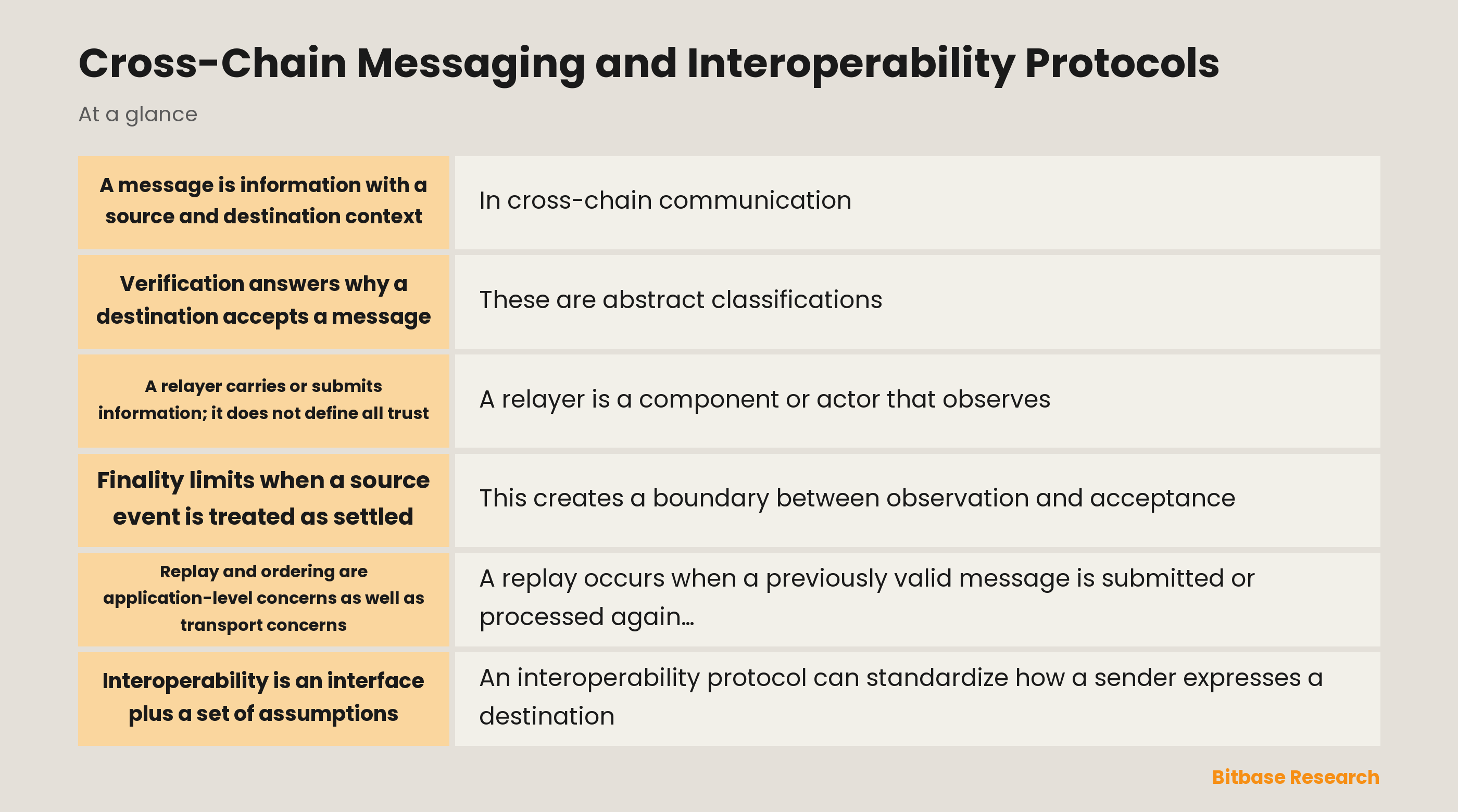
A message is information with a source and destination context
In cross-chain communication, a message normally includes more than an arbitrary string of bytes. A useful conceptual description includes a source chain, a source sender, a destination chain, a destination recipient, a payload, and identifiers or attributes needed by the protocol. The destination needs a way to connect the received data to the source context that the design intends to trust.
Message content can describe an action without moving a token. A governance instruction, an application state update, or a record of an event can all be represented as messages. The destination application still needs its own rules for interpreting the payload. Transporting data and authorizing an application action are separate questions.
This separation matters because a generic transport layer cannot infer an application’s business logic. A message may be authentic according to the transport’s verification rule and still be rejected by the destination application because it is stale, malformed, addressed incorrectly, or inconsistent with the application’s local state. Cross-chain messaging is therefore an interaction between a transport design and an application design.
Messaging and asset bridges overlap but are not identical. An asset bridge commonly coordinates a source-side event with a destination-side asset action. Depending on its mechanism, it may lock, burn, release, mint, or otherwise account for token representations. To do so, it often carries information across networks. In that sense, an asset bridge can contain a messaging component.
But cross-chain messaging is broader than an asset bridge. A message protocol may carry arbitrary data without creating or releasing an asset. Conversely, a bridge’s economic meaning depends on asset-specific rules: what is locked or burned, what is minted or released, what claims the representation has, and how the return path is defined. Those rules are not supplied merely by a generic message format. The distinction avoids two opposite mistakes. It avoids treating every message as value transfer, and it avoids assuming that every bridge is only a token movement tool. An interoperability protocol may provide a common interface for messages while separate applications define asset accounting, governance, or other application-specific effects.
Verification answers why a destination accepts a message
Verification is the process by which the destination side decides whether evidence about a source-side event satisfies its acceptance rule. The evidence can be checked through several broad design families. A system can verify a cryptographic proof related to source-chain state. It can rely on attestations from a defined set of actors. It can rely on a trusted or permissioned operator arrangement. It can combine mechanisms or use one mechanism as a fallback.
These are abstract classifications, not ratings. A proof-based design still depends on the correctness of the verifier, the assumptions attached to the source state, and the implementation of the destination logic. An attestation-based design depends on the stated rules for its attestations and the behavior assumed of its attesters. An operator-based arrangement depends on the authority and controls defined by that arrangement. Each model makes assumptions explicit in a different place.
Verification must also bind the message to the intended context. Source chain identifiers, sender identities, destination recipients, contract addresses, message identifiers, and payload encoding can all serve that purpose. Without sufficient context, data accepted in one setting could be misinterpreted in another. The relevant details belong to the protocol and application specifications, not to a token symbol or a general label.
A relayer carries or submits information; it does not define all trust
A relayer is a component or actor that observes, transports, submits, or forwards information needed for a message to be processed on another network. The relayer may publish a proof, submit an attestation, deliver a payload, or pay for a destination-side transaction according to a system’s rules. Its operational role is often about liveness: whether a message can progress toward delivery.
The relayer’s role should be distinguished from the source of verification. In some designs, anyone can relay an independently verifiable proof; the destination’s rule is what determines acceptance. In other designs, relayers are also part of the authority that attests to source events. In still other designs, a relayer is an application-specific delivery service. The same word can therefore describe different responsibilities.
This distinction is useful when reading a security model. A security model states which assumptions must hold for the protocol’s intended safety and liveness properties. It may include assumptions about source and destination chains, proof verification, signer thresholds, relayer availability, administrator authority, upgrade mechanisms, and fee handling. No single component label substitutes for the full model.
Finality limits when a source event is treated as settled
Finality is the rule or condition by which a system treats a source event as sufficiently settled for a downstream action. Blockchains can have different finality models and timing. A cross-chain design must specify, explicitly or implicitly, what source evidence it accepts and when it considers that evidence adequate for destination processing.
This creates a boundary between observation and acceptance. Seeing an event on a source chain is not necessarily the same as treating it as final for a destination action. A design may wait for a particular commitment, proof, or attestation condition. The route from source event to destination execution can therefore have stages, each with its own conditions.
Finality also does not imply that the destination application action will succeed. A destination call can fail because of local application state, execution limits, an invalid payload, or rules that changed between source observation and destination submission. A complete description separates source finality, message verification, delivery attempt, and application execution.
Replay and ordering are application-level concerns as well as transport concerns
A replay occurs when a previously valid message is submitted or processed again in a context where repeated execution is not intended. Protocol designs commonly bind messages to identifiers and context, and applications can track whether a message identifier or nonce has already been consumed. The general security principle is freshness: data that was valid once should not automatically remain valid for every future execution.
Cross-chain systems also need to consider order. Messages observed on a source network can reach a destination at different times because of network conditions, finality rules, relayer behavior, and destination execution. A destination may receive a later message before an earlier one, or it may observe an incomplete sequence. Whether order is necessary, how duplicates are handled, and what happens after a failed call are application-specific decisions.
Neither a message identifier nor a relayer label guarantees correct sequencing. An application that requires ordered state changes needs rules that make the required order explicit. An application that can tolerate independent actions may choose a different design. The key is that order, retry, expiration, and idempotence are part of the message contract, not incidental details.
Interoperability is an interface plus a set of assumptions
An interoperability protocol can standardize how a sender expresses a destination, payload, and attributes. This reduces the need for every application to invent a new message shape. It does not erase the underlying differences among chains or make all transports equivalent. Different networks can use different address formats, execution rules, finality conditions, and security assumptions.
For that reason, interoperability has two layers. The interface layer describes how components communicate. The assurance layer describes why a destination accepts a message and under what failure conditions it behaves as intended. A compatible interface can improve portability while leaving verification and operational assumptions visible.
The term security model belongs mainly to the assurance layer. It asks what must be true for an unauthorized message not to be accepted, for an authorized message not to be processed more than intended, and for a valid message to have a path toward delivery. It also includes dependencies such as upgrades, key management, and application authorization. These questions are conceptual and cannot be answered by a protocol name alone.
Boundaries, failure categories, and careful descriptions
Cross-chain communication introduces boundaries that do not exist inside a single chain: source observation, finality assessment, message verification, relaying, destination execution, and application interpretation. A failure or delay at any boundary can affect the overall result. A message can be valid but undelivered; delivered but unexecuted; or executed in a context that differs from an intended sequence. These are categories for analyzing designs, not claims about a particular service.
Careful language keeps the categories separate. “Message” describes information and context. “Verification” describes the acceptance rule. “Relayer” describes a delivery or submission role. “Finality” describes a settlement threshold. “Interoperability” describes the ability to connect systems through interfaces. “Security model” describes the assumptions and failure boundaries that make a protocol’s intended properties meaningful.
That vocabulary makes it possible to discuss cross-chain messaging without assuming that assets move, that messages are ordered, or that a label proves a security property. It is not a recommendation to select or interact with any protocol. It is an educational framework for reading specifications and distinguishing an interface from the assumptions behind it.
Disclaimer: This article is educational content from Bitbase Academy, provided for information only. It does not constitute investment, trading, tax, or financial advice. Crypto assets are volatile; assess your own risk. Written as of August 2026; refer to the latest official information.
References
[1] ERC-7786: Cross-Chain Messaging Gateway eips.ethereum.org
[2] ERC-5164: Cross-Chain Execution eips.ethereum.org
[3] ERC-7964: Crosschain EIP-712 Signatures eips.ethereum.org
[4] NIST SP 800-63B-4: Authenticators pages.nist.gov