A crypto ETF can give an investor exposure to a crypto-related asset through a share that trades as a security. That convenience should not be mistaken for direct control of the asset or for a single, all-inclusive cost. The share sits inside a legal and operational structure with a sponsor or manager, a trustee or similar governing party, service providers, market infrastructure, and disclosures. This article explains how expense ratios and custody models fit into that structure. It uses “crypto ETF” as a broad descriptive label; the exact legal form, portfolio, and terms always come from the relevant disclosure documents.
What an ETF Share Represents
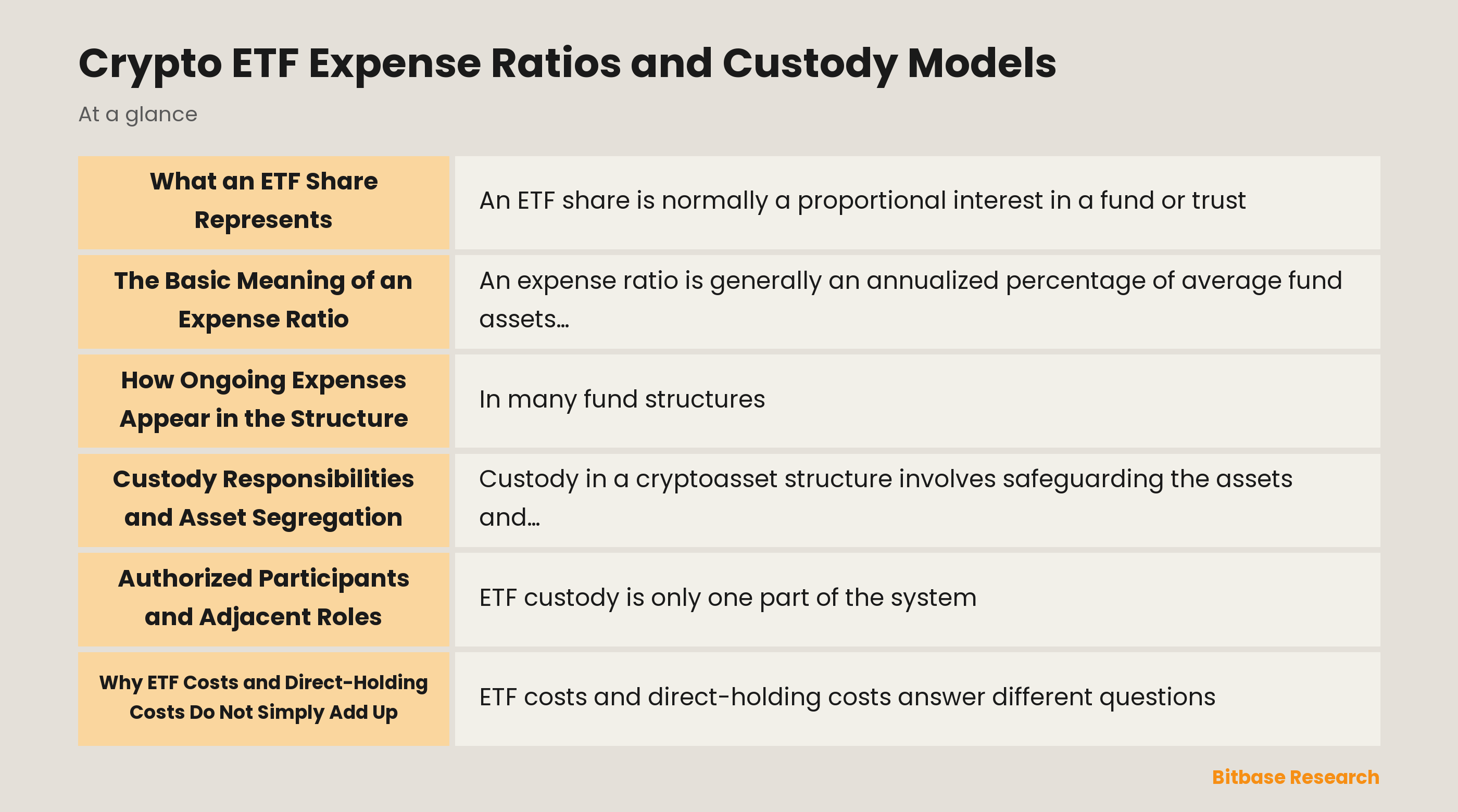
An ETF share is normally a proportional interest in a fund or trust, rather than a personal entitlement to a particular coin or a personal blockchain address. A holder commonly owns the security through a brokerage account, while the vehicle owns or gains exposure to the underlying assets under its governing documents. The holder cannot assume the abilities that come with operating a personal wallet, such as independently signing a blockchain transaction. The economic exposure, legal rights, and operational controls are defined by the share and the vehicle, not by a wallet interface.
In a crypto-focused structure, the underlying exposure can be physical cryptoassets, derivative contracts, cash, or a combination, depending on the disclosed mandate. This discussion focuses on structures that hold cryptoassets through custodial arrangements, but it does not assume every vehicle uses the same design. The relationship between a share’s market price and the vehicle’s net asset value, or NAV, is also an ETF concept, not a promise that every trade occurs at a precisely matching value. Structure and disclosure matter before a cost label can be interpreted.
The Basic Meaning of an Expense Ratio
An expense ratio is generally an annualized percentage of average fund assets used for operating expenses. If you want a bitcoin etf expense ratio explained without shorthand, treat it first as a fund-level measure: it tells readers how recurring expenses relate to the asset base, not what a particular individual will pay at a particular instant. Disclosure terminology can vary by legal form, but the central question is the same—what ongoing expenses are paid from the vehicle’s assets, and how are they described?
An annual percentage is not usually a separate invoice that arrives on one date. Expenses can accrue over time and affect the vehicle’s assets or NAV. Depending on the documents, relevant categories may include management, administration, accounting, legal, audit, custody, or other operational costs. A stated ratio is therefore useful only alongside its definitions, exceptions, and the period it covers. It is not a complete forecast of every cost connected with holding, buying, or selling a share.
How Ongoing Expenses Appear in the Structure
In many fund structures, ongoing expenses are borne at the vehicle level. The administrator and other service providers record obligations; the governing documents describe which party bears which costs; and the resulting expense treatment is reflected in the vehicle’s financial position. The exact mechanics can differ. A sponsor may assume certain ordinary costs, some expenses may fall outside an advertised fee, and unusual items may receive separate treatment. These are document questions, not universal ETF rules.
That distinction is why a label alone cannot explain economic effect. An expense ratio may be presented as gross, net of a waiver or reimbursement, estimated, or subject to specified limits. A reader needs the applicable date, definitions, duration of any arrangement, and disclosure of expenses not captured by the headline figure. Reading a historical number as a permanent contractual term can create a false impression. The educational point is to identify the accounting path, not to project a return.
Custody Responsibilities and Asset Segregation
Custody in a cryptoasset structure involves safeguarding the assets and controlling the processes that permit authorized movement of them. A bitcoin etf custody model commonly assigns this work to a custodian under an agreement with the trust or fund, rather than to each shareholder. The arrangement may address wallet architecture, key-management controls, transfer authorization, recordkeeping, reconciliations, incident procedures, and the circumstances in which a service provider can act. It does not give a shareholder a personal key or a right to direct the custodian outside the vehicle’s rules.
Asset segregation is a related, but narrower, concept. Disclosures may describe separate custody accounts, dedicated wallet addresses, or records identifying assets as belonging to a particular vehicle. The legal and operational effect depends on the contract and applicable framework; segregation is not a universal synonym for insurance, immunity from loss, or immediate recoverability in every scenario. Technology failures, unauthorized activity, reconciliation errors, counterparty distress, and legal disputes can still be relevant risks. The wording of the custody agreement and prospectus is more informative than a generic label.
Authorized Participants and Adjacent Roles
ETF custody is only one part of the system. Authorized participants, commonly large financial institutions that have a contractual relationship with an ETF, may create or redeem large blocks of shares called creation units. Retail holders ordinarily trade shares on the secondary market instead of dealing directly with the vehicle for creations or redemptions. Brokers, market makers, exchanges, transfer agents, administrators, trustees, cash custodians, and execution counterparties can have adjacent but different roles. Titles alone do not show who controls assets, calculates NAV, or bears a particular obligation.
Creation and redemption activity can connect the supply of shares with the vehicle’s underlying exposure and can support the relationship between market price and NAV. It does not guarantee that the share price will always equal NAV, that liquidity will always be available, or that operations will work without disruption. Whether a process uses cash, cryptoassets, or another settlement method is specific to the documents and can affect which parties perform which steps. Separating these roles helps readers avoid treating the custodian, sponsor, and authorized participant as interchangeable.
Why ETF Costs and Direct-Holding Costs Do Not Simply Add Up
ETF costs and direct-holding costs answer different questions, so they should not simply be added together. An ETF expense ratio measures recurring expenses inside a pooled vehicle. Direct holding may involve costs or responsibilities associated with acquiring, transferring, safeguarding, recovering access to, or accounting for assets, but their timing, payer, and control model differ. A person generally chooses the direct-holding arrangement; an ETF shareholder owns a security governed by the vehicle’s arrangements. The two routes do not create duplicate claims on the same wallet.
Direct holding can place key management and operational responsibility with an individual or a chosen service provider. An ETF can centralize certain custody and administration functions within the trust or fund, while the shareholder still faces the ordinary mechanics of owning and trading a security. Neither description establishes a universally lower-cost or lower-risk path. A careful comparison would require consistent assumptions about holding period, transaction behavior, service terms, tax treatment, security practices, and risks—assumptions this article does not make.
Reading Disclosures and the Limits of the Model
Disclosure documents are the place to connect labels to their limits. A careful reader can look for the vehicle’s objective and legal form; what a share represents; the fee table or expense description; which expenses are paid from assets; the custodian’s scope; account or wallet descriptions; the creation and redemption process; service-provider relationships; and risk factors. The most useful question is not whether a word such as “custody” sounds reassuring, but what the document says the party must do, may do, and is not required to do.
Documents also have a time boundary: they describe terms and risks as disclosed for that vehicle, not an eternal industry-wide rule. Cryptoasset value changes, market-price premiums or discounts, operational interruptions, custody incidents, counterparty dependencies, legal interpretation, and tax consequences can all affect outcomes. This material is neutral education, not investment, legal, tax, or compliance advice. It does not recommend a product, issuer, custody arrangement, transaction, or action.
Disclaimer: This article is educational content from Bitbase Academy, provided for information only. It does not constitute investment, trading, tax, or financial advice. Crypto assets are volatile; assess your own risk. Written as of August 2026; refer to the latest official information.
References
[1] SEC Investor.gov: Expense Ratio investor.gov
[2] SEC Investor.gov: Mutual Fund and ETF Fees and Expenses – Investor Bulletin investor.gov
[3] SEC Investor.gov: Updated Investor Bulletin: Exchange-Traded Funds (ETFs) investor.gov
[4] SEC EDGAR: VanEck Bitcoin Trust prospectus supplement, 2024-06-28 sec.gov