The crypto futures basis is a price relationship, not a promise of return. It compares a futures contract with a spot reference and helps describe whether the contract is priced above or below spot. Contango and backwardation describe the shape and direction of that relationship across maturities. This guide uses neutral arithmetic, states its sign convention, and keeps the discussion separate from trading recommendations.
What the crypto futures basis measures
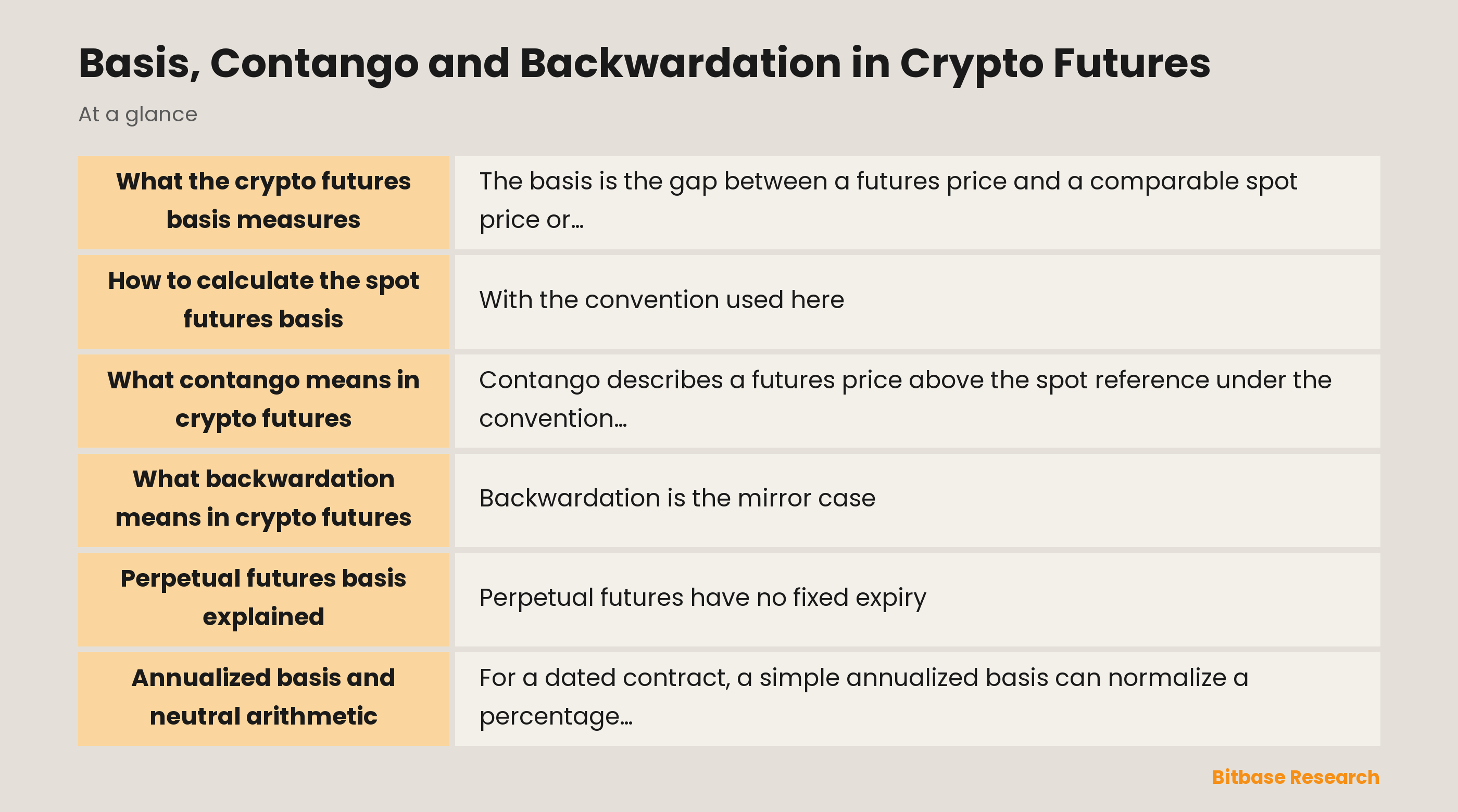
The basis is the gap between a futures price and a comparable spot price or reference index. A reader may encounter two opposite conventions. This article defines the futures-minus-spot basis as B = F − S, where F is the futures price and S is the spot reference. Under this convention, a positive basis means the futures contract is above spot, while a negative basis means it is below spot. Some market references use spot minus futures instead, so the sign should always be written down before comparing figures.
The comparison is meaningful only when the two prices refer to the same underlying, currency, valuation time, and settlement reference. A futures contract can be compared with an index rather than a single exchange quote. CME describes the basis for cryptocurrency futures relative to the relevant reference rate, while other educational materials may use a spot-market price. The definition is simple; choosing a mismatched reference is not.
The basis is also a snapshot. It can move because the futures price changes, the spot reference changes, the contract approaches expiry, liquidity changes, or participants demand different forms of exposure. A positive number is not automatically a forecast of a higher spot price, and a negative number is not automatically a forecast of a lower one.
Searches for spot futures basis crypto usually ask for this exact relationship. The short answer is: specify the futures contract, specify the spot reference, subtract using a declared convention, and record the time and days to expiry. Without those labels, a basis number is difficult to reproduce or interpret.
How to calculate the spot futures basis
With the convention used here, the absolute basis is:
B = F − S
The percentage basis divides the price difference by the spot reference:
Basis percentage = (F − S) / S
For a neutral example, suppose a spot reference is 100 units and a dated futures contract for the same underlying is 102 units. The absolute basis is 2 units. The percentage basis is 2 divided by 100, or 2%. Nothing in this arithmetic says whether either price will rise or fall. It only describes the relationship at the stated observation time.
The result can also be expressed with the opposite convention. If a report defines basis as S − F, the same example is −2 units or −2%. Neither convention is intrinsically wrong. The error is comparing a positive futures-minus-spot figure with a negative spot-minus-futures figure as if they used the same sign.
The phrase crypto basis trade explained often appears in searches that combine this measurement with a strategy label. Here, “basis trade” is treated only as terminology to identify a spot-and-derivative price relationship. The calculation does not establish that a price gap is executable, risk-free, or suitable for any person. Fees, funding, margin, custody, settlement, liquidity, taxes, and model risk are outside the arithmetic.
What contango means in crypto futures
Contango describes a futures price above the spot reference under the convention used in this guide. If the spot reference is 100 and a dated futures contract is 102, that contract is in contango relative to spot. On a chart with maturity on the horizontal axis and price on the vertical axis, an upward-sloping curve from spot toward that maturity is a common visual shorthand for contango.
Contango does not have a single cause. In traditional futures markets, financing, storage, insurance, and other carrying considerations can matter. In crypto futures, financing conditions, collateral preferences, leverage demand, market positioning, liquidity, volatility, and the design of the settlement reference can all affect the spread. The weight of each factor can change across contracts and market conditions.
The query contango in crypto explained is therefore not answered by “futures are always bullish.” Contango describes a relative price. It may reflect the cost of holding exposure through a dated contract, strong demand for leveraged exposure, or other supply-and-demand conditions. It does not by itself reveal the direction of the underlying asset after the observation date.
It is also important to separate spot-to-futures contango from the slope between two futures contracts. A near-month contract can be above spot while a later contract is below the near month, producing a curve with more than one segment. The word should describe the comparison being made, not be applied to an entire curve from one isolated price pair.
What backwardation means in crypto futures
Backwardation is the mirror case: the dated futures price is below the comparable spot reference. If spot is 100 and the futures price is 98, the futures-minus-spot basis is −2 units, or −2% before any annualization. A chart may show a downward slope from spot toward the dated contract, but the exact curve can have several slopes between several maturities.
Backwardation can appear when immediate exposure is in stronger demand than future exposure, when risk transfer is priced differently across maturities, or when liquidity and collateral conditions change. These are possible explanations, not a universal diagnosis. The same label can occur in very different market environments.
A search for backwardation in crypto explained should therefore begin with three questions: backwardation relative to which spot reference, for which maturity, and at what time? The sign alone does not identify the cause. It also does not provide a price target, a probability, or a recommendation to buy or sell anything.
A useful comparison is to place contango and backwardation side by side using the same convention. Futures at 102 against spot at 100 produce +2 units and +2%; futures at 98 against spot at 100 produce −2 units and −2%. The arithmetic is symmetrical even though the market context may not be.
Perpetual futures basis explained
Perpetual futures have no fixed expiry, so they do not have a dated contract price that naturally converges at a stated maturity. Their basis is usually described as the difference between a perpetual contract price or mark price and a spot index at a particular time. With P for the perpetual price and I for the index, a simple percentage gap can be written as (P − I) / I.
Funding is the main mechanism used by perpetual designs to encourage the contract to remain near its underlying index. When the perpetual is above the index, a positive funding arrangement may transfer value from longs to shorts; when it is below, the direction may reverse. The exact calculation, observation window, mark-price method, payment interval, and interest component depend on the contract rules. A basis snapshot and a funding rate are related but not identical measurements.
Because there is no expiry, the dated-futures annualization formula cannot be applied by simply inserting an arbitrary number of days. An analyst would need to state the observation horizon and the funding convention before converting a perpetual premium into an annualized figure. A short-lived premium and a persistent premium are not the same fact.
The phrase perpetual futures basis explained is best understood as a request to identify the contract price, the spot index, the sign convention, and the funding mechanism. It should not be read as evidence that the basis will remain positive or negative. Funding can change, the index can differ from a local spot quote, and the contract can deviate during volatile or illiquid periods.
Annualized basis and neutral arithmetic
For a dated contract, a simple annualized basis can normalize a percentage spread by the time remaining to expiry:
Annualized basis = ((F − S) / S) × (365 / D)
Here D is the number of calendar days to expiry, and 365 is a stated day-count assumption. Using the earlier example, F = 102, S = 100, and D = 90. The simple percentage basis is 2%. The simple annualized basis is 2% × 365 / 90, or approximately 8.11%. This is a normalized quote, not a guaranteed yield and not a forecast.
The search phrase annualized basis crypto often hides several choices. The calculation may use calendar or business days, a 360-day convention, a different spot or index reference, a midpoint or executable price, or a continuously compounded transformation. The number is meaningful only when those choices accompany it. Annualization also magnifies short-dated price differences, so a small absolute gap can produce a large-looking normalized figure when D is small.
A numerical example should not smuggle in a strategy. The 100 and 102 values above are fictional and deliberately omit fees, financing, funding, margin, slippage, settlement, custody, and tax. They show how to label a spread. They do not show that a spread can be locked, that it will converge on a chosen schedule, or that a participant can receive the quoted annualized number.
How to read a crypto futures curve
The crypto futures curve is the set of prices for contracts with different maturities, placed on a common reference date. The phrase crypto futures curve explained usually refers to this map rather than to one contract alone. To read it, first record the spot reference, then list each maturity and its price, then calculate adjacent differences as well as each contract’s difference from spot. This prevents a steep near-term segment from being hidden by a smooth-looking chart.
A curve can be upward sloping from spot to the front contract, flatter between the front and second contract, and downward sloping farther out. Calling the whole curve simply “contango” would lose that detail. A curve can also shift because the underlying spot reference moves, so comparing two curve snapshots requires matching timestamps and methodologies.
For a disciplined reading, label each observation with the contract type, expiry or funding interval, spot/index source, price field, time zone, and sign convention. Then ask whether the chart shows an absolute difference, a percentage difference, or an annualized number. A chart that mixes these units can make equal relationships look very different.
Basis is descriptive information about relative pricing. It may be useful in research, hedging analysis, risk reporting, or education, but this article does not recommend a position, a venue, a contract, or an execution method. Any real-world decision would require separate review of contract specifications, liquidity, collateral, operational controls, legal constraints, and the possibility that the relationship changes before an action can be completed.
Basis is a difference between a futures price and a comparable spot reference. With the declared futures-minus-spot convention, positive basis corresponds to contango and negative basis corresponds to backwardation. A dated contract can be normalized with a clearly labeled annualization formula, while a perpetual contract needs a funding and observation-horizon explanation because it has no expiry.
The most reliable habit is to name the two prices, the timestamp, the maturity, the formula, and the sign convention before interpreting a number. That habit answers the common keyword questions without turning a measurement into a prediction or a trading recommendation.
Disclaimer: This article is educational content from Bitbase Academy, provided for information only. It does not constitute investment, trading, tax, or financial advice. Crypto assets are volatile; assess your own risk. Written as of August 2026; refer to the latest official information.
References
[1] https://www.cmegroup.com/articles/2024/btic-transactions-on-cryptocurrency-futures.html cmegroup.com
[2] https://www.cmegroup.com/markets/cryptocurrencies/cryptocurrency-basis-watch-and-implied-rate-tool.html cmegroup.com
[3] https://www.cmegroup.com/education/courses/introduction-to-ferrous-metals/what-is-contango-and-backwardation cmegroup.com
[4] https://help.coinbase.com/en/international-exchange/perpetual-futures-basics/how-do-perpetual-futures-stay-in-line-with-index-price-of-the-underlying-spot-asset help.coinbase.com
[5] https://support.deribit.com/hc/en-us/articles/31424954847133-Inverse-Perpetual support.deribit.com
[6] https://www.kraken.com/ca/learn/trading/futures-trading kraken.com