
Digital assets can create a gap between knowing that an asset exists, having authority to deal with it, and being able to reach the systems or credentials connected to it. This educational framework helps separate those questions without offering legal, tax, or security instructions.
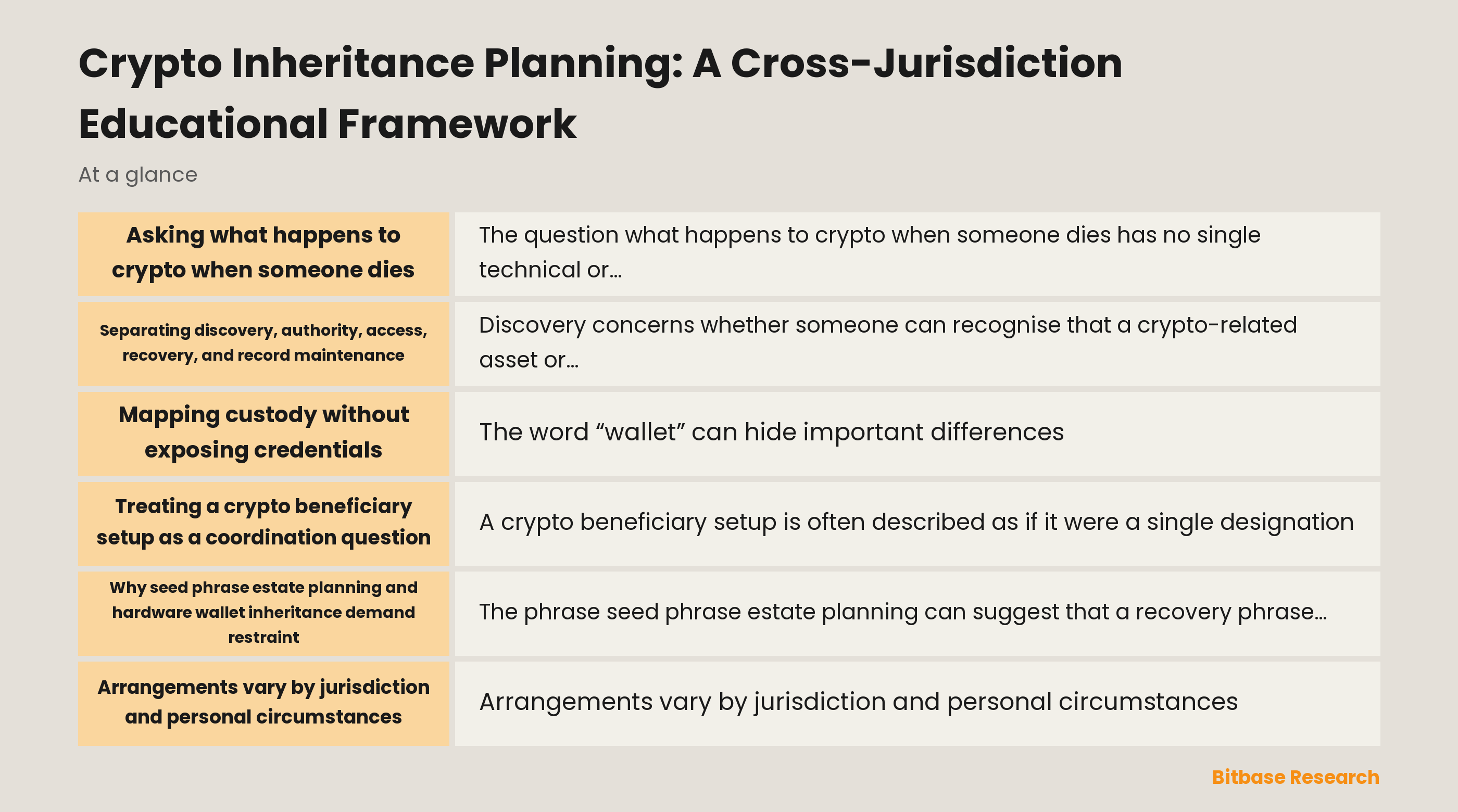
Asking what happens to crypto when someone dies
The question what happens to crypto when someone dies has no single technical or legal answer. A cryptoasset may be connected to a self-controlled arrangement, an account relationship with a service provider, or a mixture of both. The relevant record may be held in a personal archive, with a professional adviser, or in institutional documents. Each arrangement can raise different questions about identification, authority, confidentiality, and process.
It is useful to resist the shortcut of treating “inheritance” as one event. A family may know an asset exists yet lack authority to deal with it. An authorised representative may be able to administer an estate yet not have a lawful or safe route to a particular account or credential. Conversely, a person may encounter technical information without having permission to use it. These are separate issues, not interchangeable forms of control.
An educational framework therefore begins with roles and boundaries rather than an attempt to predict an outcome. It asks which assets and relationships can be identified, who may have a legitimate role after death or incapacity, what information is sensitive, and which records may need review. It does not assume that any person should be given access, nor does it turn a private credential into an estate-planning document.
Separating discovery, authority, access, recovery, and record maintenance
Discovery concerns whether someone can recognise that a crypto-related asset or account relationship exists. It is an information question, not an instruction to search private devices or communications. Authority concerns who, if anyone, has a legally recognised role to act for an estate or other relevant person. The existence of a name in a personal note does not by itself settle authority, and formal authority does not automatically reveal every asset or account.
Access is a technical and contractual question. It may involve an account process, a device, a cryptographic credential, or several layers that do not work alike. Recovery is different again: it describes the possibility of restoring an authorised path after an expected record, device, or contact is unavailable. Neither concept should be confused with permission, and neither gives a reason to disclose actual private keys, seed phrases, passwords, or unlock credentials.
Record maintenance is the connective layer. A planning record can describe categories, locations of non-secret information, responsible professional contacts, and review dates without reproducing sensitive authentication material. Keeping these layers distinct lets people discuss continuity without pretending that a technical access method creates a legal entitlement, or that a legal role removes the need for careful security and privacy handling.
Mapping custody without exposing credentials
The word “wallet” can hide important differences. In some arrangements, an individual’s own cryptographic material is central to the ability to authorise a transaction. In others, an account relationship with a third-party provider may be central, with that provider’s identity-verification and estate processes relevant to the conversation. A reader does not need to select a product or expose a secret in order to understand that these models have different dependency points.
A neutral inventory can describe the existence and broad type of an arrangement: for example, whether there is a self-managed digital asset, a provider-managed account, a device associated with access, or an outstanding record to review. It should not become a repository for real credentials. The aim is discovery and context, so that authorised professionals and relevant parties can determine what questions need to be asked under applicable rules.
This distinction also prevents false certainty. The presence of a device does not prove ownership, authority, or usable access. The presence of a provider account does not establish what the provider may disclose or to whom. Technical design, service terms, documentation, and local law may all matter. Treating custody as a map of relationships instead of a shortcut to control makes the discussion safer and more accurate.
Treating a crypto beneficiary setup as a coordination question
A crypto beneficiary setup is often described as if it were a single designation. Conceptually, it is better viewed as coordination among a person’s stated intentions, the legal instruments that may govern an estate, the nature of the asset or account relationship, and the availability of non-secret records. These elements can point in the same direction, but they are not substitutes for one another.
For example, an intention to leave a digital asset to a particular person may raise questions about whether the asset is sufficiently identified, whether authority has been assigned under local rules, and whether the relevant custody arrangement has its own procedures. This is not a template for a will, trust, designation, or provider request. It is a reminder that intent, authority, and technical context should be discussed together instead of in separate silos.
People named in a broader plan may benefit from understanding the limits of their role: they may need to identify professional contacts, preserve confidential records, or await formal authority rather than attempt to access an account or device. That distinction protects both the intended recipient and the estate. It also avoids creating a situation in which sensitive material is treated as proof of entitlement.
Why seed phrase estate planning and hardware wallet inheritance demand restraint
The phrase seed phrase estate planning can suggest that a recovery phrase belongs in an ordinary planning file. That is an unsafe simplification. A phrase or other private credential can function as highly sensitive authentication material, so its mere existence changes the security discussion. An estate-planning conversation can acknowledge that a credential-dependent arrangement exists without repeating, transmitting, or placing the credential in a document intended for broad review.
Likewise, hardware wallet inheritance should not be reduced to possession of a physical object. A device may be associated with access, but possession alone does not resolve identity, authority, configuration, confidentiality, or the presence of any additional protection. The planning issue is not how to operate a device after a death; it is how to distinguish a device’s existence from a lawful and secure decision about any next step.
The diagram is intentionally conceptual: it shows that discovery, authority, access, recovery, and record maintenance meet at boundaries rather than forming one linear handover. It should not be read as a storage design, credential-sharing method, or succession procedure. A good educational framework preserves the difference between documenting that a question exists and revealing the secret that could answer it.
Arrangements vary by jurisdiction and personal circumstances
Arrangements vary by jurisdiction and personal circumstances. Rules on succession, property, privacy, fiduciary authority, service-provider obligations, marital or family rights, incapacity, and reporting can differ across locations and can change over time. A cross-border family, an asset held through a business, a trust-like arrangement, or a move between places can add further questions that a generic article cannot resolve.
Personal circumstances matter just as much as legal geography. The nature of the person’s records, the type of custody relationship, the presence of other estate documents, family dynamics, security needs, and the capacity of any proposed representative can all affect the analysis. No article can determine whether a particular document, designation, inventory, or access plan is valid, sufficient, or appropriate for an individual situation.
Readers should consult qualified local legal, estate-planning, and tax professionals before acting on a personal arrangement. Those professionals can assess the applicable jurisdiction, the person’s wider estate documents, any provider or contractual terms, and relevant tax or reporting obligations. The purpose of this framework is to help a reader ask clearer questions, not to supply a legal conclusion or an executable plan.
Keeping a crypto recovery plan reviewable, not secret-filled
A crypto recovery plan can be understood as a reviewable continuity record rather than a cache of credentials. At a high level, it can help distinguish what should be discoverable from what must remain protected, who should be contacted for professional or administrative questions, and when the surrounding facts should be revisited. It should be designed around information boundaries, not around transferring secret material between people.
Review matters because relationships and records change. A change in residence, family situation, legal documentation, account relationship, device use, professional adviser, or intended recipient can make an old description incomplete or misleading. Periodic review is therefore about checking whether the conceptual map remains accurate, not testing secrets, bypassing safeguards, or attempting access.
The enduring goal is clarity with restraint. A person can make it easier for the right questions to be found without making sensitive information easier for the wrong person to use. By separating asset discovery, authority, access, recovery, and record maintenance, crypto inheritance planning becomes a structured conversation about continuity, privacy, and professional review rather than a promise that any single document or object can settle every outcome.
Disclaimer: This article is educational content from Bitbase Academy, provided for information only. It does not constitute investment, trading, tax, or financial advice. Crypto assets are volatile; assess your own risk. Written as of August 2026; refer to the latest official information.
References
[1] Uniform Law Commission: Revised Uniform Fiduciary Access to Digital Assets Act uniformlaws.org
[2] Law Commission of England and Wales: Digital assets lawcom.gov.uk
[3] UK Ministry of Justice: Property (Digital Assets Etc.) Bill factsheet gov.uk
[4] NIST: Recommendation for Key Management nist.gov