
Crypto mixers and privacy pools both address the public traceability of blockchain transfers, but they do not make the same promise or rely on the same trust model. A mixer generally seeks to make the link between deposits and withdrawals harder to observe. A privacy pool adds a proof and policy layer intended to let a user demonstrate an acceptable relationship to a defined association set without publishing the full transaction graph. Neither label is a universal legal status, and neither should be treated as a way to avoid sanctions or compliance duties.
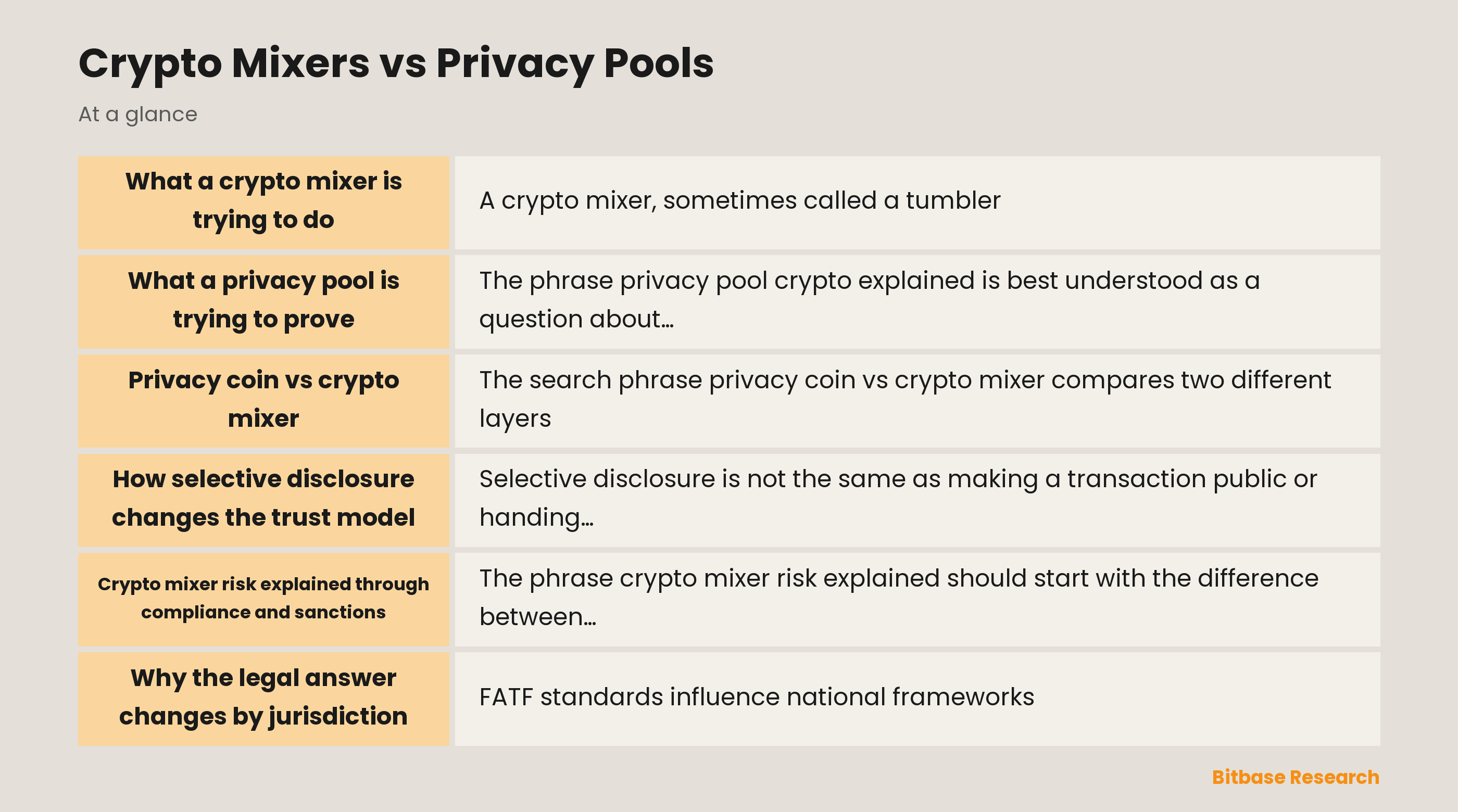
What a crypto mixer is trying to do
A crypto mixer, sometimes called a tumbler, is a transaction-layer design that combines or coordinates assets from multiple participants so that the public ledger does not show a simple, obvious path from one deposit to one withdrawal. The goal is usually transaction unlinkability: an outside observer should have more difficulty deciding which input corresponds to which output. The exact mechanism can be a smart contract, an intermediary service, a relayer arrangement, or another coordination design, so “mixer” is a functional label rather than a guarantee about implementation.
The privacy benefit depends on the size and quality of the anonymity set, the timing and amount patterns that remain visible, the correctness of the cryptography and code, and the behavior of the operators or other privileged parties. A larger group does not automatically make every participant equally private. Public transaction graphs, network metadata, entry and exit points, operational mistakes, and later analysis can still reduce the practical protection. A design can therefore make a particular link less visible without making the entire financial history anonymous.
What a privacy pool is trying to prove
The phrase privacy pool crypto explained is best understood as a question about a different design goal. The Privacy Pools paper describes a smart-contract privacy protocol in which a user can publish a zero-knowledge proof about the origin or association of funds without revealing the entire transaction graph. In the paper's framing, users can show that funds belong to a chosen set, or that they are separated from known unlawful sources, while preserving some transaction privacy. The proof is about a defined claim and set; it is not a universal certificate of innocence.
The important addition is the association-set idea. An association set provider, or another policy component in a particular implementation, may define which deposits are included in a set and which claims can be proved. This creates a separable policy surface: privacy can be preserved while a recipient, institution, or compliance process receives a narrower proof. It also creates new assumptions about the set definition, data quality, governance, proof system, smart contract, and the jurisdictions that interpret the arrangement. The paper and current project documentation describe a protocol direction, not a promise that every deployment has identical controls or legal treatment.
Privacy coin vs crypto mixer
The search phrase privacy coin vs crypto mixer compares two different layers. A privacy coin is an asset or network whose protocol is designed to hide, obscure, or selectively reveal transaction information as part of the asset's normal transfer model. A crypto mixer is normally a separate transaction-layer mechanism that receives or coordinates transfers of an existing asset. A privacy coin can have protocol-level privacy without a mixer, while a mixer can be used with a transparent asset. They may pursue related privacy outcomes, but they are not synonyms.
The distinction matters for analysis. With a privacy coin, the relevant questions include the protocol's default visibility, wallet and key assumptions, how recipients or observers can prove facts, and what information is available to a node or an authorized viewer. With a mixer, the questions include the composition of the pool, the deposit and withdrawal relationship, operator or contract privileges, relayer and front-end dependencies, and whether known-risk funds can enter. Calling both systems “anonymous crypto” hides the exact component that creates the privacy claim and the exact component that can fail.
How selective disclosure changes the trust model
Selective disclosure is not the same as making a transaction public or handing over a complete identity file. A zero-knowledge proof can be designed to show a narrower proposition, such as membership in an association set or non-association with a defined list, without exposing every transaction detail. That can reduce unnecessary data sharing. It does not mean that the proof reveals nothing, that metadata disappears, or that every observer must accept the same set or policy.
The trust model therefore moves rather than vanishes. A reader must ask who defines the association set, how updates are justified, what happens when a source is misclassified, which proof system and smart contract are used, and whether the recipient can verify the claim independently. The user may avoid trusting a mixer operator to keep a private deposit-to-withdrawal mapping, but may instead depend on an association-set provider, a governance process, a verifier, and the availability of a sound proving system. Different risks are better or worse; they are not all removed.
Selective disclosure also has a boundary around time. A proof that a deposit was outside a defined set on one date does not establish that every future interaction is acceptable. A set can change, a designation can be updated, a contract can be upgraded, and off-chain facts can remain relevant. This is why a privacy pool should be described as a mechanism for conditional privacy and evidence, not as a permanent clean-money label.
Crypto mixer risk explained through compliance and sanctions
The phrase crypto mixer risk explained should start with the difference between technology risk, financial-crime risk, and sanctions risk. FATF's updated virtual-asset guidance uses a risk-based framework for countries and virtual asset service providers. It emphasizes that countries should assess and mitigate risks, and that definitions should be applied to the activity and service rather than merely to the name used by a product. That framework does not make every privacy technology automatically unlawful, but it also does not create a safe harbor for a service that facilitates prohibited activity.
OFAC's virtual-currency guidance is a United States sanctions-compliance source, not a global privacy rule. It explains that sanctions obligations apply to virtual-currency transactions as well as transactions in traditional currency for persons subject to U.S. jurisdiction, and that firms handling digital assets need a risk-based compliance program. A transfer involving a blocked person, address, entity, or sanctioned activity can create serious exposure depending on the facts and applicable program. The existence of a zero-knowledge proof or a privacy feature does not override a sanctions prohibition.
The practical boundary for this article is important: it does not list mixers, give deposit or withdrawal instructions, explain how to hide a source of funds, or describe ways to evade screening. It is safer to analyze whether a system's claims, controls, and legal relationships are documented than to treat privacy as evidence that a transaction is permitted. Financial institutions, regulated intermediaries, developers, and users can face different obligations, and a protocol's technical design cannot answer every compliance question.
Why the legal answer changes by jurisdiction
FATF standards influence national frameworks, but they are not a single worldwide statute. The legal result can depend on the person's location and status, the service provider's location, the asset and activity involved, the intermediary, the sanctions program, and the facts of a particular transaction. One jurisdiction may focus on licensing and AML obligations for an intermediary; another may apply different rules to a protocol, a developer, a miner, a validator, or a self-hosted user. These categories should not be collapsed without a local legal analysis.
OFAC is likewise specific to U.S. sanctions authorities and the persons or transactions within their scope. Other jurisdictions can impose their own sanctions, AML rules, licensing requirements, reporting duties, or restrictions, and those regimes can change. A transaction can also cross borders through counterparties, infrastructure, or service providers even when the user does not think of it as an international transaction. “Legal in my country” is therefore not a complete answer to “safe for every participant.”
The same caution applies to the word “compliant.” A project may describe an association-set or proof-of-innocence design as compliance-oriented, but a marketing statement is not a regulator's determination. A privacy pool can reduce unnecessary disclosure while still requiring careful decisions about who may verify a claim, how sanctions and AML signals are handled, and what evidence is retained. A mixer can reduce public linkability while leaving unanswered questions about operators, fund provenance, and counterparty exposure.
Bottom line: compare functions, not labels
Start by separating the privacy claim from the legal claim. Ask whether the system is hiding a public link, proving membership in a defined set, enabling a viewer key, or applying a policy to deposits. Then identify the component that makes the claim possible: a protocol, contract, operator, relayer, association-set provider, governance process, or verifier. If that component is not documented, the label is doing too much work.
Next separate evidence from conclusion. A zero-knowledge proof can support a narrow statement without proving that an entire history is lawful. A mixer can make graph analysis harder without proving that funds are legitimate. FATF risk-based guidance and OFAC sanctions guidance help explain why service relationships and facts matter, but neither source can decide every country's treatment of a particular protocol or transaction. The correct reading is conditional, not absolute.
Crypto mixers and privacy pools overlap in their interest in transaction privacy, yet they are not the same thing. A mixer primarily changes how deposits and withdrawals are linked in public data. A privacy-pool design adds a way to make a limited, policy-shaped claim about fund association while preserving some privacy. Privacy coin, mixer, and privacy pool therefore describe different layers and assumptions. Treating them as synonyms can hide technical weaknesses, compliance exposure, and jurisdictional differences; treating them as distinct mechanisms makes the risks easier to inspect.
Disclaimer: This article is educational content from Bitbase Academy, provided for information only. It does not constitute investment, trading, tax, or financial advice. Crypto assets are volatile; assess your own risk. Written as of August 2026; refer to the latest official information.
References
[1] Privacy Pools: A Blueprint for the Future of Privacy-Preserving Compliance arxiv.org
[2] FATF: Updated Guidance for a Risk-Based Approach to Virtual Assets and VASPs fatf-gafi.org
[3] OFAC: FAQ 560, Virtual Currency Sanctions Compliance ofac.treasury.gov
[4] OFAC: Sanctions Compliance Guidance for the Virtual Currency Industry ofac.treasury.gov
[5] Monero: Moneropedia and privacy terminology getmonero.org