The System Behind a Crypto Payment
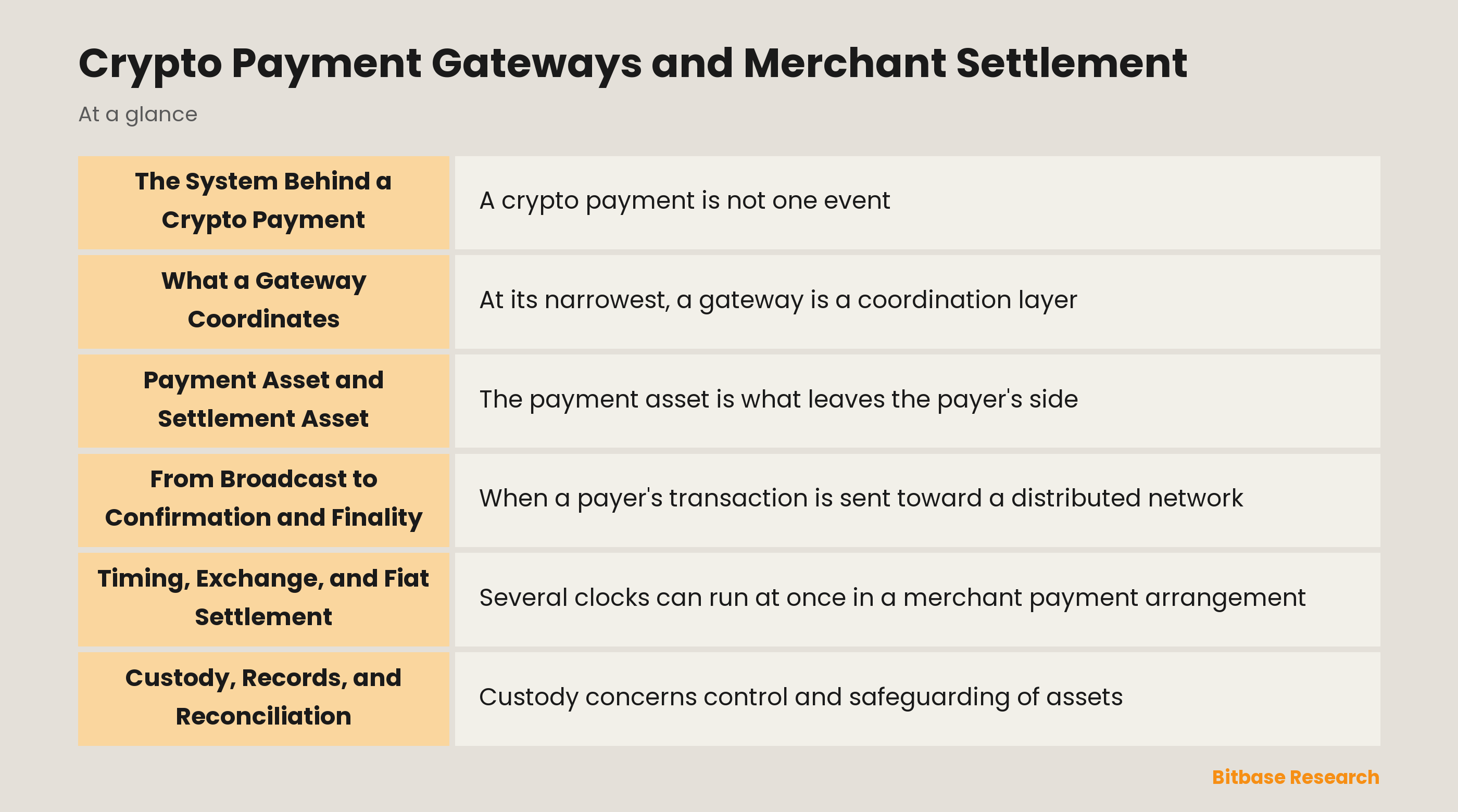
A crypto payment is not one event. It is a chain of commercial, technical, and accounting events that may be connected by software but governed by different rules. A customer may send a digital asset, a network may record a transaction, an intermediary may observe that record, and a merchant may later receive an asset or a fiat balance. Those events can be close together, but they are not automatically the same event.
The merchant is the commercial party selling goods or services and holding the claim created by the sale. The customer-side transfer is an attempt to satisfy that claim in an agreed payment asset. A gateway can organize the information that links the commercial claim to an observed transfer: an expected amount, an asset identifier, a reference, and a status. The gateway may also display records from a network or from a connected service. None of those functions alone determines who controls assets or when settlement is legally complete.
This is a crypto payment gateway explained through roles rather than through a product label. The useful question is not whether every component is called a gateway. It is which component observes a transfer, which one controls an asset, which one performs an exchange, and which one creates the merchant's settlement record.
What a Gateway Coordinates
At its narrowest, a gateway is a coordination layer. It can match a commercial reference with a payment instruction, monitor whether a network has published a related transaction, normalize status information, and pass records to the merchant's business systems. In a broader arrangement, the same organization may also supply custody, conversion, ledger services, or fiat disbursement. The label does not prove that all of those roles are present.
The distinction matters because each role answers a different question. A network observer can report that a transaction was broadcast or included in a block. A custodian can report an internal balance or control an address. An exchange function can calculate or execute a conversion between assets. A bank or other money-settlement institution can record a fiat credit. The merchant's own order system can record whether the commercial obligation is treated as paid. A single status message can summarize several of these facts, yet the underlying facts remain separate.
The gateway is therefore an information bridge, not a substitute for a payment network's consensus rules or a merchant's legal contract. Its records may be operationally useful, but their meaning depends on the service terms, the asset involved, the network data source, and the definitions used in the merchant arrangement.
Payment Asset and Settlement Asset
The payment asset is what leaves the payer's side. The settlement asset is what the merchant ultimately receives or is owed under the arrangement. They may be the same asset when a transfer is delivered and retained in that asset. They may differ when the received asset is converted into another cryptoasset or into fiat money before the merchant's balance is credited.
This difference is central to crypto merchant settlement explained clearly. A transaction can be visible on a public ledger in one asset while the merchant's economic exposure is defined in another. For example, a commercial amount may be expressed in a national currency, the customer may transfer a digital asset, and a separate exchange function may create a record in fiat. Each representation describes a different layer of the same commercial relationship.
An exchange rate is also not merely a number shown on a screen. A reference price, a price used to calculate an expected payment amount, an executed conversion rate, and a rate used for accounting can be different records at different moments. The time associated with each record matters because market values can move between a quoted amount, a chain event, and a later conversion. Contract terms determine which record affects the merchant's settlement claim and who bears any intervening exposure.
From Broadcast to Confirmation and Finality
When a payer's transaction is sent toward a distributed network, it can first be propagated among participants without being part of the canonical ledger. A later block or analogous ledger update can include it. Subsequent consensus activity can increase confidence that the recorded history will remain the accepted history. These stages are often compressed into the word confirmation, even though they describe distinct technical states.
The phrase crypto payment confirmation time is therefore not a universal clock. It can reflect network design, the asset's transaction rules, congestion, fee-market conditions, validator or miner behavior, the reliability of data feeds, and whether the relevant transfer occurs on a base layer, another execution environment, or an internal ledger. A gateway's displayed timestamp may describe when its system observed an event, not when every participant in the arrangement obtained the same view.
Finality is a further concept. Some networks use probabilistic confidence that grows as later history accumulates; others use explicit consensus conditions that make reversal economically or protocol-wise difficult. Neither description, by itself, says when a merchant has a fiat credit, when a conversion was executed, or when a custodian has made an internal balance available. A service can define its own status vocabulary, while the underlying network defines confirmation and finality according to its protocol.
Timing, Exchange, and Fiat Settlement
Several clocks can run at once in a merchant payment arrangement. One clock measures the commercial price period. Another measures network propagation and confirmation. A third may measure the moment at which an exchange records a conversion. A fourth may measure a book-entry credit or movement through a banking payment system. These clocks can align, but they need not do so.
Fiat settlement describes the merchant receiving, or becoming entitled to receive, a fiat-money balance under the applicable arrangement. It can involve commercial-bank money, an internal balance that is later transferred through a bank, or another defined money-settlement process. On-chain settlement instead concerns an asset transfer recorded under the relevant network's rules. An arrangement can have both: an on-chain transfer can be an input to a later fiat settlement process rather than the fiat settlement itself.
The timing of either outcome depends on the network, the asset, the exchange path if one exists, banking calendars or cutoffs, recordkeeping design, and the parties' contract. For that reason, a chain timestamp cannot by itself establish the timing of a fiat settlement, and a fiat ledger entry cannot by itself describe the network's finality. Each is evidence for a different part of the arrangement.
Custody, Records, and Reconciliation
Custody concerns control and safeguarding of assets. It may be performed by the merchant, by a specialized custodian, by an exchange-related entity, or within another contractual structure. A gateway can be involved in communicating payment information without being the custodian. Conversely, a custodian may maintain asset records without determining the merchant's commercial order status. Treating custody and settlement as synonyms hides important differences in control, counterparty exposure, and record ownership.
Reconciliation connects the evidence from each layer. A complete record can associate a merchant order reference with the expected asset and amount, the observed network transaction identifier, the confirmation or finality state used by the relevant system, any conversion record, custody-ledger movement, and the merchant settlement entry. The purpose is not to force all events into one timestamp. It is to preserve their sequence and make clear which party supplied each fact.
This structure also makes exceptions intelligible. A network can show a transaction while an internal ledger has not yet posted a balance. A conversion record can exist while fiat movement follows a separate timetable. A commercial order can be marked resolved under contract terms while the asset remains in custody. These are not necessarily contradictions; they show why an auditable arrangement needs separate records for separate obligations.
A Clearer Reading of Merchant Settlement
Merchant settlement is best understood as the fulfillment of a defined obligation, not as a single icon or status label. The commercial agreement identifies what the merchant is owed. The payment asset identifies what the payer transferred. The network supplies evidence about the transfer's confirmation and finality. A gateway can connect these data points. Custody identifies who controls the relevant asset, and exchange or banking records identify whether the merchant's settlement asset has changed form.
That layered view avoids two common mistakes. First, a confirmed on-chain transaction is not automatically identical to fiat settlement. Second, a credited fiat balance does not describe the consensus properties of the preceding on-chain transfer. The relationship between them is created by the particular network, asset, contract, and service arrangement.
For educational purposes, the most durable conclusion is that merchant, settlement, and confirmation belong to one connected system but answer different questions. The applicable network defines its ledger behavior; the asset and conversion terms define economic representation; and the contract and service records define what the merchant is owed and when. Clear language keeps those boundaries visible without turning a technical explanation into a platform recommendation or an operational instruction.
Disclaimer: This article is educational content from Bitbase Academy, provided for information only. It does not constitute investment, trading, tax, or financial advice. Crypto assets are volatile; assess your own risk. Written as of August 2026; refer to the latest official information.
References
[1] BIS/CPMI-IOSCO: Principles for Financial Market Infrastructures bis.org
[2] BIS/CPMI-IOSCO: Application of the PFMI to stablecoin arrangements bis.org
[3] Bitcoin Developer Guide: Payment Processing developer.bitcoin.org
[4] ethereum.org: Proof-of-stake ethereum.org