
Crypto can make an estate question look like a technology question, but probate begins with authority and evidence. After a death, an executor may need to determine whether a crypto-related asset belongs to the estate, what record supports that conclusion, and which legal instrument defines the representative’s role. Crypto probate explained in this way is not a shortcut to a digital asset. It is a framework for separating appointment, ownership, recordkeeping, and custody before any conclusion is drawn.
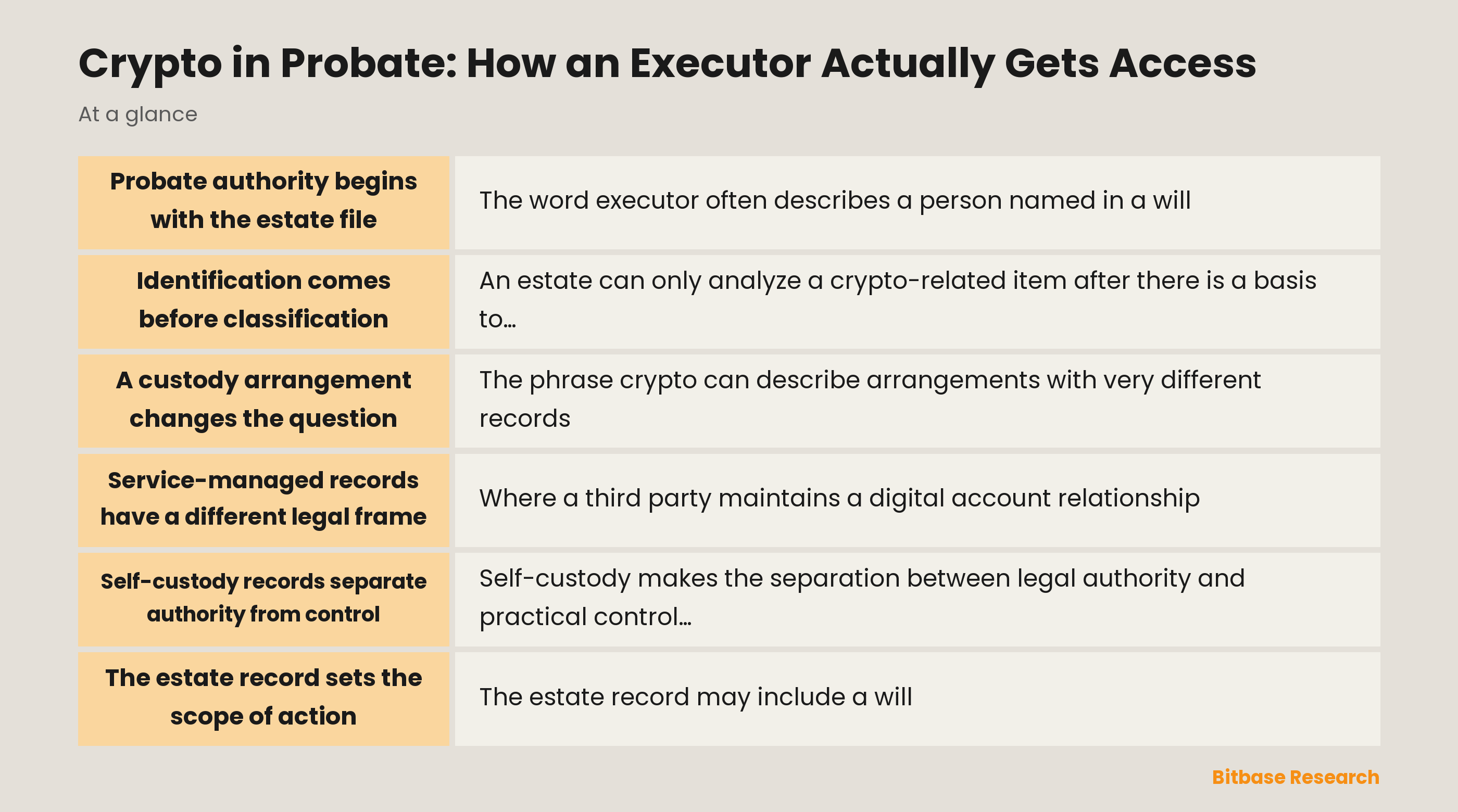
Probate authority begins with the estate file
The word executor often describes a person named in a will, while the authority to act can depend on a later court process or another legally recognized estate procedure. In some places, a court-issued appointment document is called letters testamentary or letters of administration; elsewhere, a grant or a different record performs a comparable function. The phrase how executors access crypto can therefore obscure the first issue: who is currently authorized to represent the estate, and under which document.
An authority document usually identifies the representative, the estate or person concerned, and the legal scope of that representative’s role. Its effect can be limited by the will, a court order, a trust instrument, local law, or a condition recorded in the estate file. It does not by itself decide whether a particular digital item exists, whether it belongs to the estate, or whether a separate legal restriction applies. Those questions remain distinct even when the same person is named in several documents.
Identification comes before classification
An estate can only analyze a crypto-related item after there is a basis to identify it. Relevant material may include records that indicate ownership, estate correspondence, accounting material, device records, or documents that distinguish personal property from property connected to a business or trust. A reference in one record may be incomplete, outdated, or attributable to someone else. Identification is evidence gathering in the legal sense, not a presumption that an asset is available or part of the estate.
Classification asks a different set of questions. Is the item an asset of the deceased, an asset held for another person, property connected to a trust, or something outside the estate under the governing law? The answer can affect who has a role in the analysis, but it cannot be inferred from a label such as crypto, wallet, or account. A careful record separates facts that show a possible connection from facts that establish a legal interest and from documents that define the representative’s authority.
A custody arrangement changes the question
The phrase crypto can describe arrangements with very different records. In a service-managed arrangement, another organization may maintain the account relationship and its associated records. In a self-custody arrangement, the legal question may concern property for which there is no comparable provider-maintained account relationship. These categories describe recordkeeping and control structures; they do not settle ownership, inheritance, or authority.
That distinction changes the questions an estate file has to keep separate. A service-managed relationship can bring contractual terms, privacy rules, and provider-held evidence into the picture. A self-custody situation may instead make the chain of title, estate documentation, and the factual record especially important. In either case, a court appointment answers who may represent the estate within its scope. It does not automatically answer every contractual, evidentiary, or technical question.
Service-managed records have a different legal frame
Where a third party maintains a digital account relationship, the legal frame can include the governing terms, the deceased person’s recorded directions, privacy rules, and the law of the relevant jurisdiction. Digital-asset statutes in some places distinguish account information, communications, and underlying property interests. That distinction matters because an estate’s legal need for information is not identical to a general right to every record associated with a person.
California’s official digital-asset statute is one example of a jurisdiction-specific framework. It defines a custodian and a personal representative, subjects fiduciary authority to applicable terms, law, and the scope of fiduciary duties, and does not permit impersonation. The point is not that California supplies a universal answer. It is that a will, an appointment record, and an account relationship may interact in a legally bounded way rather than producing one automatic form of access.
Self-custody records separate authority from control
Self-custody makes the separation between legal authority and practical control particularly visible. An estate may have physical records, devices, or other evidence connected to a digital asset, yet the representative’s authority still comes from the governing estate process and the applicable documents. The presence of an item does not establish who owns it, whether it is within the estate, or what a representative may lawfully do in relation to it.
A sound analysis does not equate possession of a device, familiarity with software, or a family member’s assertion with legal entitlement. The opposite error is also possible: an estate may have a colorable legal claim while the factual record remains incomplete. Authority determines who can act for the estate within a defined role; the legal and factual questions surrounding a digital item still require their own support. No technical feature turns a disputed or unclassified item into estate property.
The estate record sets the scope of action
The estate record may include a will, an appointment document, a later court order, trust terms, and records that show how a property interest was held. These materials can point in the same direction, or they can create a question that must be resolved under local law. A will may nominate an executor, a court document may confirm or limit a representative’s role, and a trust may place some property in a different legal arrangement from the probate estate.
The same caution applies to assets that appear to have another legal character. Joint ownership, beneficiary designations, business property, or trust property can be treated differently from estate property depending on the jurisdiction and the underlying documents. The relevant conclusion is not that any named executor controls every crypto-related record. It is that classification, authority, and the precise document language must be considered together before the estate’s role can be described.
Jurisdiction and documents determine the result
Probate is organized by local law, so similar facts can produce different results. A person’s domicile, the location or legal character of property, the forum handling the estate, the wording of a will or trust, and the terms governing a service-managed relationship can all matter. Even the labels for the representative and the authority document vary. A statement that is accurate for one statute or court system may be incomplete or wrong in another.
The most useful answer to how executors access crypto is therefore a bounded one. It starts with the document that establishes the representative’s authority, then distinguishes evidence of an asset from proof of estate ownership, and then identifies the custody arrangement and applicable legal constraints. When a document, jurisdiction, or asset classification is uncertain, the uncertainty is part of the result. Treating it as settled would collapse legal authority, factual evidence, and practical control into a single question that probate does not actually answer.
This framework does not establish an executor's authority, ownership, tax treatment, or estate-planning result in any individual matter. Those questions depend on applicable law, court documents, service terms, records, and facts.
Disclaimer: This article is educational content from Bitbase Academy, provided for information only. It does not constitute investment, trading, tax, or financial advice. Crypto assets are volatile; assess your own risk. Written as of August 2026; refer to the latest official information.
References
[1] California Probate Code: Revised Uniform Fiduciary Access to Digital Assets Act leginfo.legislature.ca.gov
[2] Contra Costa Superior Court: Decedents' Estates contracosta.courts.ca.gov
[3] GOV.UK: Search Probate Records gov.uk