Crypto communities often compress a whole attitude into four letters or a joking noun. GM can be a greeting, WAGMI can signal solidarity, NGMI can mock a decision, and hopium or copium can describe an argument that has become more emotional than analytical. These terms are social language, not technical indicators or investment advice. Their meaning comes from context, tone and the relationship between the people using them.
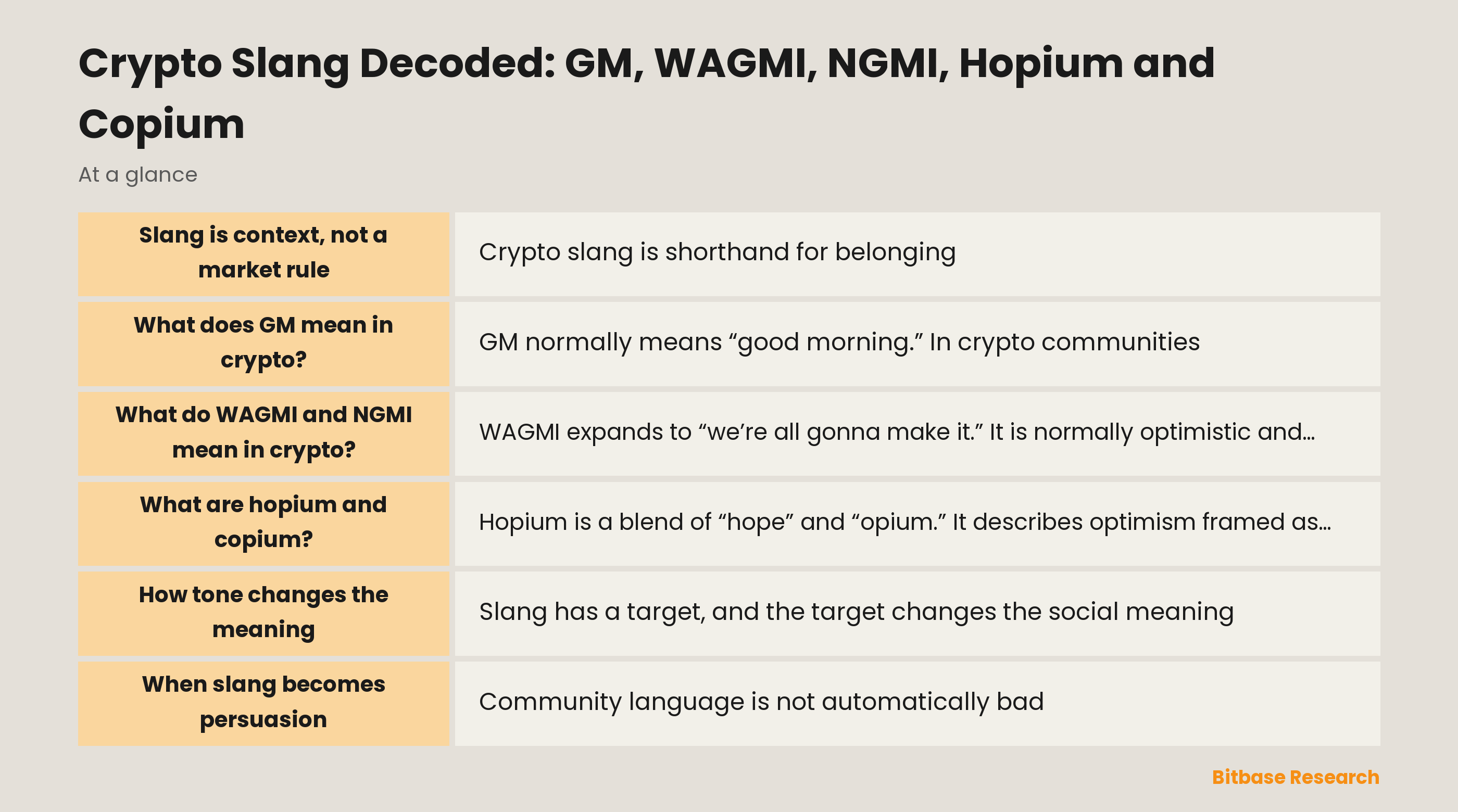
Slang is context, not a market rule
Crypto slang is shorthand for belonging, mood and judgment. It spreads through chats, social posts, livestreams and community spaces where speed matters more than formal definitions. The same word can be friendly among peers, sarcastic in a reply, or manipulative when a promoter uses it to pressure an audience.
That is why a dictionary meaning is only the starting point. A phrase such as WAGMI may be sincere encouragement, an ironic meme, or a way to avoid answering a difficult question. NGMI may be a self-deprecating joke or an insult aimed at someone who disagrees. Reading the words without reading the situation creates the wrong translation.
The five terms in this article are not unique to one chain, token or platform. They are cultural labels that travel between crypto, gaming, sports, fandom and internet communities. Their spelling also varies: `gm`, `GM`, `wagmi` and `WAGMI` usually point to the same phrase, but the capitalization can change the tone.
What does GM mean in crypto?
GM normally means “good morning.” In crypto communities, it often works as a time-independent greeting: a short way to announce presence, acknowledge the group and open a conversation. Someone may write `gm` at a time that is not morning in their own time zone because the point is participation, not a literal report about the clock.
The greeting can carry extra meaning. Repeating it daily may signal continuity or community ritual. A reply such as `gm` can be warm and reciprocal; a longer message may add optimism, a project update or a joke. None of that turns the greeting into evidence that a market, project or token is healthy.
Context still matters. In a small group, `gm` may be ordinary politeness. In a promotional thread, it may be part of an attempt to create the feeling that a large, active community is already committed. The word alone cannot tell you which case you are seeing.
What do WAGMI and NGMI mean in crypto?
WAGMI expands to “we’re all gonna make it.” It is normally optimistic and collective. People use it to express solidarity, celebrate progress or encourage a community during uncertainty. The phrase does not specify what “make it” means: social belonging, a successful build, a personal goal or a financial outcome.
NGMI expands to “not gonna make it.” It is the negative counterpart, often used to tease or criticize a person, idea or decision. It can be playful self-mockery, a warning that someone misunderstood a situation, or a way to dismiss a skeptic without addressing the argument.
The pair is easy to misuse. WAGMI can turn hope into an implied promise, while NGMI can turn disagreement into a status test. Neither acronym proves that the speaker has better information. If the post is about a token or project, translate the slogan into questions: What is the claim? What evidence supports it? What would falsify it? Who benefits if the audience believes it?
It is also possible for both terms to be ironic. A person can write WAGMI after a clearly bad outcome, or NGMI about their own mistake. Punctuation, surrounding text and the community’s shared jokes may matter more than the expansion of the acronym.
What are hopium and copium?
Hopium is a blend of “hope” and “opium.” It describes optimism framed as something a person is consuming, especially when the hope seems excessive or detached from available evidence. Copium blends “cope” and “opium.” It describes a rationalization or denial used to deal with a loss, failure or uncomfortable conclusion.
The difference is about the direction of the story. Hopium looks forward: “the outcome will still be great.” Copium looks backward or at the present: “the bad result does not really count.” In practice, people use the terms loosely and sometimes call their own optimism hopium or their own excuse copium as a joke.
Neither word is a diagnosis. It is a rhetorical label, often used to tease. Calling another person’s view copium may be a useful prompt to inspect the reasoning, but it may also be a lazy way to avoid doing so. The strongest use of the term is to identify a missing test: Which observable fact would show that the hope or explanation is wrong?
How tone changes the meaning
Slang has a target, and the target changes the social meaning. Used toward yourself, NGMI or copium can soften a mistake and invite the group to laugh with you. Used toward a stranger, the same word can shame them. Used by a project account, WAGMI can be community-building language or a marketing device.
Look for three signals. First, who is speaking and who is being addressed? Second, what action does the phrase invite: conversation, celebration, silence or an immediate decision? Third, is the speaker offering verifiable information alongside the slogan? A joke with no consequence is different from a slogan attached to a request for money, a wallet signature or a claim about future performance.
Translation across languages adds another layer. A literal translation may preserve the words but lose the irony. It is usually better to keep the acronym, explain the expansion once and describe the tone in plain language. That lets a reader understand both what the letters stand for and what the speaker is trying to do socially.
When slang becomes persuasion
Community language is not automatically bad. Shared shorthand can make a large online group feel legible and can help newcomers understand a conversation. The risk appears when emotional language substitutes for evidence or makes doubt feel like betrayal.
WAGMI may be used to frame patience as loyalty. NGMI may be used to punish a question. Hopium may make an uncertain forecast sound socially approved, while copium may turn a real loss into a joke that no one is allowed to examine. These are communication effects, not proof that the underlying project or asset is good or bad.
A simple safety check is to remove the slang and rewrite the sentence literally. “WAGMI” becomes a claim about a future outcome. “NGMI” becomes a judgment about a person or choice. “I am on hopium” becomes a statement about confidence without sufficient evidence. Once written plainly, the claim can be checked independently of the group’s mood.
The search question “what does gm mean in crypto” is usually asking for this social meaning, not a trading abbreviation or a forecast.
In other words, “what does wagmi mean in crypto” is a question about community language and implied optimism, not a calculation of expected return.
The question “what does ngmi mean in crypto” therefore needs a tone check: the same acronym can be a joke, a judgment or a shortcut around evidence.
That is the practical answer to “what does hopium mean in crypto”: it labels excessive hope, not a measurable market condition.
When someone asks “what does copium mean in crypto,” the useful translation is rationalization or denial after a difficult result, with the reminder that it is a rhetorical label rather than a diagnosis.
The bottom line
GM is usually a greeting and a sign of presence. WAGMI expresses collective optimism, while NGMI expresses a negative judgment or a joke about failure. Hopium names excessive hope; copium names rationalization or denial after a difficult outcome. None of these terms is a price signal, a risk score or proof of a project’s quality. Translate the slang, identify its tone and then evaluate the underlying claim with evidence that does not depend on the community’s enthusiasm.
Disclaimer: This article is educational content from Bitbase Academy, provided for information only. It does not constitute investment, trading, tax, or financial advice. Crypto assets are volatile; assess your own risk. Written as of August 2026; refer to the latest official information.
References
[1] Merriam-Webster: copium merriam-webster.com
[2] Dictionary.com: copium dictionary.com
[3] Decrypt: GM, WAGMI, GN decrypt.co
[4] CoinMarketCap Academy: Crypto Slang coinmarketcap.com
[5] WAGMI docs: name origin docs.wagmi.com