crypto social sentiment analysis is a measurement process for turning selected public text into labels, scores, and uncertainty estimates. It does not reveal what people truly believe, establish that a claim is true, or predict what will happen next. A useful workflow starts with the source and sampling frame, cleans language without erasing meaning, separates sentiment from topic and volume, tests for bots and selection effects, and validates the output against human judgements and other evidence.
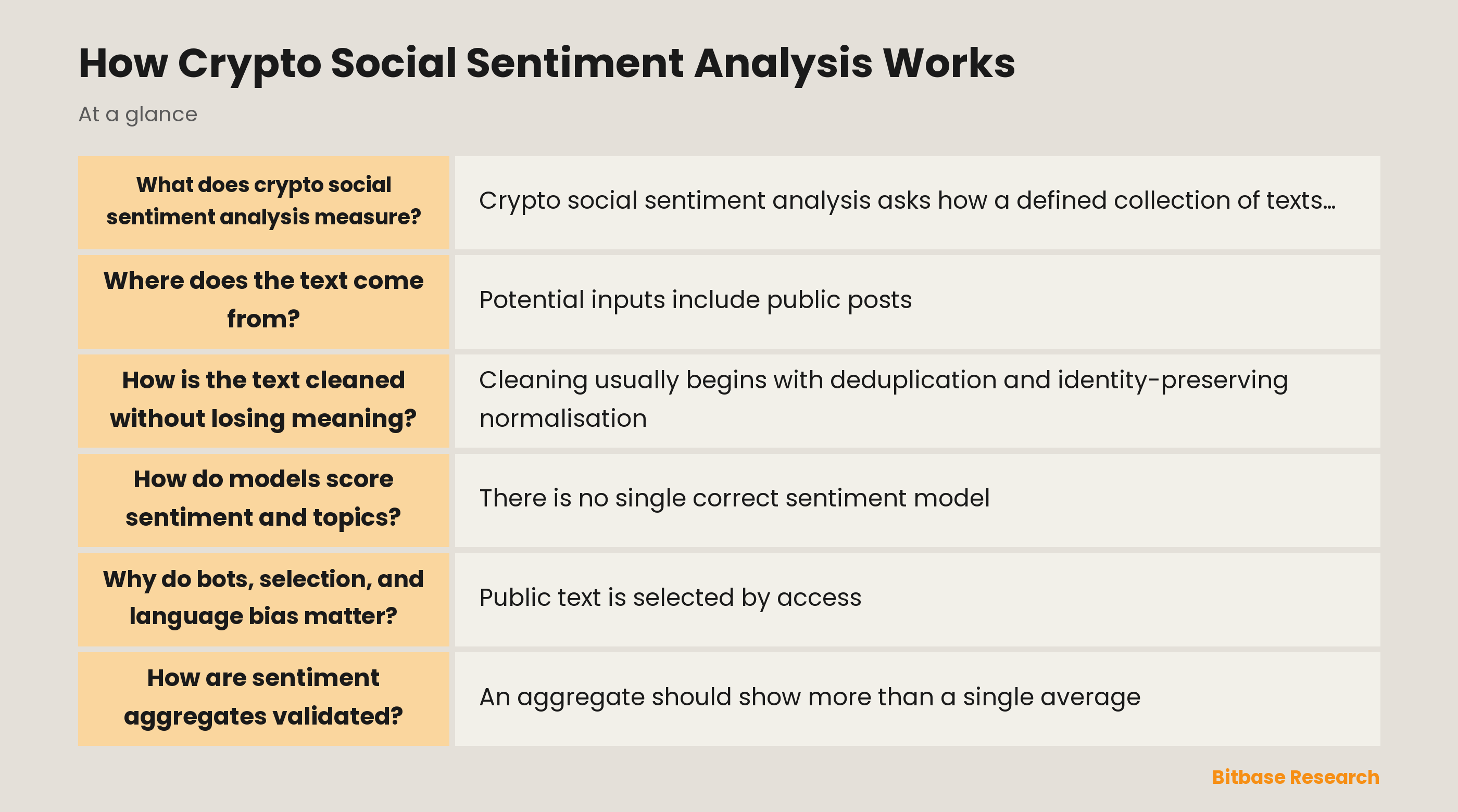
What does crypto social sentiment analysis measure?
Crypto social sentiment analysis asks how a defined collection of texts expresses an attitude toward a defined subject at a defined time. The subject might be a protocol, a policy question, a market event, or a general theme. The output can be a class such as positive, neutral, or negative, a continuous score, a confidence estimate, or a distribution across several labels. Those are properties of the measurement system, not facts that exist inside the text waiting to be discovered.
The distinction matters because language can describe, quote, joke, speculate, or criticize without expressing the author’s own view. A post that repeats a bullish claim in order to challenge it may contain positive words while communicating doubt. A headline may describe a fall without expressing an emotion. A sarcastic sentence can invert the literal meaning. The model therefore needs a target definition and a labelling policy before it can produce a number.
The first design document should state the unit of analysis, the time zone, the language coverage, the inclusion rules, and the label set. It should also say whether the result represents documents, authors, channels, or estimated readership. Counting documents is not the same as measuring people. Aggregating high-volume accounts without a weighting rule can turn repetition into a false impression of consensus.
Where does the text come from?
Potential inputs include public posts, public channel messages, search interest, and news headlines or articles that a researcher is allowed to collect and use. The phrase crypto x sentiment analysis may refer to public microblog posts, but an API or archive is never the whole conversation by default. The phrase telegram sentiment analysis crypto raises a similar issue: channel visibility, message access, language, forwarding, and moderation rules define the observed sample. A data source should be recorded with its access date and coverage, not described as the market’s complete voice.
Google Trends is a different kind of input. It reports anonymised, aggregated and normalised search interest, so a value is relative to a selected time and geography rather than a count of unique people. A search term also differs from a topic: an exact string captures one wording, while a topic may group related searches. That distinction can change the apparent level of attention. Search interest is an attention measure, not a sentiment label, unless a separate and documented model maps queries to sentiment.
News text needs its own sampling rule. A headline, a lead paragraph, an opinion column and a reported quote do not carry the same editorial function. The phrase crypto news sentiment analysis should therefore specify whether it classifies headlines, full articles, sentences, or entities within articles. It should record publication time, event time when available, language, duplication, corrections, and whether a text is reporting another speaker’s words. Access rights and retention rules are part of the method, not an afterthought.
How is the text cleaned without losing meaning?
Cleaning usually begins with deduplication and identity-preserving normalisation. Reshares, quoted posts, syndicated headlines, copied channel messages, URL-only entries, and repeated bot templates can dominate a sample. Removing every duplicate may erase genuine diffusion; keeping every copy may measure distribution mechanics instead of sentiment. A reproducible pipeline should retain an original identifier, assign a duplication or near-duplication flag, and explain whether aggregation is document-weighted, author-weighted, or both.
The text can then be normalised for URLs, user mentions, cashtags, hashtags, emojis, punctuation, elongated words, spelling variants, and mixed scripts. These tokens are not automatically noise. A hashtag may identify a topic, an emoji may carry affect, repeated punctuation may indicate emphasis, and a ticker-like token may disambiguate an entity. The safe approach is to preserve raw text, create a documented analysis representation, and test whether each transformation changes the label distribution.
Language detection, translation, tokenisation, and negation handling deserve separate checks. Translating everything into one language can make the workflow easier to describe but may flatten slang, sarcasm, or culturally specific expressions. Negation can reverse a phrase, while a quoted sentence can belong to someone other than the author. Timestamps should be normalised before windows are compared, and entity resolution should distinguish a project name, a general word, and an unrelated abbreviation. Cleaning is a measurement choice, not a neutral prelude.
How do models score sentiment and topics?
There is no single correct sentiment model. A lexicon or rule system can be transparent and inexpensive, but it may miss context, new slang, irony, and domain-specific meanings. A supervised classifier can learn from annotated examples, but its performance depends on the label instructions, annotator agreement, class balance, and whether the examples resemble the new sample. A transformer or other language model can capture richer context, yet it still inherits the data, labels, language coverage, and calibration assumptions used to build and test it.
Sentiment should be separated from topic, stance, emotion, and engagement. Topic answers what the text is about. Stance asks whether the author supports, rejects, or is undecided about a target. Emotion can distinguish fear, anger, optimism, or amusement. Engagement counts reactions or reach. A message can be highly engaged, clearly about a topic, and impossible to classify confidently as positive or negative. Reporting one score without these dimensions hides the measurement decision.
The label policy should cover mixed and uncertain cases. It should define how to treat a quoted claim, a question, a conditional statement, sarcasm, a comparison, and a post that mentions several targets. Human annotators should see examples and edge cases, and agreement should be reported before a model is tuned to the final corpus. Confidence scores are not universal probabilities; they are meaningful only after calibration and a stated evaluation set. Sentiment is a model measurement, not a fact or a forecast.
Why do bots, selection, and language bias matter?
Public text is selected by access, visibility, language, moderation, user behaviour, and the collection method. People who post often are not necessarily more representative than people who read silently. Public channels are not the same as private conversations. A news corpus reflects editorial selection. Search data reflects people who searched, the wording they used, and the normalisation rules of the tool. These gaps can create a confident score for a population the dataset never observed.
Automation and coordination add another layer. Many near-identical messages may come from one campaign, a bot network, a scheduled feed, or ordinary users repeating a breaking-news phrase. A bot detector can help flag patterns, but it is also a model with false positives and false negatives. Better practice is to report results with and without flagged activity, compare author-level and document-level aggregation, and show how sensitive the conclusion is to down-weighting repeated or high-volume sources.
Language and time drift can change the meaning of a score. New slang, translations, memes, entity names, and platform conventions can make yesterday’s features less useful. A model trained on general English may not transfer to crypto language, and a model trained on one language may not transfer to another. Quality checks should use time-based holdouts, language-specific examples, and periodic re-annotation. When a score changes, the analyst should ask whether sentiment changed or the instrument changed.
How are sentiment aggregates validated?
An aggregate should show more than a single average. Useful fields include the observation window, source mix, document and author counts, label shares, uncertainty, missingness, duplicate rate, language distribution, and the rule used to weight sources. A median or trimmed summary can reveal whether a result is driven by a small number of extreme documents. Separate source panels can show whether public posts, search interest, and news text are moving together or merely being displayed on the same chart.
Validation begins with a held-out sample labelled by humans under the same policy used for training. Report class-specific precision and recall, confusion patterns, calibration, and agreement among annotators. Then test stability across languages, topics, time periods, and source types. An aggregate that looks strong on a random split can fail on a later event, a new phrase, or a different language. Time-aware evaluation is especially important when the intended use is monitoring change.
External comparison can improve diagnosis but cannot manufacture truth. Compare the score with an independently coded event list, a second annotation round, a topic-only volume measure, or a source that uses a different collection process. If sentiment and attention diverge, keep both observations. If a result disappears after deduplication or author weighting, report that sensitivity instead of choosing the more dramatic chart. Reproducibility requires the query, window, filters, model version, label policy, and exclusions to be saved with the result.
Why sentiment is not a trading signal
Sentiment is downstream of language and measurement choices. A positive score may mean that positive words were classified as present, not that authors are informed, sincere, numerous, or correct. A negative score may reflect a warning, a quoted rumour, or a discussion of a past event. The score can also move because the source mix, vocabulary, access method, or model changed. None of these interpretations is a forecast.
Online attention can react to the same news that moves other observations, and different sources can react at different times. A correlation between a sentiment series and a later outcome may be sensitive to the sample, the window, the lag, the event selection, and the model. Earlier academic comparisons of online sentiment, news, and search data also warn that measurement and instrument effects can be difficult to separate. One study result is not a universal rule for crypto, and a backtest would still not turn a model label into a dependable decision rule.
The responsible conclusion is narrower: social sentiment analysis can help describe language, attention, themes, disagreement, and uncertainty in a defined corpus. It can support research questions and monitoring when the sampling frame, model, validation, and limitations are visible. It cannot replace primary evidence, establish a claim as true, or directly produce a directional action. Treat the output as a conditional measurement with an audit trail, not as a shortcut around reasoning.
Disclaimer: This article is educational content from Bitbase Academy, provided for information only. It does not constitute investment, trading, tax, or financial advice. Crypto assets are volatile; assess your own risk. Written as of August 2026; refer to the latest official information.
References
[1] Google Trends: FAQ about Google Trends data support.google.com
[2] Google: Text classification guide developers.google.com
[3] scikit-learn: Model evaluation scikit-learn.org
[4] NIST: AI Risk Management Framework nist.gov