Crypto Twitter, often shortened to CT, is a social layer where people discuss protocols, markets, culture and narratives in public. It can surface useful explanations quickly, but it can also reward confidence, repetition and emotional alignment rather than evidence. Shilling is the more specific label for promoting an asset or project, often for personal benefit or without making the relationship clear. The same post can contain research, enthusiasm and promotion at once. The useful skill is separating those layers without treating every mention as a sales pitch or every popular claim as research.
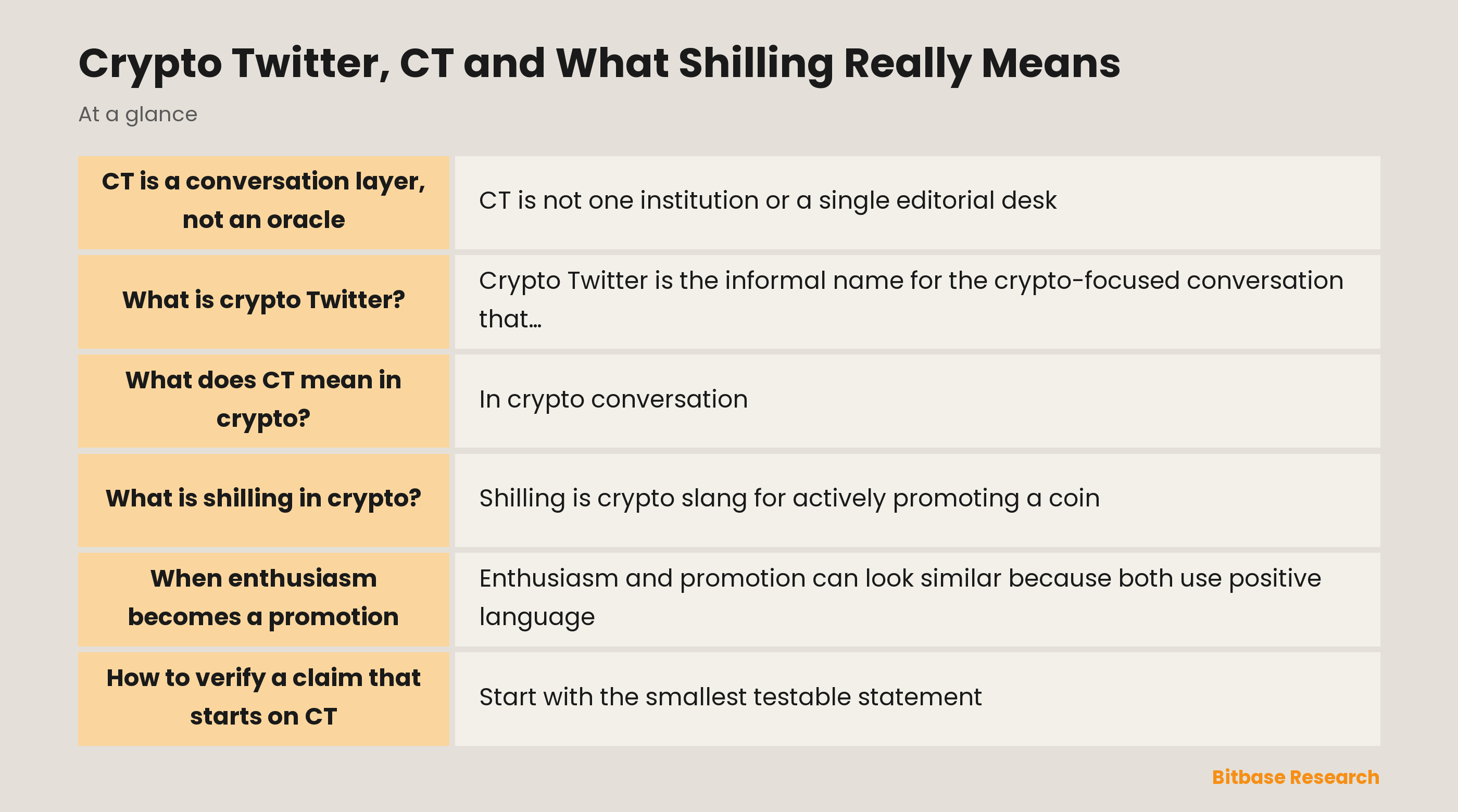
CT is a conversation layer, not an oracle
CT is not one institution or a single editorial desk. It is a loose network of public posts, replies, communities and private references that changes as people join, leave and move between topics. The abbreviation is useful because it names a culture, not because it guarantees a common standard of quality.
The culture has real strengths. Builders can explain a design choice directly, researchers can share a lead, and readers can compare competing interpretations in near real time. The speed also creates a useful record of how a narrative forms, which questions people are asking and where disagreement sits.
The same speed creates weaknesses. A confident claim can travel before its source is checked, a repeated phrase can look like independent confirmation and a dramatic chart can replace a description of the underlying mechanism. A social feed is evidence about what people are saying; it is not automatically evidence that what they say is true.
What is crypto Twitter?
Crypto Twitter is the informal name for the crypto-focused conversation that grew around short public posts and the communities connected to them. It includes traders, developers, researchers, founders, journalists, educators, meme accounts and casual readers. These groups overlap, but they do not share the same incentives or standards.
The term describes a social environment more than a technical feature. A post can be a technical explanation, a personal diary, a community ritual, a joke, a marketing message or a request for attention. The same account can switch roles from one post to the next, so the label “CT” does not identify a reliable source by itself.
CT also has its own vocabulary and status signals. Short phrases can imply that the reader belongs to an inside conversation, while screenshots, follower counts and reposts can make a claim look established. These signals explain how information travels, but they do not verify the claim’s accuracy.
A reader can use CT as a discovery layer: find a question, a source, a project document or a disagreement, then move to material that can be checked independently. Treating the feed as the final research layer reverses that order and turns popularity into a substitute for verification.
What does CT mean in crypto?
In crypto conversation, CT usually means Crypto Twitter. It can refer to the people participating in the conversation, the culture they create or the stream of narratives moving through the community. The intended meaning normally comes from context: “CT likes this” describes a perceived community mood, while “I saw it on CT” describes a discovery path.
The phrase is not a membership card. There is no single CT position on a protocol, asset or policy. Different subgroups can support competing theses and use the same vocabulary for opposite purposes. A post that says “CT is bullish” may describe a narrow corner, a short-lived trend or the author’s own audience.
CT language also changes over time. New abbreviations emerge, old jokes acquire new meanings and a term can move from sincere description to irony. A reader should ask whether the author is reporting an observation, making a prediction, selling an identity or inviting a transaction.
The safest interpretation is modest: CT is a source of leads, sentiment and social context. It is not a credential, a consensus mechanism or a replacement for primary documents, independent analysis and direct checks of the claim.
What is shilling in crypto?
Shilling is crypto slang for actively promoting a coin, token, project or idea, often because the promoter expects a personal benefit. The word usually carries a negative meaning when the promotion is exaggerated, one-sided or hidden behind the appearance of an ordinary user’s independent enthusiasm.
Promotion is not automatically shilling. A disclosed review, an official announcement, a clearly labeled advertisement or a person explaining why they use a product can be ordinary communication. The label becomes more appropriate when the relationship, incentive or intended action is obscured while the message tries to create demand or social proof.
Shilling can take several forms. It may repeat only positive claims, present a short-term narrative as inevitable, use urgency to discourage questions, recruit other accounts to repeat the same message or show selective screenshots without the missing context. None of these patterns alone proves fraud, but each is a reason to slow down and verify.
The neutral translation is “a promotional message with a possible incentive.” Ask who benefits if attention or demand increases, whether the speaker disclosed a financial or personal relationship, what evidence would count against the claim and whether the message explains risks as well as upside. That process is more useful than arguing over the label.
When enthusiasm becomes a promotion
Enthusiasm and promotion can look similar because both use positive language. The difference is not whether the speaker sounds excited. It is whether the message is trying to influence an action, whether the speaker has an interest in the result and whether the audience can see that interest clearly.
Disclosure should be easy to notice and close to the endorsement itself. Rules differ across jurisdictions and products, so a single label is not a universal compliance answer. The broader reader lesson is simple: do not assume a relationship is absent just because it is not stated, and do not assume a disclosure makes the underlying claim true.
A good disclosure also does not repair weak evidence. A person can honestly say they hold an asset and still be wrong about its design, supply, adoption or risks. Readers should evaluate the claim separately from the speaker’s honesty about incentives.
The reverse is also true. An undisclosed interest is a serious reason to question a promotion, but it does not tell you whether every factual sentence is false. Separate the communication problem from the technical or market question so that criticism remains precise.
How to verify a claim that starts on CT
Start with the smallest testable statement. “The community loves this project” is a mood claim; “the protocol released a specified upgrade on a stated date” is a factual claim; “this will outperform” is a prediction. Each needs a different kind of evidence, and none is proved by the number of reposts.
Then trace the claim to the closest primary material available. Check the project’s own technical documentation against independent analysis, inspect dates and versions, and distinguish a completed feature from a roadmap intention. For market claims, identify whether the post is describing an observation, a personal position or a forecast.
The search question “what is crypto twitter” usually asks for the social meaning of the term, not a list of accounts to follow or a promise that the community is reliable.
The query “what does ct mean in crypto” asks what the abbreviation refers to and how people use it to describe a community or its mood.
The query “what is shilling in crypto” asks about promotional behavior and possible incentives, not a test that can identify every enthusiastic post.
Finally, write down what would change your mind. If the post cannot state a condition that would count against it, it may be functioning as identity or persuasion rather than analysis. Keep the source, date and uncertainty with the claim so it can be rechecked when the narrative changes.
The bottom line
Crypto Twitter or CT is a fast-moving social conversation, not a truth machine. Shilling is promotional behavior that becomes especially concerning when incentives, evidence or risk are hidden. Use CT to discover questions and competing views, then verify the underlying claim, the speaker’s incentives and the conditions that could prove it wrong.
Disclaimer: This article is educational content from Bitbase Academy, provided for information only. It does not constitute investment, trading, tax, or financial advice. Crypto assets are volatile; assess your own risk. Written as of August 2026; refer to the latest official information.
References
[1] Babypips Decryptopedia: Shill babypips.com
[2] CoinGecko Glossary: Shilling coingecko.com
[3] Ledger Academy: What is Crypto Shilling ledger.com
[4] FTC: Disclosures 101 for Social Media Influencers ftc.gov
[5] FCA: Cryptoasset financial promotions fca.org.uk
[6] Deciphering Crypto Twitter arxiv.org