
People sometimes use the phrase cult coin for a crypto asset whose public identity seems to be carried by unusually intense community language, recurring symbols, and strong group belonging. The phrase is informal and often contested. It may be used approvingly, critically, ironically, or simply as shorthand for a visible style of participation. Its usefulness is therefore limited: it can describe a social impression, but it does not classify a protocol, prove a governance arrangement, or establish who controls anything.
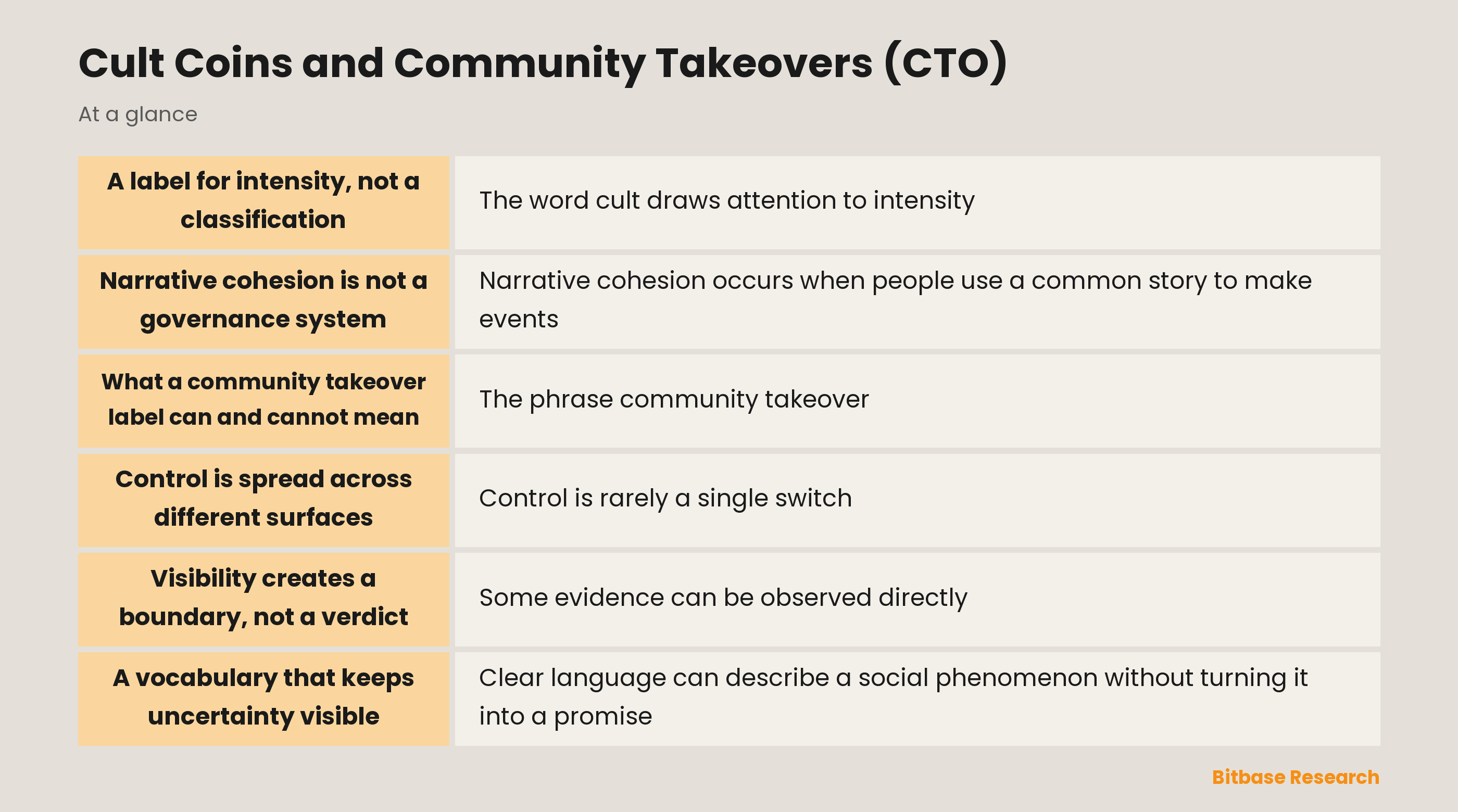
A label for intensity, not a classification
The word cult draws attention to intensity, repetition, and perceived loyalty. In a community setting, those features can appear through shared language, rituals of recognition, recurring narratives, or a strong distinction between insiders and outsiders. None of those signals is exclusive to one type of asset or one technical design. They are social features that can be interpreted differently by different observers.
That is why the question what is a cult coin is better treated as a request for careful vocabulary than as a request for a fixed category. A label may capture the tone of a conversation while leaving the underlying system undefined. It says little on its own about the software, the decision rules, the rights attached to any instrument, or the relationships among the people who take part in discussion.
The label also compresses many possible roles into one image of a community. A person can follow a narrative, contribute to conversation, maintain an information channel, write software, operate infrastructure, or hold a formal role. These are not interchangeable positions. Calling all of them evidence of a single unified community hides the differences that matter when control or responsibility is being discussed.
Narrative cohesion is not a governance system
Narrative cohesion occurs when people use a common story to make events, symbols, and decisions feel connected. It can help a dispersed group recognize a shared frame of reference, especially when messages move quickly across many channels. A coherent narrative can make participation feel continuous even when the people involved do not know one another and have no formal relationship.
That social cohesion is not the same thing as a governance system. Governance concerns the rules, practices, and processes through which a system is directed or controlled. It may involve code, formal decision procedures, operational roles, contractual arrangements, or several of these at once. A compelling story can accompany those arrangements, but the story does not demonstrate that they exist or reveal how they work.
Narratives can also survive changes in participation. A message may be repeated after its original context has shifted, and a familiar slogan can signal continuity without identifying who is making decisions. This is one reason that high engagement should be read as evidence of attention or expression, not as a direct measure of authority, consent, or collective capacity to act.
What a community takeover label can and cannot mean
The phrase community takeover, often shortened to CTO, is similarly informal. It may be used when participants describe a period of continuity after a visible change in public presence, communication, or social coordination. It can also be a retrospective story that gives a dispersed set of actions a common name. The phrase does not have one universal technical, legal, or organizational meaning.
A search phrase such as what is a community takeover crypto points to this ambiguity. It may refer to a change in who speaks publicly, who moderates a channel, who contributes to an open discussion, or who claims to continue an idea. None of those possibilities automatically means that authority over a protocol, a decision mechanism, an organization, or any assets has changed hands.
The strongest distinction is between a claim of continuity and a verified transfer of control. A group may be socially active while the relevant decision rights remain elsewhere, are divided among several participants, or are not observable from public information. Conversely, a documented change in one layer of a system does not settle every other layer. CTO is therefore a label to interpret, not a conclusion to inherit.
Control is spread across different surfaces
Control is rarely a single switch. Technical influence can arise in software maintenance, the acceptance of updates, the operation of network infrastructure, or formal decision procedures. Communications influence can arise in moderation, publishing, and the ability to set a public agenda. Organizational influence can arise in agreements, roles, access arrangements, or legal responsibilities that may not be visible in a public discussion.
These surfaces can overlap, but they need not. Someone who is prominent in a social channel may not have the ability to change software or direct a network. Someone with a technical role may not define the public narrative. A visible vote may show that a procedure occurred, but its significance depends on the rules behind it, the scope of the vote, and the relationship between that procedure and other sources of influence.
Distributed participation does not mean that influence disappears or that it is shared equally. It means that an account of control must name the layer being discussed and avoid moving silently from one layer to another. A statement about communication, for example, should not become a statement about technical authority merely because the same people appear in both conversations.
Visibility creates a boundary, not a verdict
Some evidence can be observed directly. Where a system records an action in a publicly inspectable form, that record may show that the action occurred within the scope of that system. Public documentation can also make a stated rule, proposed change, or published role easier to inspect. Such material helps describe a visible surface of governance.
Yet visibility has a boundary. A record may not identify a real-world person, reveal informal coordination, show the full set of access arrangements, or explain why a decision was made. Public conversation can show that people are speaking, but it cannot by itself establish their authority, their independence, the completeness of the information they use, or the consent of everyone affected.
This boundary matters most when a label sounds decisive. The existence of a public channel, a recurring narrative, or an observable action can support a narrow statement about what is visible. It cannot, without further evidence, settle whether a community takeover happened in a broader sense. The difference between an observable event and a broad conclusion should remain explicit.
Reading claims without converting them into conclusions
Claims about community control often combine four different things: a label, an event, a piece of evidence, and an inference. The label may be CTO. The event may be a change in visible communication. The evidence may be a public record or statement. The inference may be that a whole community now governs a system. Keeping those parts separate makes the description more accurate without requiring a verdict.
A claim becomes more interpretable when it specifies the layer to which it refers. A statement about an account, a discussion space, a published proposal, or a software change can be described at that level. The statement becomes less reliable when it silently expands into a claim about every technical, organizational, and legal relationship connected to a community.
Silence and absence also need careful treatment. A public record that does not show a role cannot establish that the role does not exist, and a visible participant cannot establish that all relevant participants are visible. Public evidence is useful because it limits what can be responsibly asserted. It does not erase the difference between partial observation and complete knowledge.
A vocabulary that keeps uncertainty visible
Clear language can describe a social phenomenon without turning it into a promise. Terms such as narrative, supporter network, public communication, technical influence, decision procedure, and observable record point to different things. They make it easier to say what is being seen and what remains unknown, rather than using one broad label to stand in for all of them.
In that vocabulary, a cult coin is a description of perceived intensity around an asset, not a diagnosis of its participants or a statement about its structure. A community takeover is a claim about a change in social or operational presence whose meaning depends on the layer being named. Neither phrase proves a unified community, a transfer of authority, or a settled outcome.
This distinction preserves the most useful part of the discussion: communities can shape attention, language, and coordination while still leaving important questions unanswered. The durable question is not whether a label sounds persuasive. It is which kind of activity is visible, which kind of control is actually being claimed, and where the available evidence stops.
Disclaimer: This article is educational content from Bitbase Academy, provided for information only. It does not constitute investment, trading, tax, or financial advice. Crypto assets are volatile; assess your own risk. Written as of August 2026; refer to the latest official information.
References
[1] NISTIR 8202: Blockchain Technology Overview nvlpubs.nist.gov
[2] FSB: Crypto-asset Activities and Markets Recommendations fsb.org
[3] FATF: Risk-Based Approach to Virtual Assets fatf-gafi.org
[4] IOSCO FR14/23: DeFi Policy Recommendations iosco.org