
An exchange bankruptcy changes the language needed to describe customer assets. Before a proceeding, an account balance can feel like a direct statement of ownership and availability. In a legal proceeding, that balance is only one part of a larger record. The questions become more precise: which entity operated the account, what relationship did the account terms describe, which assets were held or controlled by that entity, and what records identify a customer’s interest? The phrase exchange bankruptcy customer assets therefore points to legal and factual relationships, not to a single technical status. An on-chain address, a platform ledger, and a customer-facing balance may all be relevant, yet none alone settles every question.
Why a Bankruptcy Proceeding Changes the Question
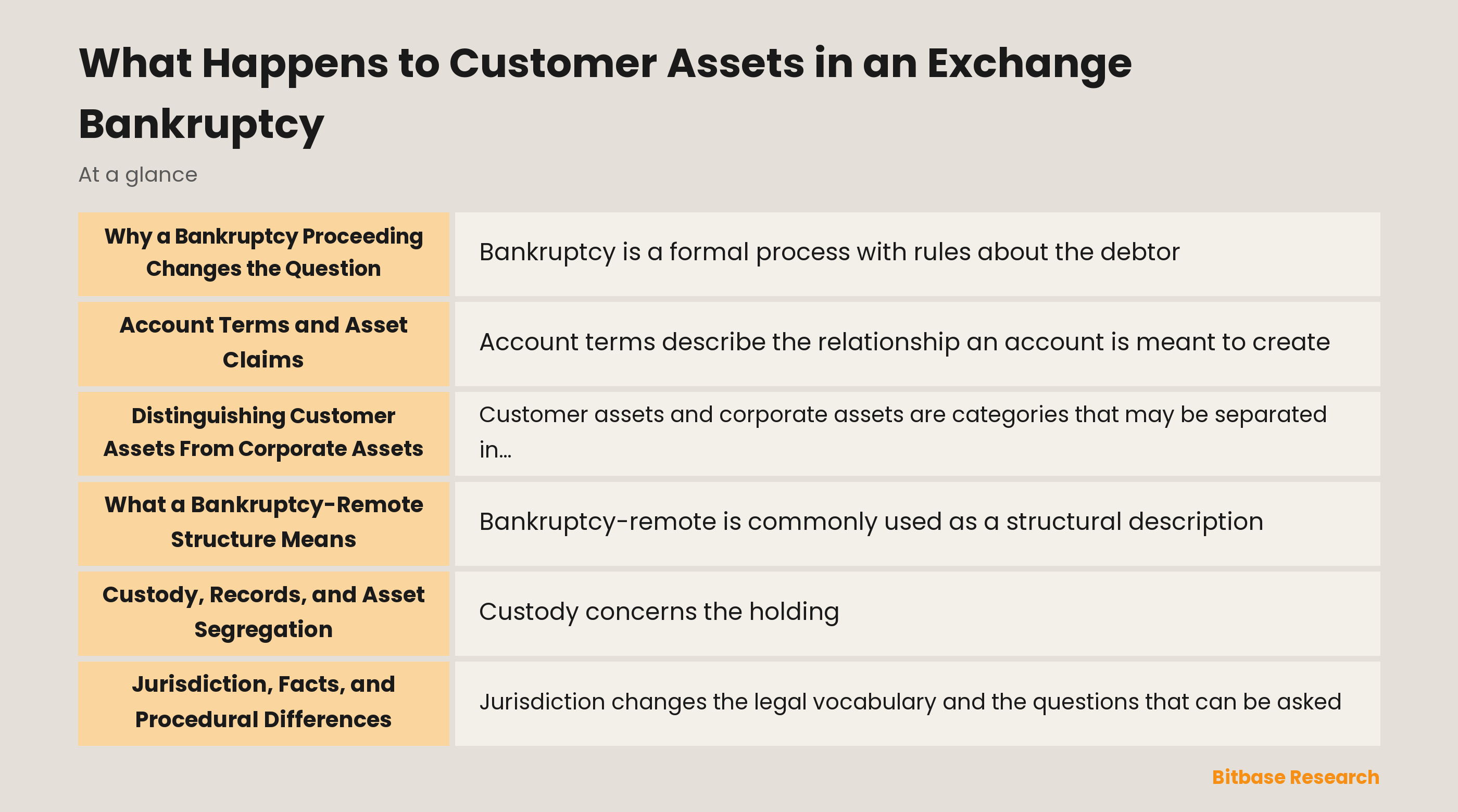
Bankruptcy is a formal process with rules about the debtor, its property, its contracts, and the court’s authority. That setting changes an everyday question such as “where are the assets?” into several narrower questions about legal interests, possession, control, and documentation. The proceeding is not simply an interruption to a service. It supplies a legal framework in which the company’s position and the position of other parties are examined under the law that applies to that entity and case.
The same word can carry different meanings inside and outside that framework. A customer may use “my assets” to describe the balance shown in an account. A company’s records may use a different category to describe assets it holds, administers, owes, or can use. A court-facing analysis may focus on still other terms, such as legal title, beneficial interest, agency, trust, or contractual rights. Keeping those layers distinct makes it easier to understand why a familiar balance screen cannot, by itself, answer a legal question.
Account Terms and Asset Claims
Account terms describe the relationship an account is meant to create. They can identify the contracting entity, the services offered, the treatment of deposited assets, the use of sub-custodians, and the limits placed on the provider or the customer. The terms may use words such as custody, safekeeping, agency, lending, title, or control. Those words matter because they frame the intended relationship, but their practical effect depends on the governing law and on the full agreement rather than on an isolated sentence.
Records give those terms an operational context. An account identifier, a transaction history, internal ledger entries, wallet designations, and reconciliation practices may help show how a relationship was administered. They do not all answer the same question. A record that identifies an asset movement is different from a record that identifies the customer associated with that movement, and both differ from a document that defines the legal relationship. The meaning of an account is therefore drawn from a connected body of terms and evidence, not from a label alone.
Distinguishing Customer Assets From Corporate Assets
Customer assets and corporate assets are categories that may be separated in operational systems, contracts, and legal analysis. Corporate assets are assets in which the company has its own interest or which it may use for its own business under the applicable arrangements. Customer assets are assets recorded or held in connection with customers. The distinction matters because a company may perform custody or administrative functions without that fact alone describing the whole nature of the customer’s interest.
Several concepts can overlap without being identical. Legal title concerns formal ownership under law, beneficial interest concerns who receives the benefit of an asset, possession concerns who has physical or technical custody, and control concerns who can direct a relevant action. Separate accounting can make these relationships more visible, but an accounting entry does not automatically settle every legal characterization. The relevant documents, the actual handling of assets, and the applicable legal framework remain part of the analysis.
What a Bankruptcy-Remote Structure Means
Bankruptcy-remote is commonly used as a structural description, not as a universal legal classification or a guaranteed result. It can refer to arrangements designed to keep a set of assets, an account relationship, or a separate entity distinct from the financial condition of another entity. The design may involve separate entities, separate records, limited-purpose arrangements, account titling, contractual restrictions, or defined roles for custodians and service providers. Each feature describes an element of architecture rather than a complete conclusion.
A request framed as crypto custody bankruptcy remote explained is best understood as a request to separate architecture from outcome. A structure described as bankruptcy-remote may still depend on the actual documents, the identity and role of every entity, the handling of assets, and the law governing the arrangement. The phrase does not mean that an account is outside every proceeding, that assets have one predetermined treatment, or that records cannot be examined. It describes a design objective whose significance must be assessed in its own legal and factual setting.
Custody, Records, and Asset Segregation
Custody concerns the holding, safeguarding, or control of assets for another person or entity. It can be performed through individual wallets, omnibus wallets that contain only customer assets, internal ledger accounts, or a combination of on-chain and off-chain records. An omnibus arrangement does not by itself say that customer interests are indistinguishable. Its clarity depends on whether the records and audit trail reliably identify the customer interests associated with the pooled assets.
Segregation and separate accounting describe ways of keeping customer-related assets and records distinct from corporate assets and records. They can make the boundaries of a custody arrangement more legible and can support reconciliation between different records. They are not interchangeable with a legal conclusion. On-chain activity may show transfers involving an address, while internal records may associate activity with particular accounts, and agreements may explain the roles of the entities involved. Understanding the three layers together avoids treating any one record as complete on its own.
Jurisdiction, Facts, and Procedural Differences
Jurisdiction changes the legal vocabulary and the questions that can be asked. Insolvency law, property law, contract law, financial-services regulation, and court procedure differ across countries and can differ within a country. The location and legal identity of the relevant entity, the governing-law clause of an agreement, the location of records, the role of an intermediary, and the kind of asset involved can all matter. Cross-border arrangements can add more than one legal system to the same factual picture.
Facts also matter at a fine level of detail. Similar account labels can sit above different custody arrangements, and similar technical designs can sit inside different legal entities or agreements. Regulatory requirements may establish expectations for a defined population of firms without controlling every other arrangement. A general explanation cannot convert those variables into a single answer. It can only show why careful wording distinguishes a custody structure, a contractual description, a recordkeeping practice, and a legal determination.
Neutral Terms and Legal Boundaries
Neutral language reduces the risk of treating a description as a decision. Words such as held, recorded, controlled, segregated, custodied, and beneficial interest describe different aspects of an arrangement. They should not be silently substituted for words such as owned, excluded, protected, or owed. The distinction is especially important when a technical fact, such as a wallet address or a balance display, is being discussed alongside a legal fact, such as the nature of an entity’s interest in an asset.
This article maps general concepts rather than deciding any person’s rights or predicting any proceeding’s result. Jurisdiction, the governing agreement, the entity structure, the actual custody records, and the verified facts can change the legal analysis. The discussion is educational and does not establish a legal, tax, or estate-planning conclusion. It avoids treating exchange bankruptcy customer assets as a promise about treatment and treats crypto custody bankruptcy remote explained as a question of structure, terminology, and context.
Disclaimer: This article is educational content from Bitbase Academy, provided for information only. It does not constitute investment, trading, tax, or financial advice. Crypto assets are volatile; assess your own risk. Written as of August 2026; refer to the latest official information.
References
[1] U.S. Code: 11 USC 541, Property of the Estate uscode.house.gov
[2] U.S. Courts: Process - Bankruptcy Basics uscourts.gov
[3] New York DFS: Updated Guidance on Custodial Structures for Customer Protection in the Event of Insolvency dfs.ny.gov
[4] OCC Interpretive Letter 1170: Authority of a National Bank to Provide Cryptocurrency Custody Services occ.treas.gov