Decentralized identity is a way to separate identification, credential issuance, storage, and verification so that no single login provider has to be the permanent gatekeeper for every interaction. Decentralized identifiers, or DIDs, can help an entity prove control of an identifier, while verifiable credentials, or VCs, carry claims signed by an issuer. The useful mental model is not a magic identity owned by a wallet. It is a trust workflow: an issuer makes a claim, a holder stores and presents it, and a verifier checks the proof, status, context, and policy. This article explains that workflow, where blockchain can fit, and why key management, revocation, selective disclosure, and data protection remain essential.
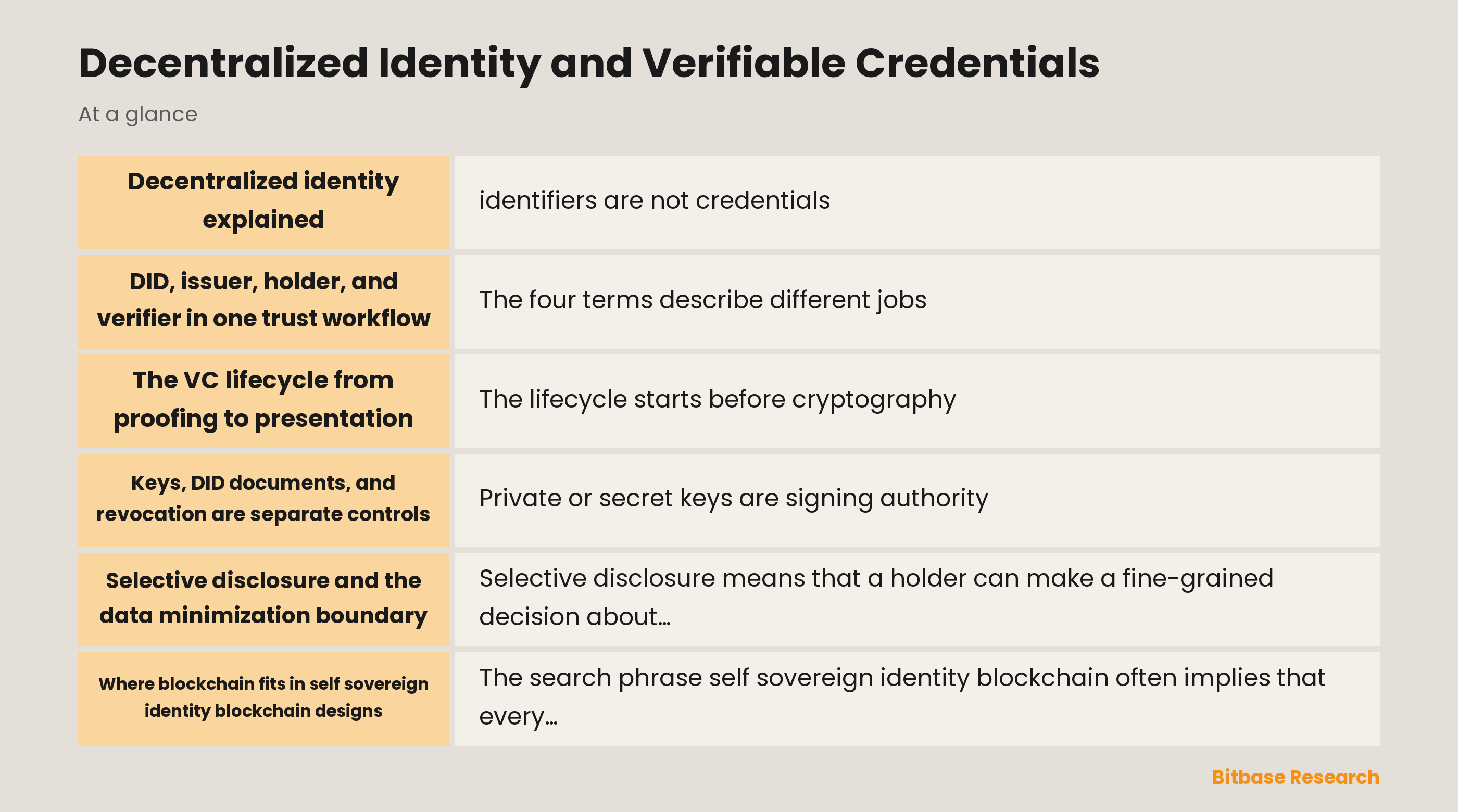
Decentralized identity explained: identifiers are not credentials
The phrase decentralized identity explained is easiest to understand if identity is split into layers. A DID is an identifier that can resolve through a DID method to a DID document or related resource. The document can describe verification methods, services, and the relationships for which a key may be used. A VC is different: it is a set of claims made by an issuer about a subject, packaged so that a verifier can check its authorship and integrity. A DID may identify a person, organization, device, or service, but a DID alone does not prove a person's age, education, employment, or legal status.
This separation prevents a common overstatement. Decentralized does not mean anonymous, untraceable, or outside regulation. A credential can be strongly bound to a real-world proofing process, and a verifier can still be required to apply its own eligibility, fraud, sanctions, or access rules. A DID method can also depend on a centralized service, a federated system, a database, a distributed ledger, or another registry. The design question is who controls the identifier, who makes the claim, who can update the associated keys, and which party is allowed to rely on the result.
DID, issuer, holder, and verifier in one trust workflow
The four terms describe different jobs. The issuer is the authority or organization that asserts a claim and creates a credential. The holder possesses the credential, often in a wallet or other protected repository, and decides when to present it. The verifier receives a credential or verifiable presentation and checks the securing mechanism, issuer, subject, validity period, status, and the request's business purpose. The subject is the entity the claim is about. The holder and subject are often the same person, but a parent can hold a credential about a child, or an organization can hold credentials about a device.
A DID document can help a verifier discover the public verification material associated with an issuer or holder. Data Integrity proofs can bind a proof to a verification method and a stated purpose, but a successful signature check is not the same as accepting every claim. The verifier still needs a trust decision: is this issuer recognized for this type of claim, is the credential schema appropriate, is the presentation fresh, and is the requested disclosure proportionate? NIST describes this as separating cryptographic verification from the validation and assessment of the claims.
The VC lifecycle from proofing to presentation
The lifecycle starts before cryptography. During enrollment or identity proofing, an issuer decides what evidence is sufficient and what assurance level the use case requires. It then creates claims about a subject, adds metadata such as type and validity, and secures the credential using a compatible mechanism. The wallet or repository protects the holder's copy. At presentation time, the holder creates a presentation for a particular verifier, possibly using one credential or a set of credentials and possibly disclosing only selected claims.
Verification is a sequence, not a single green tick. A verifier parses the document, checks the data model and securing mechanism, resolves the relevant verification material, validates the proof purpose and any holder binding, checks the credential's validity period, and performs a status check when one is present or required by policy. It then evaluates whether the issuer and claims meet the business rule. A credential can be cryptographically authentic but still fail because it is expired, revoked, issued by an untrusted authority, for the wrong subject, or not fit for the requested purpose. Renewal, update, suspension, revocation, and eventual deletion are lifecycle events rather than properties that a blockchain automatically manages.
Keys, DID documents, and revocation are separate controls
Private or secret keys are signing authority. A public key or other verification method lets a verifier test a proof, but it does not let the verifier create a new valid proof. The issuer must protect its signing keys, define which verification relationship each key supports, monitor for compromise, and have a rotation and recovery plan. A holder also needs secure device access, backup or recovery procedures, and a way to distinguish a credential presentation from a request to surrender a wallet secret. Losing a key can affect access; exposing a secret key can allow impersonation until the ecosystem detects and responds.
Three clocks must not be confused. A proof can have creation and expiration times, a credential can have validFrom and validUntil, and a verification method can be rotated, revoked, or allowed to expire because its key is compromised. Credential status is a different signal: it can indicate that the privilege or claim represented by a credential is no longer current. A verifier therefore needs to check the status mechanism and its freshness, not just whether a signature mathematically verifies. Status lists, registries, or issuer endpoints can improve operational control, but they also need availability, privacy, integrity, and governance safeguards.
Selective disclosure and the data minimization boundary
Selective disclosure means that a holder can make a fine-grained decision about which information to share. If a service needs to know whether someone is over a threshold, a full date of birth may be unnecessary. A presentation can sometimes carry an abstract claim or a zero-knowledge proof rather than the original attribute. Other profiles use selective-disclosure tokens or proof suites. The exact privacy property depends on the credential format, cryptographic suite, wallet, verifier request, and whether repeated presentations can be linked.
The important boundary is that a DID and a VC do not automatically provide privacy. A stable identifier, a repeated signature, a status lookup, a wallet telemetry event, or a public ledger entry can create correlation. Data minimization therefore starts with the verifier's question: what is the smallest claim needed for this decision, for how long, and who must see it? Designers should avoid putting personal data on an immutable public registry, prefer pairwise or context-appropriate identifiers where supported, reduce retention, protect logs, and make the user understand the party and purpose before sharing. Privacy is an architectural outcome, not a label attached to a wallet.
Where blockchain fits in self sovereign identity blockchain designs
The search phrase self sovereign identity blockchain often implies that every identity record must be on-chain. That is not required by DID Core. A DID method defines how identifiers and their documents are created, resolved, updated, or deactivated, and a verifiable data registry can be a distributed ledger, database, decentralized file system, or another trusted system. Blockchain may be useful for a public, tamper-evident registry of method operations, issuer trust metadata, key rotation events, or compact status information. It can also make shared discovery easier when participants do not want one operator to control the registry.
Blockchain also introduces costs and risks. Public records can be copied, correlated, and difficult to remove; transaction availability and governance can change; a hash does not prove that the original data was accurate; and an immutable anchor does not repair a compromised issuer key. A sound design keeps personal claims and large documents in appropriate protected storage, publishes only the minimum registry data needed, and documents how updates, recovery, migration, and legal requests work. Self-sovereign control is better treated as a set of user and organizational capabilities than as a promise that a chain makes a person independent of issuers, verifiers, or law.
Compliance and a practical verification checklist
Identity systems still have legal and operational obligations. Depending on the jurisdiction and use case, an operator may need a lawful basis, purpose limitation, data minimization, retention controls, access and correction processes, security safeguards, incident response, cross-border transfer controls, and an auditable trust framework. The European Digital Identity Wallet materials emphasize sharing only the agreed information, while NIST identity-proofing guidance shows that validation, revocation checks when available, and authentication assurance are separate steps. These are governance requirements around a technical credential, not features that a DID or blockchain can waive.
For a real integration, ask seven questions. Which DID method and registry are being used, and how are resolution failures handled? Which issuer is trusted for the claim and how was the subject proofed? Which securing mechanism, cryptosuite, key relationship, and presentation binding are required? How are validity, status, rotation, compromise, and recovery checked? Does the request ask for more data than the decision needs, and can the presentation resist replay or correlation? Where are credentials, logs, and status records stored, and how long are they retained? Finally, which regulator, contract, trust list, or internal policy determines whether the verifier may rely on the claim? The phrase verifiable credentials blockchain describes infrastructure possibilities, not a guarantee of truth, privacy, or compliance.
Disclaimer: This article is educational content from Bitbase Academy, provided for information only. It does not constitute investment, trading, tax, or financial advice. Crypto assets are volatile; assess your own risk. Written as of August 2026; refer to the latest official information.
References
[1] W3C: Decentralized Identifiers v1.0 w3.org
[2] W3C: Verifiable Credentials Data Model v2.0 w3.org
[3] W3C: Verifiable Credential Data Integrity 1.0 w3.org
[4] NIST: Digital Identity Guidelines nist.gov
[5] European Commission: European Digital Identity europa.eu