Crypto communities use labels such as diamond hands, paper hands and jeets to describe what someone appears to do when a position becomes uncomfortable. These are social descriptions, not measures of skill, courage or asset quality. A person can hold for the wrong reason, exit for a sensible reason, or be called a jeet simply because the crowd wanted a different answer. The useful question is not which label sounds strongest, but what decision, evidence and risk the label is hiding.
These labels describe behavior, not quality
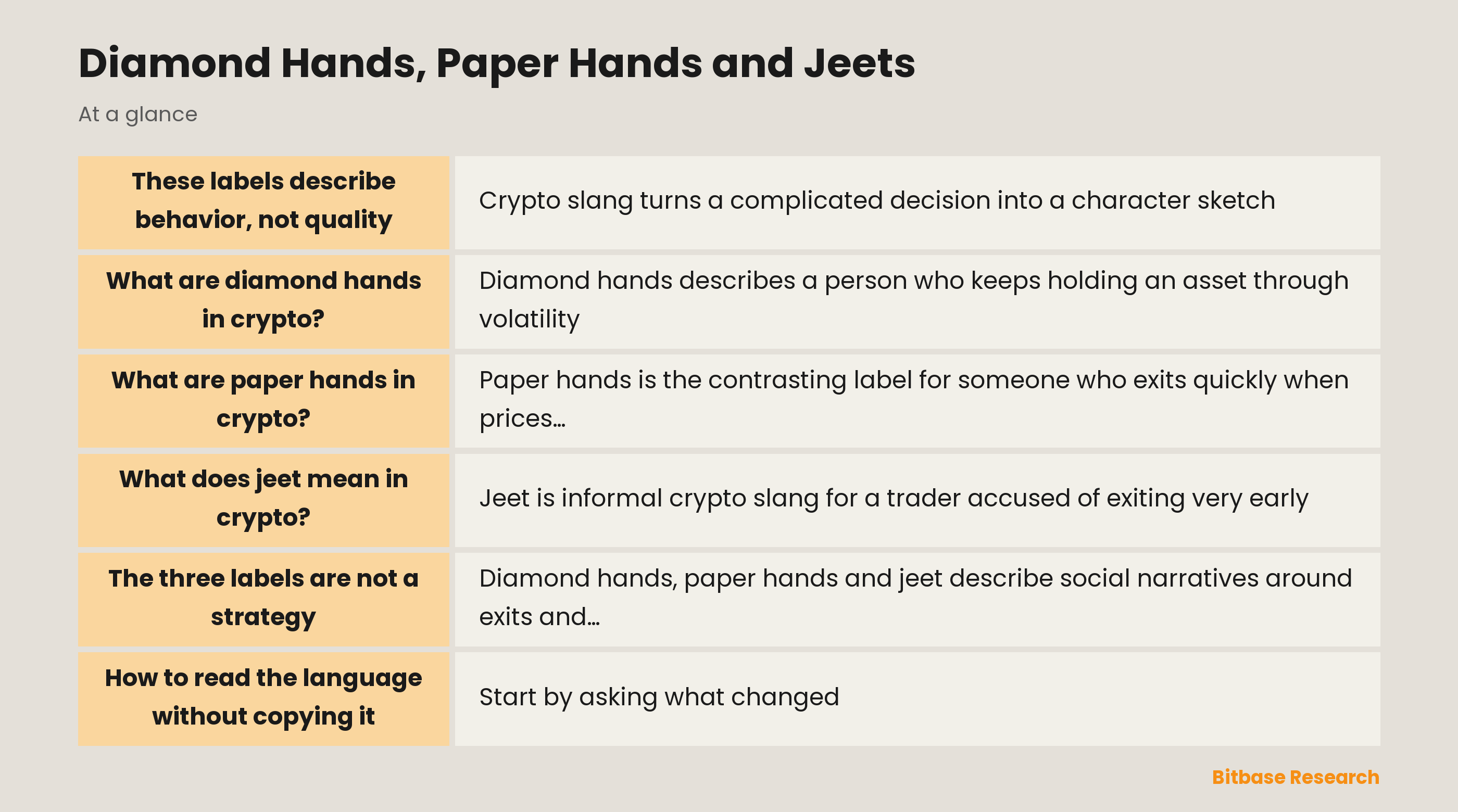
Crypto slang turns a complicated decision into a character sketch. “Diamond hands” sounds durable, “paper hands” sounds fragile and “jeet” sounds impatient. That emotional coloring is part of the point: the words help a group praise persistence, mock an exit or create a shared story about what just happened.
The same action can receive different labels depending on who is speaking. Selling after a thesis changes may be called paper hands by someone who wanted continued support. Holding after the original reason disappears may be called diamond hands by a community that values loyalty. The label does not settle whether the decision was sound.
These terms also move between stocks, memecoins, online forums and other internet communities. Their meanings are informal and can vary by region or group. Read them as clues about tone and social pressure, then translate them into a plain description of the behavior.
What are diamond hands in crypto?
Diamond hands describes a person who keeps holding an asset through volatility, drawdowns or pressure to exit. The image suggests a grip as hard as a diamond. In crypto conversation, it is often close to HODL, but diamond hands emphasizes identity and emotional endurance more than a neutral description of time horizon.
The term can be complimentary. It may describe someone following a documented long-term thesis instead of reacting to every short-term move. It can also be ironic or self-mocking, especially when a person admits that stubbornness kept them in a position after the original evidence weakened.
Holding through volatility is not automatically prudent. An asset can lose liquidity, a protocol can change, an assumption can fail or a personal need for cash can change. A slogan about never selling cannot evaluate those facts, and it cannot turn an uncertain asset into a safe one.
The better translation is therefore conditional: “I am choosing not to exit despite this pressure, and I should be able to explain why.” That explanation should include what would change the thesis, how much loss is tolerable and whether the position still fits the person’s circumstances. Those are decision rules, not proof that diamond hands are superior.
What are paper hands in crypto?
Paper hands is the contrasting label for someone who exits quickly when prices fall, sentiment turns negative or uncertainty rises. The metaphor implies that the hands are weak or easy to tear. In practice, the phrase is often used to shame a person for selling earlier than the speaker wanted.
The label can hide very different decisions. A rushed exit made from panic is not the same as reducing exposure because the investment thesis failed. Selling to meet a real-world obligation is not the same as abandoning a carefully defined plan. Looking only at the outcome makes it impossible to tell which situation occurred.
Paper hands can also be a useful reminder about process if the person chose an exit without checking the facts or without a pre-defined limit. But that lesson is about preparation and emotional regulation, not about proving that every holder should wait longer. A decision that protects capital or preserves liquidity can be reasonable even when a market later rises.
When someone uses the phrase, ask what behavior they mean. Did the person react to a rumor, a verified change, a liquidity problem, a risk limit or a personal need? Replacing the insult with that specific description makes the event easier to evaluate and reduces pressure to perform toughness for an audience.
What does jeet mean in crypto?
Jeet is informal crypto slang for a trader accused of exiting very early, often after a small gain or at the first sign of weakness. It is commonly used in memecoin and fast-moving community conversations, where an early exit can be framed as abandoning a shared narrative or reducing momentum.
Unlike a neutral trading term, jeet is usually pejorative. It can describe a real pattern of short-horizon behavior, but it can also be thrown at anyone who does not follow a group’s preferred holding story. Some explanations connect the word to a derogatory ethnic association; because of that baggage, it should not be used casually to label people.
The behavior itself can have many causes. A trader may be taking a planned small profit, managing a position that is too large, responding to a liquidity change or simply changing their mind. Calling the person a jeet does not reveal which explanation is true. It often reveals that other participants wanted them to keep holding.
If the term appears in a post, translate it into an observable statement: “this participant reduced or closed a position earlier than the speaker expected.” Then ask whether the post provides evidence, whether the speaker benefits from continued holding and whether the label is being used to discourage questions. That is more informative than debating the insult.
The three labels are not a strategy
Diamond hands, paper hands and jeet describe social narratives around exits and continued exposure. None specifies an entry rule, a risk limit, a time horizon, an information set or a way to test whether the decision worked. Treating one of them as a strategy imports a conclusion before the relevant facts have been examined.
The labels can also create hindsight bias. After an asset rises, a holder may be celebrated as diamond-handed; after it falls, the same persistence may be called denial. After an exit, a person may be mocked as a paper hand even if the later move was unknowable at the time. Results do not, by themselves, prove that the process was good or bad.
They can reinforce group pressure. A community that rewards “diamond hands” may make members reluctant to acknowledge new information. A community that mocks “paper hands” may discourage people from protecting liquidity. A jeet accusation can turn a normal disagreement about timing into a loyalty test.
The safer habit is to separate three layers: the observable action, the reason given for the action and the social reaction around it. Only the first is directly visible. The second needs evidence. The third may be persuasion rather than analysis.
How to read the language without copying it
Start by asking what changed. Was there a change in the asset, the market structure, the person’s finances or only the mood of the group? A label attached to a screenshot is not a substitute for a timeline, a stated thesis or a record of the risks that were known at the time.
Next, check whether the speaker is making a claim about identity or a claim about facts. “Diamond hands” often says “people like us stay.” “Paper hands” often says “people who left were weak.” “Jeet” often says “an early exit harmed our story.” None of those claims establishes what the asset is worth or what another person should do.
The search query “what are diamond hands in crypto” is asking for the community meaning of persistent holding, not for evidence that holding is always correct.
The query “what are paper hands in crypto” points to the social label for an early or fear-driven exit, not a diagnosis of poor judgment.
When someone asks “what does jeet mean in crypto,” the most useful answer describes the pejorative label and its implied early exit while noting that context and derogatory associations matter.
Finally, rewrite the post without the slang. State the action, the time, the stated reason and the uncertainty. If a decision still makes sense in that plain form, it does not need a badge of toughness. If it does not, a meme label will not repair it.
The bottom line
Diamond hands means holding through pressure, paper hands usually means exiting quickly, and jeet is a pejorative label for an early exit in some crypto communities. None is a score for intelligence, courage or future performance. Separate behavior from identity, inspect the evidence and remember that changing a decision can be rational when the facts, risks or personal circumstances change.
Disclaimer: This article is educational content from Bitbase Academy, provided for information only. It does not constitute investment, trading, tax, or financial advice. Crypto assets are volatile; assess your own risk. Written as of August 2026; refer to the latest official information.
References
[1] CoinMarketCap Academy: Crypto Slang coinmarketcap.com
[2] CoinMarketCap Glossary: Diamond Hands coinmarketcap.com
[3] Binance Academy: Diamond Hands academy.binance.com
[4] Ledger Academy: Diamond Hands ledger.com
[5] Know Your Meme: Jeet (Crypto) knowyourmeme.com
[6] CryptoEinfach: What is a Jeet? cryptoeinfach.net