
An exchange-traded fund or exchange-traded product can have several prices at once: the value calculated for its holdings, the price at which its shares trade, and the return of a chosen benchmark. NAV, premium or discount, and tracking error describe different relationships between those numbers. They are useful only when their valuation time, benchmark, fees and product structure are clear. This article is an educational explanation, not a return forecast, product recommendation or tax opinion.
What is crypto ETF NAV?
NAV means net asset value. At a basic level, it is the fair value assigned to a fund or trust’s assets, minus its liabilities, divided by the number of shares outstanding. For a crypto ETF or exchange-traded product, the assets may include bitcoin or another digital asset, cash, and other permitted holdings. Liabilities can include accrued fees, operating expenses and other obligations. The exact rule comes from the product’s governing documents and valuation policy.
NAV is not the same thing as the quote that appears during the trading day. An ETF calculates a reference NAV on a stated schedule, often at the end of a business day or using a defined valuation window. Its shares trade continuously while the exchange is open, so the market price can move before the next official NAV is published. A crypto product adds another timing issue: the underlying spot market may trade around the clock while the listing exchange has regular hours.
If you search for “crypto etf net asset value”, the practical question is usually: what assets and liabilities are included, which prices are used, and at what time? A NAV number without that context is incomplete. Check whether the product is a registered investment company, a trust or another exchange-traded structure, because the legal framework and disclosures can differ.
How is NAV per share calculated?
The simplified equation is:
`NAV per share = (fair value of assets − liabilities) / shares outstanding`
The equation is simple; the inputs require judgment and documented policy. “Fair value” may refer to a benchmark, an index, a volume-weighted price, a closing price or another permitted method. The policy may also specify what happens when a market is disrupted, a price source is unavailable or a fair-value adjustment is needed. For a spot bitcoin product, two products can therefore use different valuation windows or reference methodologies while both call the result NAV.
The denominator matters too. New shares can be created, existing shares can be redeemed, and cash or assets can move into or out of the vehicle. Accrued fees and other liabilities can also reduce NAV even when the underlying asset price is unchanged. A page showing NAV, market price, benchmark and premium/discount should be read as a dated data set, not as four interchangeable live prices.
A useful reading sequence is to record the NAV date and time, identify the asset valuation source, note the number of shares or basket amount if disclosed, and then look for the expense ratio and other costs. This prevents a comparison based on two figures captured at different times or calculated under different policies.
Bitcoin ETF premium and discount explained
The market price of an ETF share can be above or below its reported NAV per share. The standard calculation is:
`premium_or_discount = (market price − NAV per share) / NAV per share × 100%`
A positive result is a premium; a negative result is a discount. For example, if a reported NAV is 100 and the share trades at 101, the premium is 1%. If the share trades at 99, the discount is 1%. The calculation describes a relationship at a particular time. It does not predict what the share or the underlying asset will do next.
The phrase “bitcoin etf premium discount explained” often points to a confusion between the value of the bitcoin held by a vehicle and the price that a buyer or seller accepts for the listed share. The listed price is set by supply and demand in the secondary market. Creation and redemption by authorized participants can help connect share supply with the underlying basket, but that mechanism does not guarantee a zero difference at every moment.
For crypto products, also ask whether the comparison uses a closing share price and a once-daily NAV while bitcoin continues trading overnight and on weekends. A large-looking number can partly reflect a stale or differently timed reference. The difference is still relevant to the price a person receives, but it needs the right time alignment before it is interpreted.
Why can a Bitcoin ETF trade away from NAV?
Several ordinary frictions can produce a premium or discount. The listed share trades on an exchange, where liquidity, order imbalance and the bid-ask spread affect the executable price. The underlying bitcoin market is fragmented across venues and operates continuously. If the exchange is open while the NAV reference window is closed, the share can incorporate new information before the official NAV changes.
Creation and redemption also take time and have costs. Authorized participants, market makers and custodians must source or deliver the relevant basket, manage cash and meet operational requirements. During stress, wider spreads, reduced liquidity, disrupted price sources or limits on in-kind or cash processing can make arbitrage less immediate. A premium or discount can therefore widen without proving that the product’s holdings were mispriced.
The valuation methodology matters. One product may use a benchmark index built from multiple venues, while another may use a different index, time window or fair-value policy. For a 24/7 asset, the closing price of the listed share and the valuation point for the underlying asset may not represent the same market moment. BlackRock’s educational materials use spot bitcoin ETPs to illustrate why methodology and timing can create an apparent difference between similar products.
If you see a premium or discount, record the timestamp, compare like-for-like data, inspect the historical range, and check the product’s explanation. Do not treat one observation as a stable feature or as a standalone signal to buy or sell.
What does Bitcoin ETF tracking error measure?
Tracking error asks how closely a product’s returns follow a specified benchmark over a series of periods. The benchmark might be a spot price index, a total-return index or another stated reference. A related but distinct concept is tracking difference: the product’s return minus the benchmark’s return over a chosen period. A negative difference may reflect fees and expenses, while other differences can come from cash balances, trading, valuation, rebalancing or the way the benchmark is constructed.
The query “bitcoin etf tracking error” should therefore lead to the benchmark definition and the measurement window, not just to a single daily premium or discount. Tracking error is normally about the dispersion of return differences across observations. Products and data vendors can annualize or otherwise summarize it differently, so the methodology and period should accompany the number.
For a bitcoin product, possible sources of divergence include the sponsor fee and operating expenses, the timing mismatch between a 24/7 spot market and exchange trading hours, the NAV valuation window, benchmark methodology, cash holdings, creation and redemption frictions, and market-price premiums or discounts. A product can have a small average premium/discount but still show meaningful return differences against a benchmark, or the reverse, depending on the measurement window.
In other words, premium/discount is mainly a market-price-versus-NAV observation, while tracking difference/error compares returns with a benchmark. They can interact, but they are not synonyms. A careful review keeps the benchmark, dates, prices and calculation method visible.
How do fees, timing, tax and structure affect the comparison?
Fees reduce the assets available to a vehicle over time, so a product’s net return can lag a benchmark even when its operational tracking is working as designed. Brokerage commissions, bid-ask spreads, custody costs, creation or redemption costs and other transaction expenses may sit outside the headline expense ratio. The practical effect depends on the product, the trade size and the holding period; it should not be converted into a universal ranking.
Timing can matter even more for a short observation. A share price measured at an exchange close may be compared with a NAV calculated from a different crypto valuation window. If bitcoin moves sharply after that window, the computed premium or discount can look large while the two numbers are simply using different snapshots. Comparing daily returns also requires matching the benchmark’s time zone, cut-off and price source.
Structure matters. A spot trust, a registered ETF, a futures-based product and a note may have different assets, liabilities, creation mechanisms, legal disclosures, counterparty exposures and tax treatment. The phrase “ETF” is not enough to identify all of those features. Read the prospectus, fact sheet and methodology for the exact vehicle, and note whether the product holds the asset directly, uses derivatives or tracks an index through another arrangement.
Tax is jurisdiction-specific. The classification of a listed product, the treatment of disposals, distributions, withholding, reporting and cost basis can vary by country, account type and personal facts. Nothing in NAV, premium/discount or tracking error calculates a reader’s tax bill. Use the relevant official tax authority and qualified local advice for an actual filing decision.
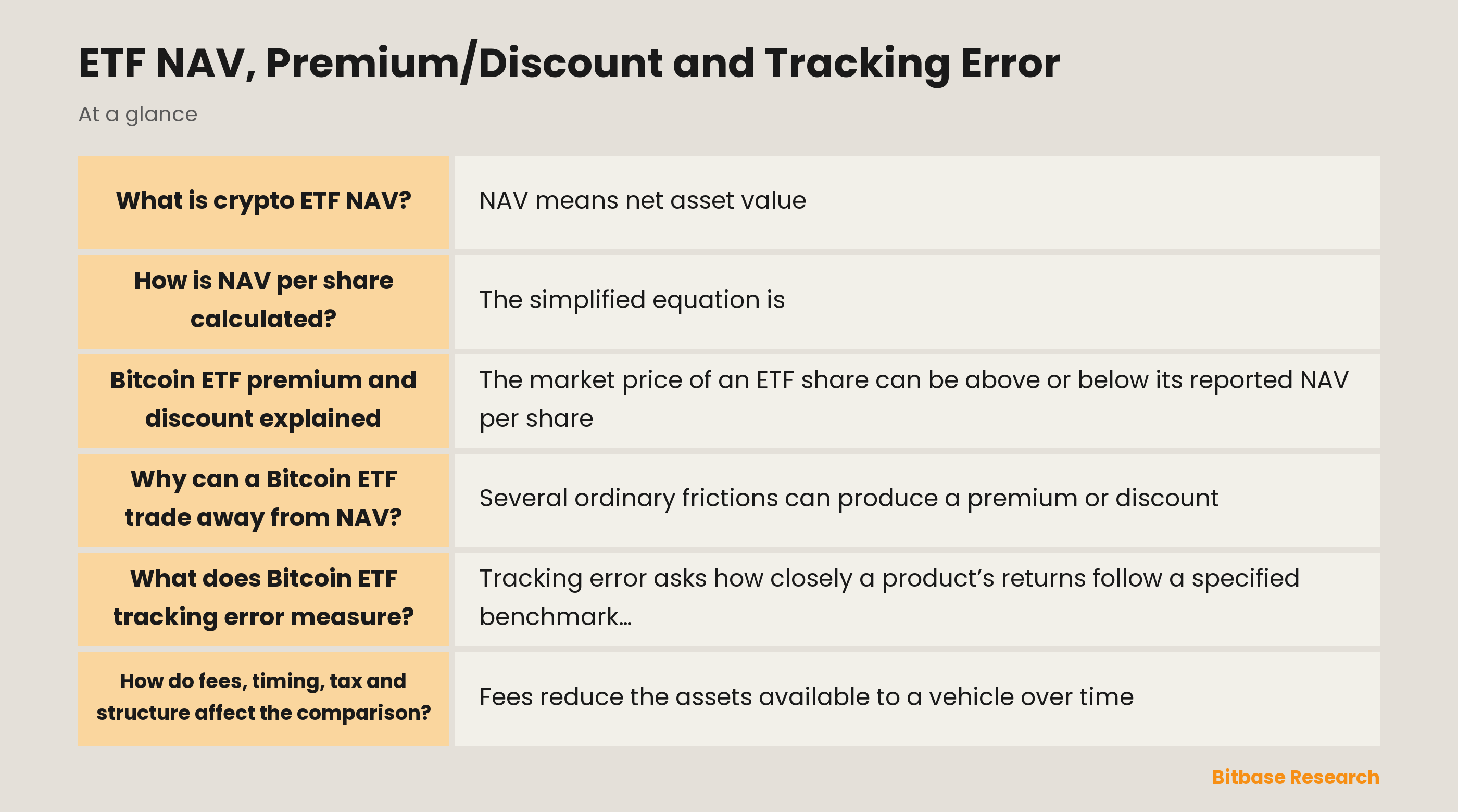
A practical checklist for reading ETF data
When a product page shows NAV and performance fields, start with five questions. First, what exactly is the vehicle and what assets does it hold? Second, what benchmark and valuation methodology are used? Third, what date, time zone and cut-off apply to NAV, market price and return figures? Fourth, which fees and trading costs are included or excluded? Fifth, are the reported premium/discount and tracking statistics calculated over a long enough, clearly defined period?
Then separate the observations. Use the formula above to reproduce a point-in-time premium or discount when the inputs are comparable. Use a return series to examine tracking difference and the dispersion around it. Look for historical tables rather than relying on one intraday screenshot, and note whether a period includes unusual volatility, market closures or operational events.
The final interpretation should stay modest. NAV is a valuation convention; market price is the price available in the trading venue; premium or discount is their percentage difference at a stated time; tracking error is a statistic about return divergence from a stated benchmark. Fees, timing, structure and local tax rules can change the outcome. Keeping those distinctions visible makes the data easier to understand without turning an educational comparison into a product recommendation.
Disclaimer: This article is educational content from Bitbase Academy, provided for information only. It does not constitute investment, trading, tax, or financial advice. Crypto assets are volatile; assess your own risk. Written as of August 2026; refer to the latest official information.
References
[1] Investor.gov: Updated Investor Bulletin—ETFs investor.gov
[2] Investor.gov: Mutual Fund and ETF Fees and Expenses investor.gov
[3] SEC: ETF website posting requirements sec.gov
[4] BlackRock iShares: ETP Premiums and Discounts ishares.com
[5] BlackRock iShares: iShares Bitcoin Trust ETF ishares.com
[6] CME Group: What is Basis? cmegroup.com
[7] IRS: Virtual Currency Transactions irs.gov