
A crypto card is best understood as a bridge between a digital-asset funding arrangement and an ordinary card-payment rail. A merchant is ordinarily paid in a conventional payment currency, while the funding logic behind the card may involve a conventional-currency balance, a digital asset, or a programmed conversion between them. The moment a payment is requested therefore brings together two questions: whether the card payment can be authorized and whether the programme’s own funding condition is met. Separating those questions makes settlement, conversion, fees, and records easier to understand.
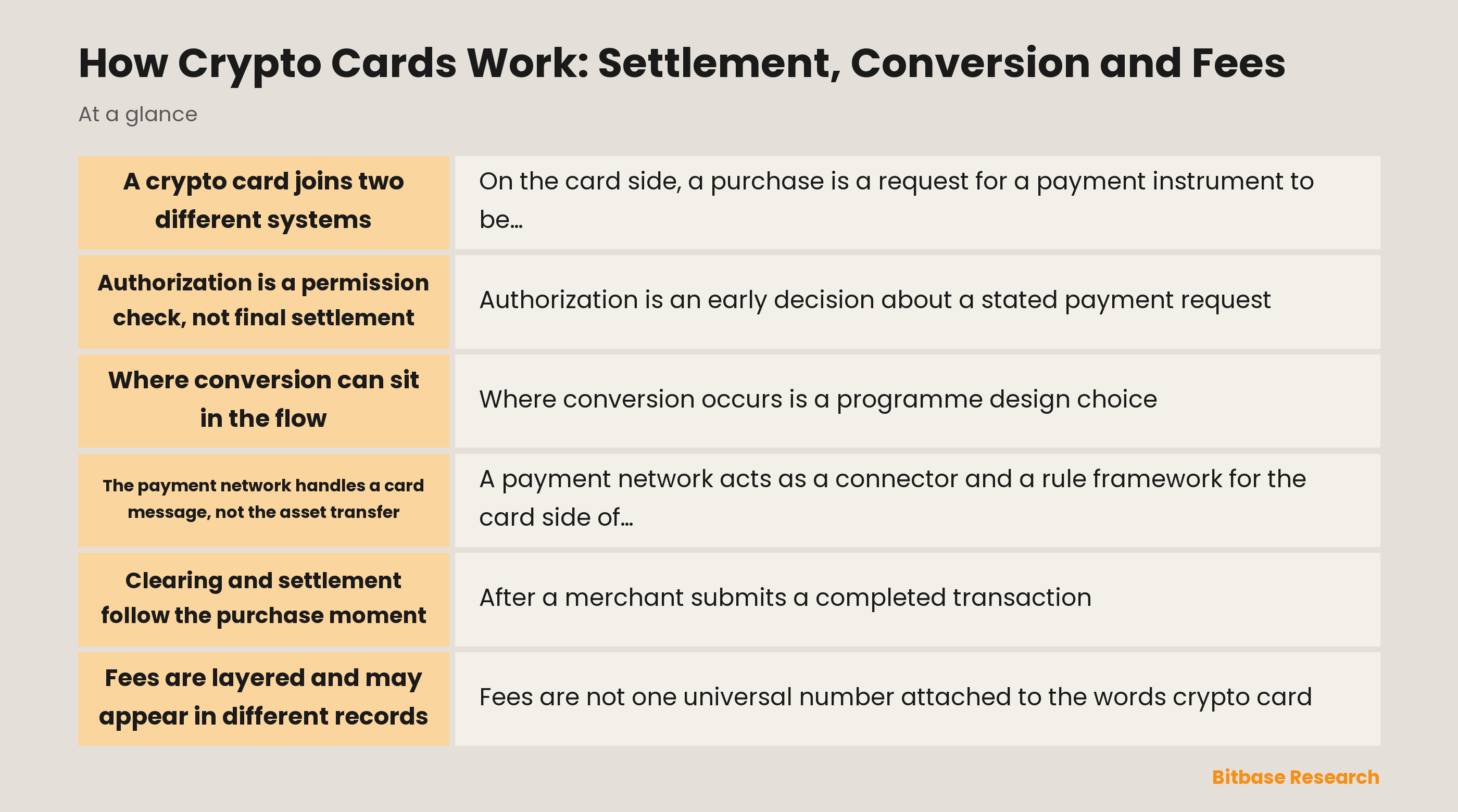
A crypto card joins two different systems
On the card side, a purchase is a request for a payment instrument to be accepted by a merchant and processed by financial institutions and a payment network. The message normally carries a transaction amount, a payment currency, merchant information, and a card credential. It lets the responsible card-side participant evaluate the request under the relevant payment rules. That process does not require the merchant to receive, hold, or interact with a digital asset. From the merchant’s viewpoint, it resembles another card-payment message.
On the funding side, the arrangement determines what supports an approval. A programme might use an already available conventional-currency balance, or it might assess the value of a digital asset and arrange a conversion. Those are different economic and record-keeping events from the card authorization itself. The card gives a common payment interface; it does not make every merchant purchase an on-chain transaction or determine how the digital asset is held.
Authorization is a permission check, not final settlement
Authorization is an early decision about a stated payment request. An approval shows that, at that moment and under the applicable rules, the card side is willing to stand behind the requested amount. It commonly creates an authorization record and can affect the amount shown as available. It is a permission check, not the completed exchange of payment between every participant in the later flow.
A later message can differ from the initial request, be adjusted, be reversed, or not be presented for clearing. An approved authorization therefore is not proof that the merchant has received final payment or that a separate conversion has completed. Card authorization, merchant completion, conversion, clearing, and settlement can be related states, but they are not the same state. Treating them as identical obscures where an amount, a fee, or a reversal belongs.
Where conversion can sit in the flow
Where conversion occurs is a programme design choice, not a universal feature of a crypto card. One arrangement can convert value before the card request and maintain a conventional payment balance. Another can evaluate digital-asset value when the payment request arrives and arrange the card-side funding then. A further arrangement can establish a card-side funding outcome while separate internal records confirm the associated conversion. The physical or digital card credential alone does not reveal which model applies.
The trigger point matters because each model can create different timestamps, reference identifiers, balance views, and fee entries. A conversion and a merchant purchase may be associated with the same overall event while remaining distinct entries in the records. The relevant programme terms, payment rules, and applicable law define the boundaries in a particular arrangement. A general explanation should not assume that every approval converts value at the same instant or by the same method.
The payment network handles a card message, not the asset transfer
A payment network acts as a connector and a rule framework for the card side of the transaction. At authorization, it can route a request and response between participating institutions. During later stages, it can support the exchange of transaction information and the calculation or communication of obligations. Card-message standards describe a common interface for those messages, while the way settlement occurs and the way a separate funding arrangement works remain outside that message interface.
When people search for crypto card settlement explained, the key distinction is that a payment approval does not, by itself, identify a particular digital asset, prove an asset transfer, or tell a merchant how card funding was arranged. The merchant needs a card-payment result in the payment currency. The card programme may maintain separate balance and conversion records behind that result. Network rules, contractual arrangements, and applicable requirements can shape the roles and records without changing the basic distinction.
Clearing and settlement follow the purchase moment
After a merchant submits a completed transaction, clearing handles transaction information before settlement. In broad terms, it can transmit, reconcile, confirm, and prepare amounts or positions among the parties involved. This is the stage in which the initial payment request is connected to the interparty accounting process. It is useful to distinguish this from the earlier authorization, which concerns whether a request may proceed, and from settlement, which concerns the resulting obligations.
Settlement is the card-side payment of obligations that result from the cleared transaction. Its exact timing and mechanics can depend on the network, participating institutions, merchant arrangement, payment currency, and applicable rules. A simple customer-facing display may compress those stages into one word such as completed, but the underlying records can retain separate authorization, clearing, settlement, adjustment, or reversal states. A later correction does not change the fact that each state has a different purpose.
Fees are layered and may appear in different records
Fees are not one universal number attached to the words crypto card. Payment acceptance, the network, the institutions that service the card side, the programme administrator, and the conversion mechanism can each have a cost or pricing rule. In one arrangement, an amount can appear separately; in another, a conversion rate can incorporate the relevant cost; in another, the merchant-side cost can be recorded elsewhere. Which parties bear which cost follows the applicable terms and payment structure, not a single category label.
The phrase crypto debit card fees explained is best handled by separating those layers instead of assuming every charge arises from the digital asset. A card payment can be associated with a payment-network-related charge, a card-account charge, a conversion spread or fee, or a merchant-side acceptance cost. The presence, treatment, and record location of any of those items can vary. A transaction total alone may answer one question while a separate conversion or account record answers another.
Records, reversals, and the limits of the payment view
One purchase can create an authorization entry, a merchant receipt, a clearing record, a settlement entry, a card-account ledger event, and a digital-asset or conversion record. They can use different timestamps, descriptions, and reference identifiers because they serve different participants and purposes. A merchant receipt can evidence a sale and a card-payment outcome without documenting the complete funding path. Conversely, a conversion record can describe a funding event without replacing the merchant’s transaction record.
This separation also helps explain reversals and adjustments. A correction can affect a card-side authorization or clearing record while a separate funding record has its own status and timing. It is unsafe to assume that a reversed card message has the same treatment in every arrangement, or that one entry fully explains every other entry. Connecting the records requires the governing terms and the facts of a particular case; this overview only describes the general architecture.
A conversion connected to spending may have tax consequences, but its treatment depends on the applicable jurisdiction, the asset classification, the transaction terms, the timing, and the relevant facts. A card record or merchant receipt cannot determine a tax result by itself. The same limit applies to legal and payment-rule conclusions: the transaction architecture explains what categories of records can exist, not what a particular record means for an individual case.
The useful mental model is therefore a layered one. A crypto card can present an ordinary card-payment message to a merchant while a separate funding arrangement supports that message. Authorization asks whether the request may proceed, conversion concerns the funding logic when one is used, clearing organizes transaction information, and settlement addresses resulting payment obligations. Keeping these layers distinct makes fees and records more intelligible without turning a general explanation into a product, trading, or tax instruction.
Disclaimer: This article is educational content from Bitbase Academy, provided for information only. It does not constitute investment, trading, tax, or financial advice. Crypto assets are volatile; assess your own risk. Written as of August 2026; refer to the latest official information.
References
[1] BIS CPMI: Payments and Markets Glossary bis.org
[2] ISO 8583:2023 Financial Transaction Card Messages iso.org
[3] Visa Core Rules and Visa Product and Service Rules visa.com
[4] PCI DSS Document Library pcisecuritystandards.org
[5] OECD: Taxing Virtual Currencies oecd.org