
A fiat rail is the set of institutions, messages, rules and settlement arrangements used to move a currency-denominated payment. At the edge of a crypto-related service, it is easy to reduce that system to a button labelled “bank” or “card.” That shortcut hides important differences: who sends the payment instruction, who checks it, when institutions exchange information, when obligations are settled, and when a receiving service makes value available. A useful comparison describes those layers without promising a particular speed, cost or outcome.
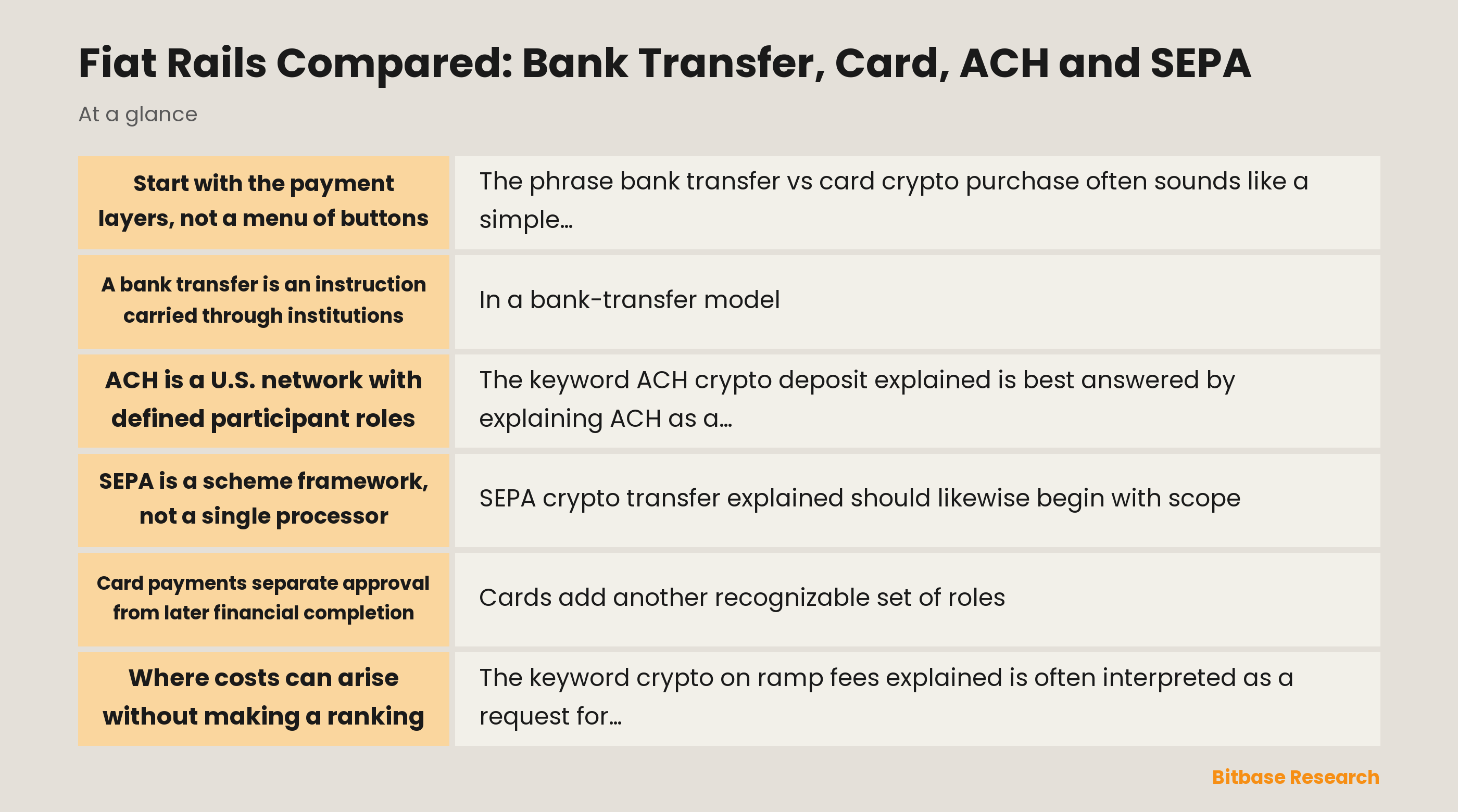
Start with the payment layers, not a menu of buttons
The phrase bank transfer vs card crypto purchase often sounds like a simple choice between two consumer-facing methods. Structurally, it compares different chains of participants and messages. A bank transfer can mean a credit transfer within a domestic system, a cross-border arrangement, or a scheme such as ACH or SEPA. A card payment normally adds a merchant, acquirer, issuer, network and processor roles. A service that connects either rail to a crypto-related account may also have its own acceptance, reconciliation, compliance and availability policies.
That is why a status shown by one interface does not settle the status of the whole payment. One system may have received an instruction, another may be assessing authorization, and a third may be waiting to reconcile a payment record. The Federal Reserve’s payment-process terminology separates initiation, authentication, authorization, approval, clearing, receipt, settlement and reconciliation. Not every method performs those steps in the same order or through the same entities.
The comparison is therefore about architecture. It does not establish that one rail is universally better, lower cost, quicker or more suitable. Geography, currency, participating institutions, rules, contract terms, risk controls and operational availability can all change the relevant path.
A bank transfer is an instruction carried through institutions
In a bank-transfer model, a payer’s bank or payment provider passes a payment instruction through an arrangement that can involve an operator, clearing mechanism or correspondent relationship before a receiving institution updates the beneficiary side. The visible instruction, the exchange of payment information and the inter-institution settlement are related, but they are not identical events.
This distinction matters when a transfer is associated with a crypto-related service. The service may need to identify the payment, match a reference, apply risk controls and reconcile its own ledgers after a bank-side event. None of those descriptions says that a particular transfer will be accepted or credited. They simply show why “sent,” “received,” and “available” can refer to different layers.
The word availability deserves particular care. It may refer to an institution’s decision to show or make funds usable, while settlement refers to the discharge of obligations between relevant parties. A service can also apply a separate handling window under its own arrangements. Describing those concepts separately is more accurate than attaching a universal timetable to bank transfers.
ACH is a U.S. network with defined participant roles
The keyword ACH crypto deposit explained is best answered by explaining ACH as a U.S. automated clearing house network rather than presenting it as a generic synonym for every transfer. Nacha describes an originator, an originating depository financial institution, an ACH operator, a receiving depository financial institution and a receiver. Those roles clarify how payment instructions can be collected, sorted and delivered among financial institutions.
ACH can carry credits and debits, and the direction of the instruction changes the role that begins the entry. The network’s rules cover how participants exchange and settle instructions, but a network-level description is not a statement about a separate service’s internal processing. A payment can be part of an ACH process while another organization still performs identification, reconciliation or compliance review in its own environment.
ACH also illustrates why early display is not always the same as completed settlement. Nacha notes that an institution may make a routine payment available before settlement by advancing its own funds. This is a process distinction, not a guarantee. It reinforces the need to describe settlement, availability and reversible processes as separate questions.
SEPA is a scheme framework, not a single processor
SEPA crypto transfer explained should likewise begin with scope. The Single Euro Payments Area includes payment schemes with common rulebooks and implementation guidance for participating payment service providers. The European Payments Council’s SEPA Credit Transfer materials describe a rulebook and message guidance, including inter-provider considerations. That shared framework supports interoperability, but it does not erase differences among institutions, account terms, local legal requirements or individual payment instructions.
SEPA credit transfer also should not be collapsed into any one speed or consumer experience. The scheme level tells us about a common set of operating rules; the end-to-end path can still depend on participation, the selected scheme, processing calendars, message data, screening and the receiving organization’s procedures. A cross-border label may add context, but it is not enough to infer how an unrelated service will handle the related funds.
The same caution applies to reversals, recalls and exception handling. Scheme rulebooks can contain structured procedures, yet the existence of a procedure is not a promise that an instruction can be reversed in every circumstance. The applicable rule, facts, timing and parties determine what is considered reversible.
Card payments separate approval from later financial completion
Cards add another recognizable set of roles. In a typical card payment, a merchant accepts the card, an acquirer provides settlement services to the merchant, an issuer authorizes use of the card, and a payment-card network routes information for authorization, clearance and settlement. A processor can provide routing or processing functions for one or more of those parties.
An authorization response is therefore not the whole financial lifecycle. Depending on the card type and arrangement, clearing can occur later, and a dispute or chargeback process may be governed by applicable law, network rules and contract terms. The possibility of a later dispute is why a card payment may be treated differently from a bank credit transfer by a receiving service, but it does not identify a universal policy or outcome.
This layer-based view also avoids treating “card” as a single rail with one finality rule. The payment context, issuer decision, merchant relationship, network process and downstream service controls can all matter. A card label alone does not disclose every fee, approval, settlement or reversible condition.
Where costs can arise without making a ranking
The keyword crypto on ramp fees explained is often interpreted as a request for a number. A more durable explanation is to map potential cost layers. Depending on the arrangement, charges may be connected to bank services, card-network economics, merchant acquiring, currency conversion, payment processing, compliance operations, reconciliation or a service’s own contractual terms. Some costs may be explicit, while others may be embedded in an exchange rate or a service arrangement.
Those layers cannot responsibly be converted into a permanent ranking. A fee can depend on a currency, location, institution, payment type, contractual relationship, transaction context and changes in scheme or regulatory requirements. Even two transfers with similar labels can use different routes or incur different arrangements. The relevant analytical question is which layers exist and who bears them, not which named product is cheapest.
Compare reversibility, information and operational dependencies
The most useful comparison framework asks several neutral questions. Which party starts the payment instruction? Which parties authenticate or authorize it? Does the arrangement use clearing before settlement? What conditions determine availability? What exception, recall, dispute or chargeback processes can apply? Which information has to be reconciled between institutions and the service that receives the funds?
These questions also make uncertainty visible. A bank transfer, ACH entry, SEPA credit transfer and card payment may each include rules for errors or disputes, but their reversible characteristics arise from different legal, scheme and contractual contexts. A status update can be informative without resolving every issue around settlement finality, service acceptance or future adjustment.
A rail is one part of a wider service arrangement.
Fiat rails help transfer money, but they are only one part of a wider arrangement. A crypto-related service may depend on banking access, payment-message matching, custody or ledger records, compliance processes and operational continuity alongside the payment method itself. Conflating those dependencies with the rail makes both the payment mechanism and the service risk harder to understand.
The durable conclusion is not a recommendation. Bank transfers, cards, ACH and SEPA can be compared by their participants, message flow, settlement architecture, availability decisions, exception processes and cost layers. That framework explains why two payments that look similar on a screen can follow different paths, while leaving the actual fee, timing, reversibility and acceptance outcome to the applicable institutions and arrangements.
Disclaimer: This article is educational content from Bitbase Academy, provided for information only. It does not constitute investment, trading, tax, or financial advice. Crypto assets are volatile; assess your own risk. Written as of August 2026; refer to the latest official information.
References
[1] Nacha: How ACH Payments Work nacha.org
[2] European Payments Council: SEPA Credit Transfer rulebook and implementation guidelines europeanpaymentscouncil.eu
[3] Federal Reserve: The U.S. Path to Faster Payments federalreserve.gov
[4] Federal Reserve: Regulation II definitions federalreserve.gov