A crypto narrative is best treated as a research hypothesis about a recurring topic, not as a label for an asset and not as a forecast. This guide explains a disciplined way to notice, describe, test, and sometimes reject an emerging theme without turning attention data into advice.
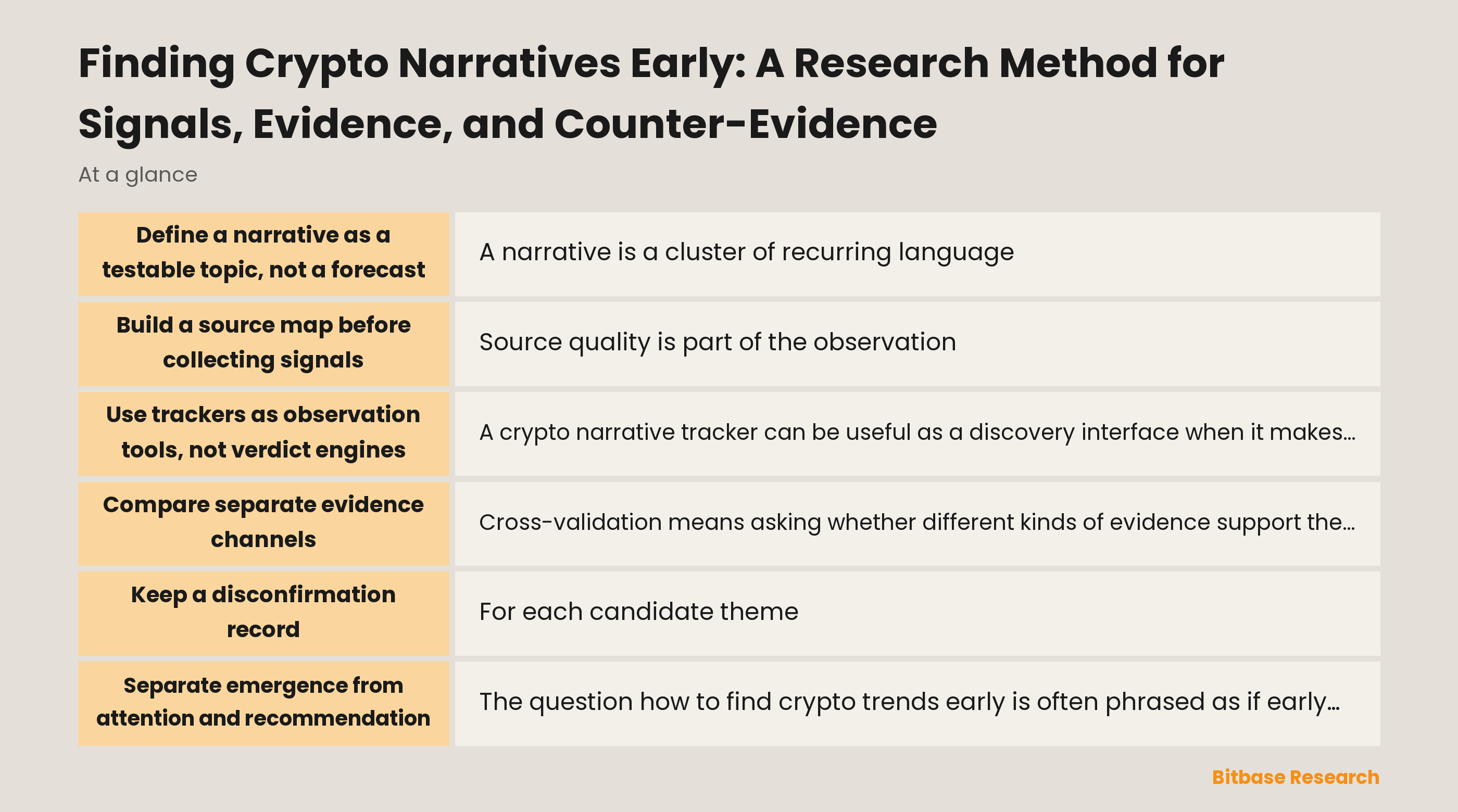
Define a narrative as a testable topic, not a forecast
A narrative is a cluster of recurring language, questions, technical claims, and public context. It may appear when different people begin using related terms to describe a problem, a design approach, or a change in the surrounding environment. That cluster can be worth documenting even when its boundaries are uncertain. Its existence does not establish that the claims inside it are correct, broadly adopted, or durable.
Starting with a definition prevents a common category error. A topic is an object of observation; an outcome is a claim about what will happen next. A research note can say that a phrase recurs across a specified set of sources during a specified period. It should not convert that observation into a statement about future importance, adoption, or value. Those are different questions requiring different evidence.
Write the initial hypothesis in language that can be challenged. For example, the hypothesis might be that several independently published materials are addressing the same design problem with related terminology. It should also name what would weaken it: a shared source behind the apparent repetition, a mismatch between terms and underlying material, or a short-lived response to one unrelated event. That makes the subject inspectable rather than promotional.
Build a source map before collecting signals
Source quality is part of the observation, not a cleanup task for the end. Begin by separating materials into a primary layer, an independent explanatory layer, and a discovery layer. Primary material can establish what a document, specification, public record, or versioned technical artifact actually says. Independent research or reporting can provide context. Public discussion and aggregators can surface terms that may deserve further inspection.
The layers serve different roles. A discovery source can make a researcher aware of a phrase, but it cannot by itself confirm the identity of the underlying entity or the truth of a claim. An explanatory source may offer useful interpretation, while a primary source is still needed for a claim about a stated mechanism or published change. Record the publisher, timestamp, language, access date, and reason each source is included.
Independence matters as much as source count. Ten items that repeat one original statement are not ten confirmations. A source map should therefore note citations, shared authorship, common data feeds, and unattributed copying where these are visible. The goal is not to manufacture consensus; it is to show which observations come from genuinely separate evidence channels and which do not.
Use trackers as observation tools, not verdict engines
A crypto narrative tracker can be useful as a discovery interface when it makes its scope, refresh timing, grouping rules, and data sources legible. It may reveal vocabulary that is appearing more often, connections between related terms, or questions that are moving across communities. Those observations are leads for research. They are not a measurement of truth, practical relevance, or future performance.
The same limit applies to a crypto trending tokens tracker. A label, rank, or visual increase can describe how that particular product has organized attention under its own rules, but it cannot establish why attention exists. Search services and dashboards can use samples, normalization, thresholds, entity matching, and filters that differ by place and time. A sound research record captures those limits before treating any output as comparable.
Use the tracker entry as a pointer, then move outward. Preserve the exact query or category, the observation window, the region or language setting, and the displayed timestamp. Check whether the terms name a concept, an organization, a feature, or several unrelated things. If the answer is unclear, mark the signal as ambiguous rather than silently resolving the ambiguity in favor of a more compelling story.
Compare separate evidence channels
Cross-validation means asking whether different kinds of evidence support the same narrow statement. For an identity claim, compare a primary document or record with an independently published description and verify that names, dates, and terminology refer to the same thing. For a claim about a mechanism, return to the original material and distinguish what it explicitly states from what a later summary infers.
Time is another channel that needs comparison. A recurring topic should be logged in a fixed window, with later observations kept separate from earlier ones. This stops a retrospective account from blending first appearance, later explanation, and unrelated follow-on coverage into a single apparent emergence. It also makes it possible to see whether the topic remains coherent once the initial burst of attention passes.
The comparison should preserve disagreement. One source can use broad language while another uses a narrower technical definition; both facts belong in the note. Instead of forcing a unified label, identify the point of disagreement and the evidence behind each wording. This approach produces a more useful map of uncertainty than a polished narrative that hides incompatible definitions.
Keep a disconfirmation record
For each candidate theme, create a small record with the initial wording, the sources that motivated it, the claims that are actually being examined, and the conditions that could undermine those claims. A record can note an unclear entity match, a source that is derivative rather than independent, an alternative explanation for repeated terms, or a lack of primary material. These are findings about evidence quality, not defects to be edited away.
Counter-evidence should be collected at the same time as supporting material. If a term has multiple meanings, retain the competing meanings. If a burst is tied to one announcement, retain that context. If a source cannot be traced beyond a repost, record the missing provenance. A claim that survives such checks may be ready for narrower description; a claim that does not should remain unresolved or be removed from the working hypothesis.
The final status does not need to be dramatic. “Observed but unconfirmed,” “partly supported,” “reframed,” and “not supported by available primary material” are all legitimate outcomes. The important property is traceability: another reader should be able to see what was known at the time, what was inferred, what conflicted, and why the description changed.
Separate emergence from attention and recommendation
The question how to find crypto trends early is often phrased as if early visibility automatically creates an action to take. A research method should resist that framing. Early, here, means early in the documentation process: the first time a coherent cluster can be noticed and bounded for further verification. It does not mean an early position, a privileged advantage, or a conclusion that anyone should act.
Attention can arise for many reasons: a genuine technical discussion, a policy event, a naming coincidence, automated repetition, a controversy, or a single widely copied interpretation. None of these explanations can be selected merely because a dashboard looks active. The researcher’s job is to preserve the competing explanations until source provenance, definitions, and timestamps justify a narrower account.
This distinction keeps a topic review useful for education. It lets readers see how claims travel, which source categories can support which statements, and where uncertainty remains. It also prevents a methodology article from becoming a disguised ranking, a screening system, or a claim that visibility can predict a price or a return.
Turn observations into a repeatable review record
People asking how to find new crypto narratives often need a repeatable standard more than a larger stream of alerts. Use a stable template: topic wording, scope, entities or concepts that require disambiguation, source tier, timestamp, supporting material, counter-evidence, alternate explanations, and a plain-language conclusion. Keeping the template stable makes later comparisons possible without pretending that different sources have the same meaning.
Schedule review by evidence state rather than by excitement. A note may need revision when primary material appears, when an alleged source is corrected, when a term proves ambiguous, or when independent accounts fail to materialize. Record what changed and why, instead of replacing the previous note without a trace. That history is what allows a reader to audit the difference between an observation and an interpretation.
The result is an evidence practice, not a shortcut. It can help researchers organize weak and strong signals, identify where more verification is needed, and document why a theme was retained, narrowed, or rejected. It cannot determine what anyone should buy, sell, use, or expect. Its value lies in making uncertainty visible and keeping the next research question clear.
Disclaimer: This article is educational content from Bitbase Academy, provided for information only. It does not constitute investment, trading, tax, or financial advice. Crypto assets are volatile; assess your own risk. Written as of August 2026; refer to the latest official information.
References
[1] Google Trends: FAQ about Google Trends data support.google.com
[2] Google Trends: Compare search terms and topics support.google.com
[3] Discovering Emerging Topics in Social Streams via Link Anomaly Detection arxiv.org
[4] NEWSSENSE: Reference-free Verification via Cross-document Comparison aclanthology.org
[5] NIST AI Risk Management Framework 1.0 nvlpubs.nist.gov