
A spot bitcoin ETF is usually a listed wrapper that seeks to track bitcoin by holding bitcoin or an equivalent asset position inside a trust or fund structure. A retail investor normally buys and sells shares on an exchange, while large financial intermediaries handle the creation and redemption of share baskets. That division explains why the product can trade throughout the day without every retail order sending bitcoin to or from the custodian. It also explains why the label “ETF” does not describe one identical legal structure in every jurisdiction.
What a spot bitcoin ETF actually holds
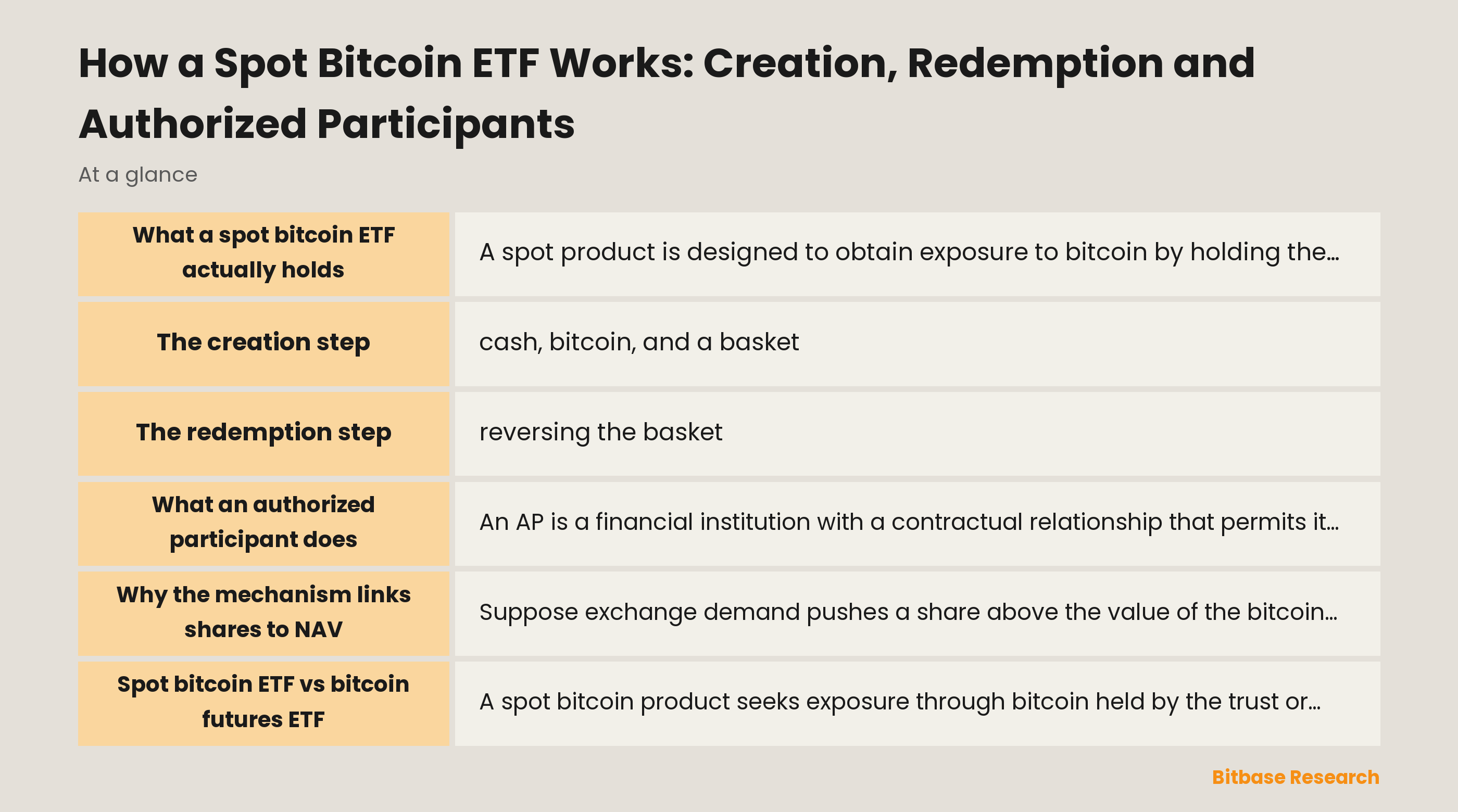
A spot product is designed to obtain exposure to bitcoin by holding the underlying asset itself, rather than by holding a chain of expiring bitcoin futures contracts. The trust or fund records its assets, liabilities, fees, and the amount of bitcoin attributable to each share. The administrator then calculates a net asset value, or NAV, using the product’s stated pricing methodology. Shareholders own shares in the vehicle; they do not automatically receive the trust’s bitcoin or its private keys.
In the United States, the products commonly called spot bitcoin ETFs are often described by the SEC as spot bitcoin exchange-traded products. The SEC’s investor bulletin says these products are structured as exchange-traded commodity trusts and are not registered as investment companies under the Investment Company Act of 1940. That distinction matters because the legal protections, custody rules, disclosures, and oversight are not identical to those of a conventional 1940 Act mutual fund or ETF.
The wrapper also does not remove the underlying risks. A share can trade at a premium or discount to NAV, the trust charges expenses, the reference price can differ from prices on individual trading venues, and custody or operational events can affect the product. The wrapper changes how exposure is accessed; it does not turn bitcoin into a low-risk asset or give a shareholder direct control of the underlying coins.
The creation step: cash, bitcoin, and a basket
New shares are normally issued in a large block called a creation basket or creation unit. An authorized participant, or AP, submits an order under the trust’s participant agreement and delivers the required consideration. Depending on the product and the permitted method, that consideration can be cash, bitcoin, a mixture of cash and bitcoin, or another specified combination. The basket amount is calculated from the product’s rules and the relevant NAV process, not from the price paid by a retail buyer on the exchange.
In a cash creation, the AP delivers cash to the trust or its designated agent. The sponsor or a trading counterparty then arranges for the corresponding bitcoin to be purchased, after which the trust issues the basket of shares to the AP. In an in-kind creation, the AP or its designee delivers the required bitcoin directly to the trust’s custodian and receives shares. A partial-cash process combines the two: the AP delivers bitcoin for one part of the basket and cash for the part that the trust elects to source or settle in cash.
The bitcoin etf creation redemption process therefore has two layers. The primary-market layer is the AP’s large-basket transaction with the trust. The secondary-market layer is the ordinary exchange trading in which retail investors and institutions buy or sell individual shares. The two layers connect through the AP, but a retail order is not itself a creation order and does not normally involve the retail investor sending bitcoin to the trust.
The redemption step: reversing the basket
Redemption is the reverse primary-market operation. An AP gathers the required number of shares, delivers the basket to the trust or transfer agent, and receives the amount specified by the trust’s redemption rules. In a cash redemption, the trust sells or otherwise converts the relevant bitcoin position and pays cash to the AP or its designee. In an in-kind redemption, the trust transfers bitcoin to the AP or its designee in exchange for the surrendered shares. A partial-cash redemption uses both assets and cash according to the order terms.
The amount delivered is tied to the basket amount and the product’s NAV methodology, after accounting for accrued fees, expenses, and other liabilities. The exact cut-off time, settlement calendar, transaction fee, custody steps, and responsibility for execution-price differences are product-specific. A prospectus can therefore describe a process that looks similar to another trust while assigning the cash-conversion risk or timing risk to a different participant.
A key point is that retail investors generally do not redeem a single share directly with the trust. They sell shares in the secondary market through a broker. The AP channel is designed for large blocks, and the trust’s documents define who can act, which assets may be delivered, and which designees may perform parts of the transaction.
What an authorized participant does
An AP is a financial institution with a contractual relationship that permits it to create and redeem baskets directly with the product. In many ETF structures, APs are large broker-dealers or other market intermediaries that meet the product’s eligibility and settlement requirements. The AP is not the same as a retail broker, and the AP role does not mean that the institution guarantees the share price or the value of bitcoin.
The AP coordinates several moving parts: it submits a valid order, arranges cash or bitcoin, works with the custodian and transfer agent, receives or delivers the share basket, and may distribute shares to market makers or other buyers. Some documents also allow an AP to use a designated agent or liquidity provider for part of the bitcoin transaction. The precise chain depends on the trust, its service providers, and the settlement method available at that time.
The phrase authorized participant bitcoin etf is therefore a search label for a mechanism, not a product recommendation. It points to the institution that can interact with the trust in creation units. It does not tell a retail reader which intermediary is available, whether it is acting in a particular transaction, or whether the product accepts cash, in-kind, or partial-cash orders. Those details belong in the current prospectus and participant documentation.
Why the mechanism links shares to NAV
Suppose exchange demand pushes a share above the value of the bitcoin represented by its NAV. An AP or another market participant may be able to create new shares, sell them into the market, and capture the difference after costs. Additional supply can reduce the premium. If a share trades below NAV, an AP may buy shares, redeem them for the permitted cash or bitcoin consideration, and use that process to reduce the discount. This is an economic tendency, not a guaranteed arbitrage or a promise that the share price will equal NAV at every moment.
The mechanism works only when participants can price the basket, access the required markets, finance the transaction, and settle assets on time. Trading halts, limits on counterparties, custody interruptions, bitcoin-market dislocations, fees, and balance-sheet constraints can weaken the link. Even in ordinary conditions, the share price can move away from NAV during the trading day because exchange supply and demand change faster than the underlying valuation process.
The product can also track imperfectly. Sponsor fees reduce the bitcoin represented by each share over time, and the reference index may use a defined set of pricing venues rather than every global trade. A trust may hold cash temporarily, use a prime execution arrangement, or incur transaction costs when buying or selling bitcoin. These details belong to the tracking and risk discussion, not to a claim that the wrapper reproduces every movement in the spot market.
Spot bitcoin ETF vs bitcoin futures ETF
A spot bitcoin product seeks exposure through bitcoin held by the trust or through a closely specified spot-asset process. A bitcoin futures ETF instead holds futures contracts, collateral, and related positions. A futures contract has a delivery month and a price that can differ from the current spot market. When the contract approaches expiry, the fund normally closes or reduces it and establishes exposure in another contract. That roll can add or subtract from returns, depending on the shape of the futures curve and the execution costs.
The difference is not simply “real bitcoin versus paper bitcoin.” Both products are securities or exchange-traded products with their own fees, custody arrangements, trading hours, valuation rules, and tracking differences. A spot product has direct custody, wallet, private-key, and underlying-market risks at the trust level. A futures product adds derivatives, margin, contract rollover, collateral, and futures-market basis risks. Both can trade at a premium or discount to their own NAV, and neither gives a retail holder the same control as holding bitcoin directly.
The query spot bitcoin etf vs bitcoin futures etf is useful when it leads to a structural comparison: what does the vehicle hold, how is exposure maintained, how are creations and redemptions settled, and what can cause tracking to diverge? It is not a shortcut to deciding which product is suitable. Suitability depends on the investor’s jurisdiction, account, time horizon, risk capacity, and the product documents in force at the time.
Jurisdiction, regulation and tax can change the answer
The description above uses the U.S. spot bitcoin ETP model as a reference point, not as a global definition. In the United States, the SEC approved exchange rule changes for spot bitcoin ETP listings in January 2024. The SEC later announced in July 2025 that approved orders permitted in-kind creations and redemptions for crypto ETP shares. As of the 10 August 2026 cutoff, that history means a reader should not assume that every trust uses the same cash-only or in-kind process: the current prospectus, supplement, AP agreement, and listing rules control the live mechanics.
Other jurisdictions may use a different wrapper or name. A Canadian exchange-listed bitcoin investment fund may be governed by Canadian securities rules and local prospectus requirements. In Europe or the United Kingdom, a product marketed as bitcoin exposure may be an ETP, ETN, or ETC rather than a UCITS ETF, and its collateral, issuer-credit, custody, and investor-protection framework can differ. A product’s ticker or marketing label is not enough to establish its legal form. Read the local offering document, key information document, and exchange listing information.
Tax treatment is separate from the AP mechanism. The trust’s in-kind redemption may affect the trust’s operations, but it does not automatically make a retail sale tax-free. The result can depend on residence, account type, holding period, whether the wrapper is a fund, trust, note, or other security, and local rules for capital gains, income, withholding, and reporting. The query bitcoin etf creation redemption process describes product plumbing; it does not answer an individual tax question. Treat the information here as structural education, and verify the rules that apply at the cutoff date with the relevant regulator, prospectus, and qualified tax adviser.
Disclaimer: This article is educational content from Bitbase Academy, provided for information only. It does not constitute investment, trading, tax, or financial advice. Crypto assets are volatile; assess your own risk. Written as of August 2026; refer to the latest official information.
References
[1] SEC Investor.gov: ETPs Providing Exposure to Bitcoin and Ether investor.gov
[2] SEC Investor.gov: Updated Investor Bulletin ETFs investor.gov
[3] SEC: In-Kind Creations and Redemptions for Crypto ETPs sec.gov
[4] SEC/CFTC Investor.gov: Funds Trading in Bitcoin Futures investor.gov
[5] ESMA: Eligible assets for UCITS esma.europa.eu
[6] HMRC: Tax treatment of cryptoasset ETNs gov.uk
[7] IRS: Digital asset transaction FAQs irs.gov
[8] CRA: Crypto-asset information and tax guidance canada.ca