
An airdrop eligibility framework is best understood as a rule-based classification of historical information. It does not describe a person’s identity, establish a future outcome, or make a promise about any address. A well-designed framework states which records are in scope, how those records are interpreted, which safeguards address duplicated identities, and how the resulting set can be examined. The useful question is therefore not whether a phrase found in a search field proves anything. It is how a transparent system translates a defined historical record into a reproducible result while acknowledging uncertainty.
This article explains the general mechanics behind snapshots, points, rules, and Sybil filters. It does not report program status for any network, application, or company. It also does not turn a search phrase into evidence about a named project. Those distinctions matter because rule-based distributions combine data engineering, governance, security, and communication: a result can be technically reproducible while still depending on policy choices that should be made visible.
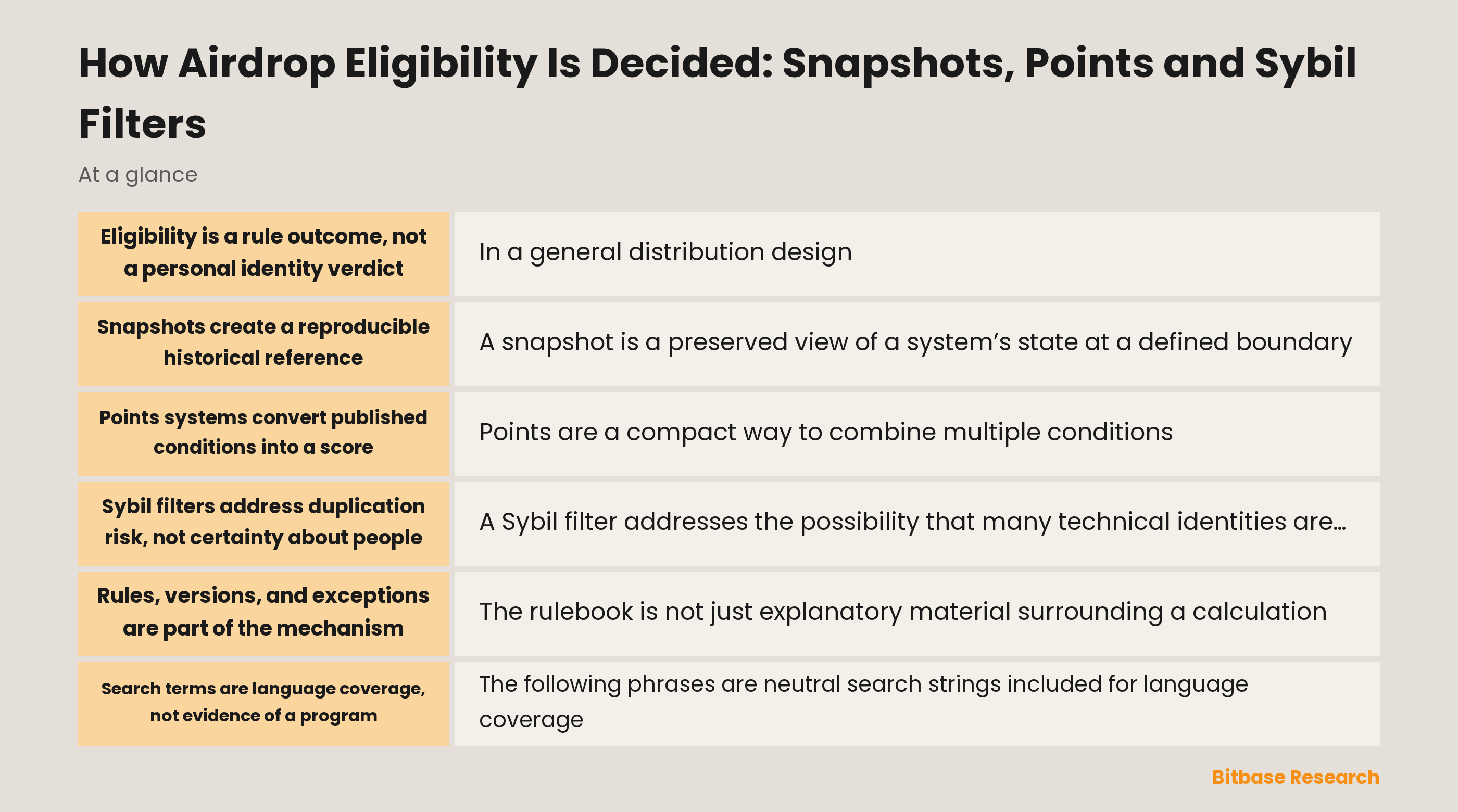
1. Eligibility is a rule outcome, not a personal identity verdict
In a general distribution design, eligibility is an output of stated conditions. The conditions may refer to recorded interactions, balances, governance participation, attestation data, or other inputs chosen by the designers. Each input needs a definition: where it comes from, what time range it represents, how duplicates are handled, and what happens when data is missing. Without those definitions, a label can sound precise while hiding important decisions.
That output should not be confused with a conclusion about a human being. A blockchain address, an account, a credential, or a device identifier is a technical reference. It may be controlled by one person, several people, an organization, a service, or software. Conversely, one person may control more than one technical reference. A framework can evaluate the references it has defined without proving an off-chain identity. This distinction is central to both privacy and fairness.
Clear rules also separate observation from interpretation. An observed event may be easy to record, while deciding what that event represents can be difficult. Was it independent activity, automated behavior, an internal transfer, a test, or a duplicated pattern? A sound design names the limits of its data rather than treating every recorded event as equally meaningful. It describes the scope of evaluation, the order in which conditions apply, and the uncertainty that remains after automated checks.
2. Snapshots create a reproducible historical reference
A snapshot is a preserved view of a system’s state at a defined boundary. In blockchain-oriented designs, that boundary may be expressed through a block height, epoch, finalized record, or another documented data condition. In other systems, it may be a versioned database extract. The important property is not the label; it is the ability to explain exactly which historical information was considered and to distinguish that information from later changes.
Reproducibility starts with provenance. A rule set should make clear which source supplied the records, which fields were read, and how the input was normalized. For example, an address may need consistent casing, a transaction may need a finality policy, and an event may need a canonical identifier. These are data-quality choices. If they are invisible, two reviewers can apply what appears to be the same rule and reach different outcomes.
Integrity commitments make a historical reference easier to audit. A published dataset hash, a Merkle root, a schema version, or a deterministic transformation description can help reviewers compare the source material with the set that was evaluated. Merkle proofs are one technical way to demonstrate that a particular item belongs to a committed set without revealing every item in that set. They explain membership relative to a known commitment; they do not independently explain why the set was assembled or whether its policy choices were appropriate.
A snapshot also draws a line between history and later activity. Records created after the documented boundary are simply outside that particular evaluation, even if they are otherwise genuine. That is not a judgment about their quality. It is a consequence of the design’s stated scope. Good documentation explains that scope plainly, including how data corrections, chain reorganizations, indexing gaps, or source outages were treated.
3. Points systems convert published conditions into a score
Points are a compact way to combine multiple conditions. A rule might assign a score to categories of recorded activity, apply weights to different periods, cap the contribution of repeated actions, or exclude events that fail validation. The exact arithmetic is less important than the fact that it is a policy choice. A score records how the system interpreted its inputs; it is not a universal measurement of value, loyalty, knowledge, or personal identity.
For a points model to be understandable, every component needs an explanation. The model should identify the event types it counts, the unit of measurement, any thresholds, caps, and order of operations. It should also distinguish between a metric used for inclusion and a metric used only for review. When a score relies on several data sources, the model should identify which source takes precedence if records conflict. These details prevent a simple total from concealing a complicated chain of decisions.
Attribution is a related but separate problem. A record may be associated with an address because it appears in an event log, yet that association does not show why the event occurred or whether multiple references share a controller. A points system can therefore be internally consistent and still have limits. Designers should treat those limits as part of the rule description, rather than as an afterthought added only when a result is disputed.
The same caution applies to threshold language. A threshold is a boundary inside a model, not proof that the boundary perfectly separates every intended case from every unintended case. Small changes in rounding, data availability, repeated-event treatment, or version order can change an outcome near a boundary. Explaining those sensitivities makes the mechanism easier to evaluate without converting it into advice about what anyone should do.
4. Sybil filters address duplication risk, not certainty about people
A Sybil filter addresses the possibility that many technical identities are controlled or coordinated in a way that defeats a system’s intended one-person, one-community-member, or one-independent-participant policy. The central problem is duplication: a system can observe many addresses or accounts, but it cannot automatically assume that each one represents a distinct human being. This is why Sybil resistance is usually framed as risk reduction rather than perfect identification.
Signals used in a filter can include relationship patterns, repeated behavior, attestation records, known service characteristics, or evidence from an identity system. Each signal has limitations. Similar timing can occur for benign reasons; shared funding patterns can reflect a legitimate service; an attestation can be absent because a person values privacy or lacks access to the relevant system. A robust framework therefore avoids presenting any single signal as a conclusive explanation.
Filtering also creates an error trade-off. A strict model may reduce some forms of duplication while excluding independent participants whose activity happens to look similar. A permissive model may include more legitimate references while allowing more coordinated patterns through. This is a governance choice with privacy, accessibility, and fairness consequences. It should be documented alongside the technical method, not treated as a purely mechanical decision.
Human review, if a design uses it, is not a cure for ambiguity by itself. Review criteria, authority boundaries, data retention, and consistent treatment all matter. A review layer can make edge cases more visible, but it can also introduce discretion. The clearest systems explain which parts are automated, which parts are judgment-based, and which uncertainties cannot be resolved from the available data.
5. Rules, versions, and exceptions are part of the mechanism
The rulebook is not just explanatory material surrounding a calculation; it is part of the calculation’s meaning. A complete rulebook identifies input sources, interpretation rules, exclusions, scoring logic, filtering signals, and the treatment of exceptional records. It also assigns versions to those components. If an input definition changes, a version label helps reviewers tell whether the same historical data was evaluated under the same policy.
Versioning is particularly important when data quality problems appear. An indexer may correct an event classification, a source may add missing records, or a security review may identify a weakness in a heuristic. Those changes can be legitimate reasons to revise a method, but they should be traceable. A revision note can describe what changed, why it changed, which inputs were affected, and whether earlier results were recalculated. Traceability does not eliminate disagreement; it gives disagreement a factual basis.
Exceptions require the same discipline. An exception can be a formally defined edge case, a data correction pathway, or a decision to exclude records that cannot be verified under the published rules. It should not be an invisible shortcut. Where privacy permits, aggregate explanations of exception categories can help readers understand the system without exposing sensitive information about any individual reference.
Rule changes also create communication risk. Vague language can make a framework appear fixed when it is actually provisional, or final when it remains subject to review. The responsible approach is to separate stable definitions from assumptions, explain the version in use, and state the limits of what the available evidence can show. That clarity is more useful than confidence that cannot be supported by the data.
6. Search terms are language coverage, not evidence of a program
The following phrases are neutral search strings included for language coverage: `aster airdrop eligibility`, `berachain airdrop eligibility`, `monad airdrop eligibility`, `solana seeker airdrop eligibility`, `falcon finance airdrop eligibility`, `jupiter airdrop eligibility`, `lighter airdrop eligibility`, `linea airdrop eligibility`, and `meteora airdrop eligibility`. Their presence in this article does not establish that a named project has a distribution, a rule set, an authentic page, an available process, or any particular result.
Search language often compresses several separate questions into a few words. A phrase may refer to a rumor, a past discussion, a generic topic, a typo, or a request for background knowledge. It does not identify the authoritative source of rules, the version of data under discussion, or whether the searcher’s assumptions are valid. Treating a query as evidence is therefore a category error: it confuses a string of text with a verified record.
Neutral coverage is especially important for names associated with financial or technical ecosystems. A general article can explain how historical state, scoring models, filters, and rules might work without making a statement about a named ecosystem. The correct level of confidence depends on documentary evidence, defined inputs, and reproducible methodology—not on the popularity or wording of a search query.
7. Sources
- Human Passport documentation — background material on identity verification and Sybil resistance.
- NIST SP 800-63-4 Digital Identity Guidelines — background material on identity proofing, authentication, federation, risk, and privacy.
- NIST identity proofing security considerations — background material on automated enrollment and identity-related threat models.
- OpenZeppelin Cryptography: MerkleProof — reference documentation for Merkle tree proof verification.
Disclaimer: This article is educational content from Bitbase Academy, provided for information only. It does not constitute investment, trading, tax, or financial advice. Crypto assets are volatile; assess your own risk. Written as of August 2026; refer to the latest official information.
References
[1] Human Passport documentation docs.passport.xyz
[2] NIST SP 800-63-4 Digital Identity Guidelines pages.nist.gov
[3] NIST identity proofing security considerations pages.nist.gov
[4] OpenZeppelin Cryptography: MerkleProof docs.openzeppelin.com