
Federal Reserve decisions can matter to the financial environment in which crypto markets operate, but they do not provide a mechanical instruction for Bitcoin or any other cryptoasset to rise or fall. A useful explanation begins with the policy tool itself, follows the channels through rates, funding, expectations, and risk appetite, and then keeps the measurement limits in view. That approach is more informative than treating a meeting headline as a complete market explanation.
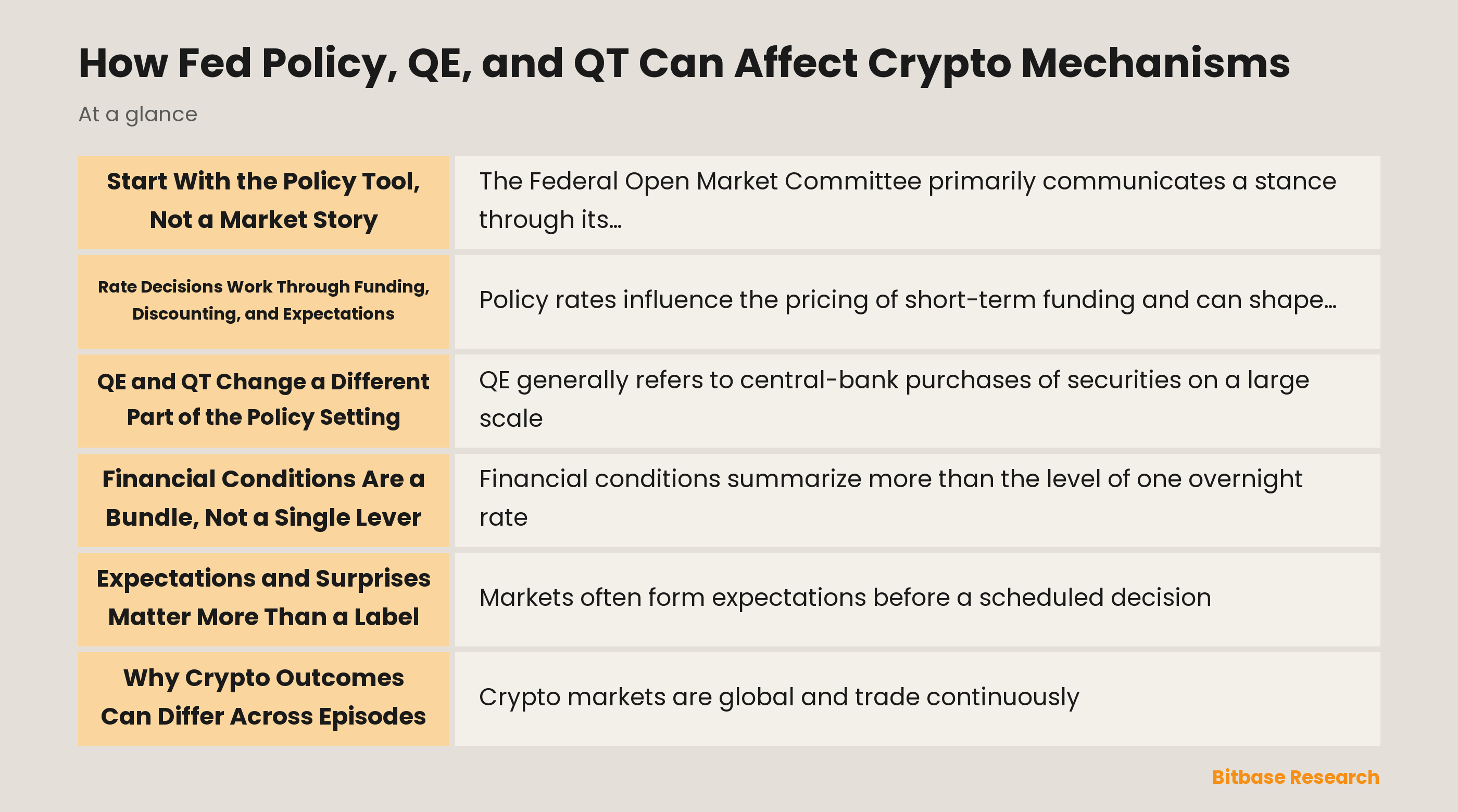
Start With the Policy Tool, Not a Market Story
The Federal Open Market Committee primarily communicates a stance through its target range for the federal funds rate. That rate concerns overnight borrowing in the banking system, while implementation also involves administered rates and market operations. It is therefore the starting point for a broader transmission process, not a direct setting for the price of a cryptoasset. The phrase fed rate decision crypto impact is best understood as a question about those possible links rather than a promise of a single outcome.
Rate policy, balance-sheet policy, and communication are related but distinct. A change in the policy-rate target concerns the short end of the interest-rate environment. Large-scale asset purchases, often called quantitative easing or QE, concern the central bank's holdings of securities and can be used to influence longer-term financial conditions or market functioning. Balance-sheet reduction, commonly called quantitative tightening or QT, concerns the reduction of those holdings, often through the treatment of maturing securities.
Separating the tools prevents a common error: calling every easier-looking condition QE or every tighter-looking condition QT. A rate decision can occur while the balance sheet follows a different operational path, and balance-sheet operations can have purposes beyond changing the policy stance. Crypto-market participants may react to the broader setting that follows from those tools, but the tools do not target crypto markets and should not be described as doing so.
Rate Decisions Work Through Funding, Discounting, and Expectations
Policy rates influence the pricing of short-term funding and can shape expectations for rates further out the curve. Those changes may alter how investors compare the return and risk characteristics of cash-like instruments, bonds, equities, and other assets. In crypto, the connection is indirect: changes in financing costs, hedging costs, collateral terms, and leverage capacity can affect the conditions under which different participants hold or trade assets.
The keyword phrase interest rate cuts bitcoin impact often compresses several mechanisms into one. A lower policy-rate setting can coincide with lower short-term rates and a different expected path for funding, yet it does not automatically produce a particular Bitcoin outcome. Participants may have already anticipated the decision, may interpret the accompanying communication differently, or may be responding more strongly to credit conditions, economic uncertainty, exchange-rate conditions, or crypto-specific developments.
Discounting is another useful but limited lens. In conventional valuation models, a change in the rate used to value uncertain future cash flows can alter a present valuation. Bitcoin does not have contractual cash flows to insert into that model, but the model can still describe a broader change in how investors weigh duration, liquidity, and uncertainty across assets. The relevance of that shift depends on who is active in the market and what constraints they face at that time.
QE and QT Change a Different Part of the Policy Setting
QE generally refers to central-bank purchases of securities on a large scale. By changing the quantity and composition of securities held by the central bank, purchases can affect the supply of securities held by private investors, reserve balances, and conditions in longer-term funding markets. The Federal Reserve Bank of New York explains that asset purchases can serve reserve management, policy accommodation, or market-functioning purposes, so the label alone does not disclose a complete mechanism.
QT is the opposite direction for the balance sheet, but it should not be reduced to a slogan about liquidity. It may be implemented by allowing securities to mature without full reinvestment or, in some circumstances, through sales. The pace, composition, reserve environment, and accompanying rate policy all matter. For that reason, quantitative tightening bitcoin impact is a question about several potential financial channels, not a statement that a balance-sheet decline will dictate a crypto-market result.
The same discipline applies to quantitative easing bitcoin impact. Asset purchases may influence financial conditions, but an observed crypto response can also reflect risk perceptions, market structure, macroeconomic news, or changes in expectations that occurred before the purchases became effective. A sound explanation traces what changed in the policy framework and what other conditions changed alongside it; it does not equate a larger balance sheet with an automatic destination for every form of liquidity.
Financial Conditions Are a Bundle, Not a Single Lever
Financial conditions summarize more than the level of one overnight rate. They can include short- and longer-term yields, credit spreads, the availability of financing, risk premia, the exchange rate, and market liquidity. These elements do not always move together. A policy decision can be accompanied by easier conditions in one part of the system and greater risk aversion in another, which makes a one-line narrative inadequate.
For crypto markets, financial conditions can matter through participant balance sheets and trading infrastructure. A dealer, fund, market maker, lender, or derivative user may face changing borrowing costs, collateral rules, or risk limits. Those constraints can influence the willingness to provide liquidity or carry exposure. They are not the same as a protocol's design, network activity, or security model, which can introduce separate drivers of attention and demand.
This is why a policy label is usually less informative than a small dashboard of related measures. An analyst can distinguish a change in expected short-term rates from a change in longer-term yields, credit stress, or a broad change in risk appetite. The exercise does not turn the relationship into a forecast; it simply avoids attributing every crypto-market movement to the most visible headline.
Expectations and Surprises Matter More Than a Label
Markets often form expectations before a scheduled decision. If an announced action matches a widely held view, much of its expected effect may already be reflected in pricing. A meaningful reaction can instead arise from an unexpected decision, a different description of the likely policy path, or new information that participants infer from the statement and press conference. The announcement is therefore both an action and a communication event.
This distinction is especially important when assessing the fed rate decision crypto impact around a meeting. A reaction observed over a short window may combine the surprise portion of the decision with changing views about inflation, growth, risk, or future policy. It may also overlap with unrelated news. Treating the entire movement as the pure effect of a single rate change would overlook the information contained in the event.
For research, the practical implication is to identify what was expected before the decision and what changed after it. Event windows can be useful for limiting unrelated developments, but they do not eliminate every confounder. A broader window may capture slower transmission into funding and financial conditions, while a narrower one may better isolate the immediate communication surprise. Each choice answers a different question.
Why Crypto Outcomes Can Differ Across Episodes
Crypto markets are global and trade continuously, while Federal Reserve decisions are one input into a wider information environment. Participants differ in location, currency exposure, custody arrangements, regulatory obligations, collateral practices, and use of derivatives. A policy announcement can therefore reach the market through several intermediaries, and the relative importance of those intermediaries can change from one period to another.
Assets within crypto can also respond differently. Bitcoin, a stablecoin, a protocol token, and a tokenized financial instrument have different uses, ownership structures, liquidity profiles, and links to traditional funding markets. Network upgrades, protocol incentives, legal developments, security incidents, and venue-specific conditions may be more important for a particular asset than a contemporaneous monetary-policy decision. A category-wide conclusion can hide those differences.
The surrounding macroeconomic narrative matters as well. The same policy action can be interpreted as a response to different underlying conditions, and those conditions can change how market participants assess uncertainty. That is why recurring patterns should be treated as hypotheses to test, not rules to apply mechanically. A mechanism can be plausible without being the dominant explanation in every observation.
A Disciplined Way to Measure the Relationship
A careful study starts by defining the policy event and the asset being examined. It should separate the announced rate setting from balance-sheet operations and from guidance about future policy. It should also record what was expected beforehand, choose a transparent observation window, and identify major overlapping developments. This makes the question precise enough to evaluate instead of relying on an after-the-fact headline.
The next step is to compare several channels rather than one price series. Changes in short-term funding expectations, longer-term yields, credit conditions, the dollar, derivatives positioning, and trading liquidity can provide context for a crypto-market observation. None of these measures alone proves causation, and some may be responding to a shared underlying shock. Their value is in showing whether a proposed mechanism has supporting evidence or remains speculative.
The most durable conclusion is modest: Fed decisions, QE, and QT can alter financial conditions and expectations that may be relevant to crypto participants. The size, direction, and timing of any crypto response are not fixed by the policy label. Explaining that uncertainty is not a gap in the analysis; it is the necessary boundary between a mechanism-based account and an unsupported market claim.
Disclaimer: This article is educational content from Bitbase Academy, provided for information only. It does not constitute investment, trading, tax, or financial advice. Crypto assets are volatile; assess your own risk. Written as of August 2026; refer to the latest official information.
References
[1] Federal Reserve: The Fed Explained — Monetary Policy federalreserve.gov
[2] Federal Reserve Bank of New York: Monetary Policy Implementation newyorkfed.org
[3] Federal Reserve: Balance-sheet reduction plan federalreserve.gov
[4] Federal Reserve: Large-scale asset purchase research federalreserve.gov
[5] BIS: Financial conditions and the macroeconomy bis.org