
Crypto ETF flow reports compress several kinds of activity into one number. A headline can say that money entered or left a fund, while investors may also exchange existing ETF shares with one another without the fund issuing or cancelling a share. That distinction is the starting point for a careful reading. This article explains general ETF mechanics, how daily data is commonly organized, and why a flow figure is context rather than a verdict. It does not assess any fund, report live data, compare products, or suggest a transaction.
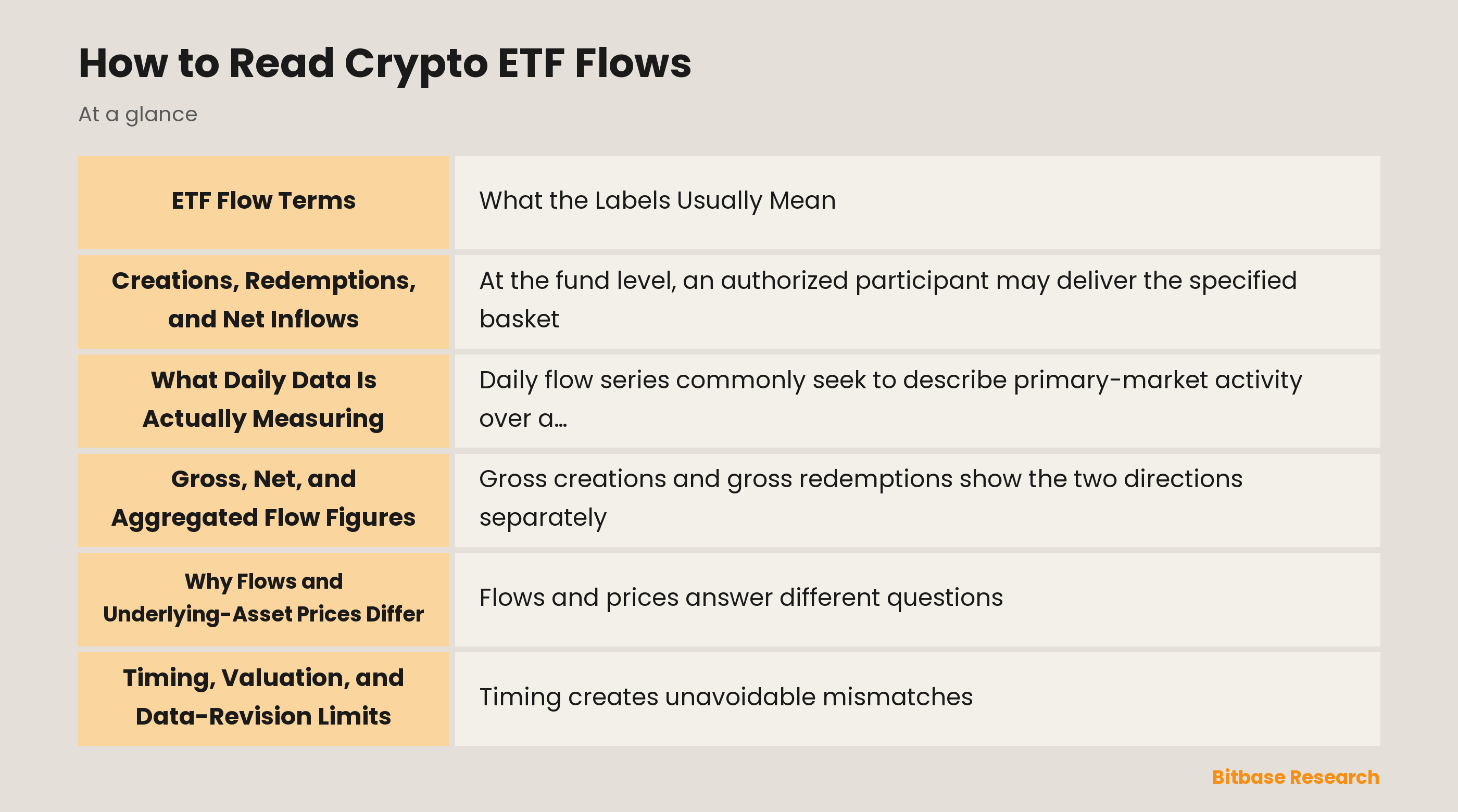
ETF Flow Terms: What the Labels Usually Mean
An ETF flow is a summary of changes associated with a fund’s shares and assets over a stated period. An inflow normally denotes net creation of fund shares or value entering through that creation process, while an outflow normally denotes net redemption. A net flow offsets one against the other. Those labels are useful shorthand, but their precise meaning comes from the source’s methodology. Some reports express the result in a currency, some in shares, and some display total net assets, which is not itself a flow measure.
Readers looking for “spot bitcoin etf inflows explained” are usually asking about this accounting layer rather than a record of every trade on an exchange. For a crypto ETF, the stated exposure, creation arrangement, and published fields can differ by structure. A careful definition therefore says whether the number reflects primary-market activity, a change in total assets, or an estimate constructed from reported shares and NAV. Without that definition, an identical-looking label can refer to different observations.
Creations, Redemptions, and Net Inflows
At the fund level, an authorized participant may deliver the specified basket, cash, or a combination described by the fund’s process and receive a large block of ETF shares called a creation unit. The fund then has more shares outstanding. This is a creation in the primary market. It can be connected with later secondary-market activity, but the creation itself is an institutional fund-level process rather than a complete record of one identifiable investor’s decision.
A redemption works in reverse: an authorized participant returns a creation-unit quantity of ETF shares to the fund and receives the applicable basket, cash, or combination. The outstanding-share count then falls. When the value of creations exceeds the value of redemptions for the same defined period, a dataset may call the difference a net inflow; the opposite relationship may be called a net outflow. Neither label proves that every creation reflects new long-term demand or that every redemption carries a uniform negative meaning.
What Daily Data Is Actually Measuring
Daily flow series commonly seek to describe primary-market activity over a defined business-day window. Depending on the publisher, the input may be direct fund records, a reported change in shares outstanding, a NAV-based valuation, creation and redemption information, or a combination of such fields. The result may be published as a final fund figure or as an estimate subject to later confirmation. Two sources can use the same word, “flow,” while relying on different inputs and cutoffs.
The phrase “crypto etf daily flows meaning” therefore has an operational answer before it has an interpretive one. Check which date is assigned to the observation, whether that date is a trade date, valuation date, settlement-related date, or publication date, and which currency and close are used. A daily number is an observation defined by those choices, not a continuous cash meter for an entire market. Its useful scope is the period and methodology stated alongside it.
Gross, Net, and Aggregated Flow Figures
Gross creations and gross redemptions show the two directions separately. A net flow subtracts one from the other, which can make a busy day look quiet when both amounts are large and similar. Conversely, a sizable net result does not reveal whether it came from one direction alone or from larger activity offset by the other direction. Knowing whether a figure is gross or net prevents a reader from treating a compact summary as a full activity log.
Aggregation adds another layer of definition. A total is comparable only when its constituents, inclusion rules, base currency, valuation point, and treatment of creations and redemptions are known. One compiler may include a broader or narrower set of funds than another, or may use a different daily cutoff, while both calculations remain internally consistent. An aggregate also cannot identify the origin of funds, the type of holder, or the purpose behind a creation or redemption.
Why Flows and Underlying-Asset Prices Differ
Flows and prices answer different questions. A flow tracks a defined change in fund shares or their measured value; a market price reflects valuations and trading conditions at a particular time. The creation and redemption mechanism can help authorized participants keep an ETF share price near its NAV through arbitrage, but it does not guarantee that the two measures match at every moment. Premiums, discounts, spreads, timing differences, and changing underlying valuations can all matter.
Total net assets can change because the value of a portfolio changes, because the number of ETF shares changes, or because both change together. As a result, an increase in assets can occur on a net-outflow day if valuation gains are large enough, and a reported inflow can coincide with a decline in an underlying asset’s price. Neither pairing establishes a cause. A flow series describes a bounded fund-accounting observation, not a price forecast or a complete explanation of market movement.
Timing, Valuation, and Data-Revision Limits
Timing creates unavoidable mismatches. Crypto asset markets can operate across broader hours than an ETF’s trading session and closing process, so a provider may observe holdings, market prices, and NAV at different cutoffs. A flow labelled with one date can enter the creation or redemption process, receive a valuation, and be published on separate schedules. Market holidays, settlement conventions, and the local time zone of a data source can further change how a “daily” line should be read.
Valuation choices and data revisions create another limit. NAV depends on the value of assets minus liabilities and on the share count used for a per-share calculation; currency conversion and pricing-source conventions can affect a reported value. A provider or fund may correct a share count, NAV, or historical record after an initial publication. Comparing a number responsibly therefore means noting its timestamp, source, currency, scope, and stated methodology. A revision is a data correction or a changed method, not automatically a new economic event.
A Neutral Framework for Reading a Flow Report
A neutral reading begins with four questions: who supplied the data, what exactly counts as a flow, which date and currency apply, and whether the number is gross, net, or aggregated. Then keep primary-market creations and redemptions separate from secondary-market turnover and from changes in the underlying asset’s price. This framework makes it possible to describe a figure precisely without turning it into a verdict about demand, sentiment, or the quality of a particular fund.
A flow report is most useful as a bounded piece of fund-accounting context. By itself, it cannot identify every participant, establish an investor’s intention, prove a causal relationship, predict a price, or determine whether an ETF suits anyone’s circumstances. Read the methodology and relevant fund documentation for definitions and limits, and keep the report’s timestamp visible when comparing observations. That habit supports clearer market education while avoiding an unsupported conclusion from a single daily number.
Disclaimer: This article is educational content from Bitbase Academy, provided for information only. It does not constitute investment, trading, tax, or financial advice. Crypto assets are volatile; assess your own risk. Written as of August 2026; refer to the latest official information.
References
[1] U.S. SEC: Exchange-Traded Funds Small Entity Compliance Guide sec.gov
[2] Investor.gov: Updated Investor Bulletin—Exchange-Traded Funds (ETFs) investor.gov
[3] Investor.gov: Net Asset Value investor.gov
[4] Investment Company Institute: ETF Basics and Structure FAQs ici.org
[5] Investment Company Institute: The US ETF Market FAQs ici.org