
An airdrop-themed post can spread quickly because it combines a familiar name, a visual that looks polished, and a suggestion that attention must be paid immediately. None of those features establishes that an announcement is genuine. A careful reader separates the subject of a message from the evidence for the message. The useful question is not whether a post is exciting or widely repeated. It is whether the message can be verified through independent evidence that does not rely on the message itself.
This article uses independent, impersonation, and verify as practical concepts. Independent evidence comes from a source or record reached separately from the item being evaluated. Impersonation is the act of borrowing cues that make a message appear to come from a trusted source. To verify is to compare claims with evidence while leaving room for an unresolved result. That framing is deliberately cautious: a reader can recognize a lack of proof without asserting that a particular project, account, or page is fraudulent.
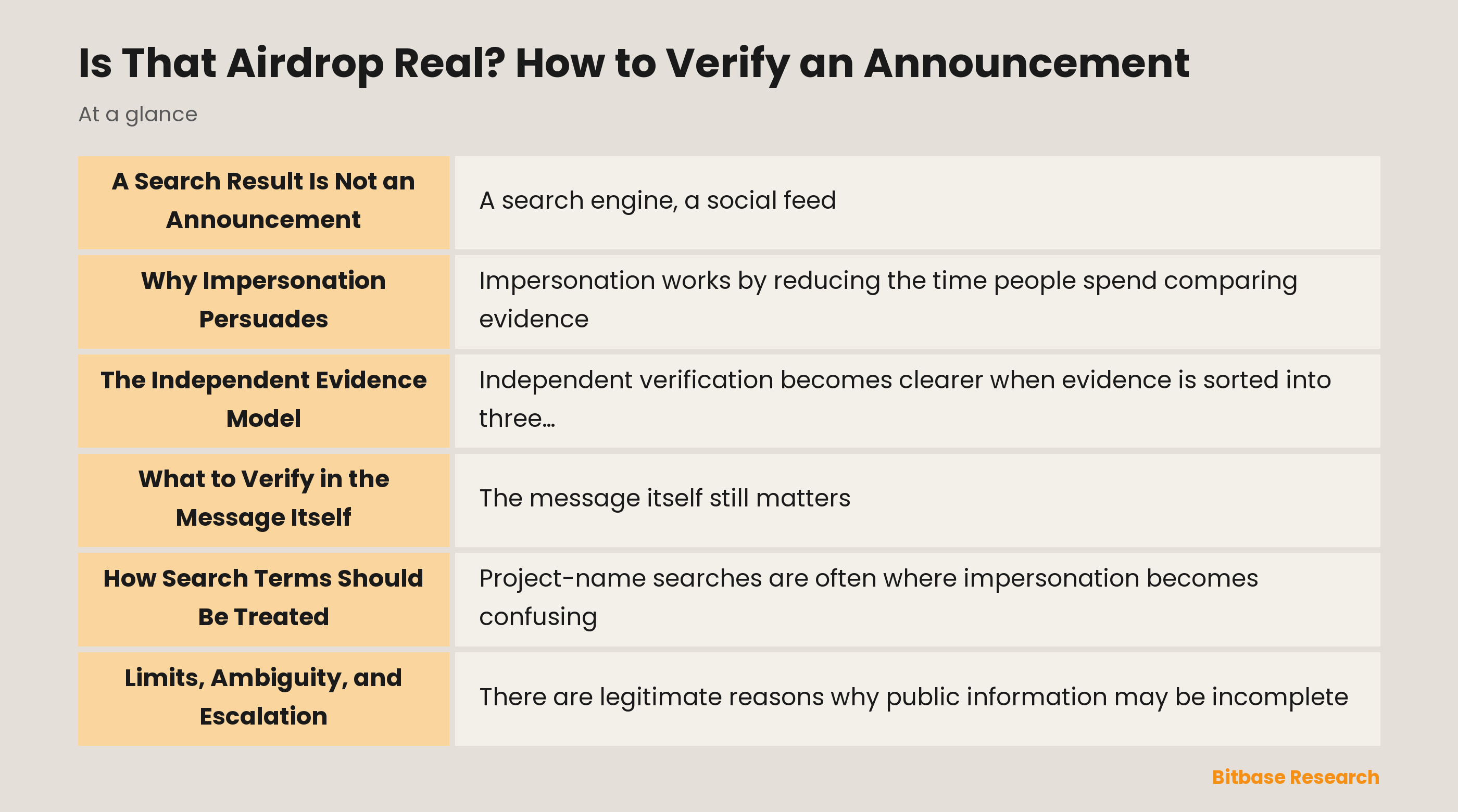
A Search Result Is Not an Announcement
A search engine, a social feed, and a chat channel are discovery systems. They can surface useful material, but they also surface copied wording, paid placement, stale screenshots, parody, and impersonation. Seeing the same phrase in several places may show that the phrase is being repeated; it does not show that the underlying statement has a trustworthy origin. Repetition is especially weak evidence when accounts cite one another in a loop or when every post points back to the same unverified item.
An announcement should therefore be understood as a claim that needs a source history. A sound assessment asks whether there is a consistent identity behind the communication, whether the wording is stable across independently reached public records, and whether the context matches established publishing behavior. These are evidence questions, not popularity questions. A logo, a verified-looking badge, a follower count, or professional design can be copied or misread. They may be cues worth noticing, but they are not proof by themselves.
The standard is not perfection. Public communications can be incomplete, delayed, translated, or corrected. The important distinction is between an ordinary ambiguity and a message that depends on urgency, secrecy, or a single supplied route for validation. If a statement cannot be confirmed beyond its own links, images, and reposts, the appropriate conclusion is simply that it remains unverified.
Why Impersonation Persuades
Impersonation works by reducing the time people spend comparing evidence. A message may imitate a familiar voice, reuse an image, copy a name with a minor spelling difference, or borrow a tone of authority. It may also rely on social proof: replies, reactions, screenshots, or comments that appear to confirm the story. These details can make a message feel coherent even when its origin has not been established.
Security authorities describe phishing as deception that seeks sensitive information, a response, or movement toward a harmful destination. The wording can be emotional, urgent, flattering, or alarming. In an airdrop context, the content may use scarcity language or suggest that a short window is closing. Such language does not prove malicious intent, and its absence does not prove safety. It is a reason to slow the evidentiary judgment and look for a separate record of who published the statement.
An impersonation test is therefore about identity continuity. Does the apparent author have a durable, recognizable publishing history? Are identity cues consistent across sources that were found independently? Is the alleged message supported by materials that do not derive from the same repost chain? The goal is not to guess an attacker’s motive. It is to avoid converting resemblance into certainty.
The Independent Evidence Model
Independent verification becomes clearer when evidence is sorted into three categories. The first is identity evidence: information that helps establish who is speaking, without relying only on a display name, image, or message supplied by an unknown sender. The second is publication evidence: a stable record that shows what was said, in what context, and whether the wording is consistent across separate records. The third is request evidence: what the message asks a reader to do, disclose, or trust.
Each category should be assessed separately. Strong publication evidence cannot automatically compensate for weak identity evidence. Likewise, a familiar-looking identity does not make an unusual request harmless. A careful verifier considers whether the three categories reinforce each other or conflict. Conflicts are often more informative than decorative similarities: a different spelling, an unfamiliar destination, a changed tone, or a demand for immediate action can show that the apparent story has not yet met a reasonable evidentiary standard.
This model also prevents an all-or-nothing mistake. A reader need not label something authentic or malicious based on one clue. Possible outcomes include confirmed by multiple independent records, plausible but incomplete, internally inconsistent, or insufficiently evidenced. The last of these is not a failure of analysis. It is a disciplined conclusion when the available material does not support a stronger one.
What to Verify in the Message Itself
The message itself still matters, but it should be treated as an object of analysis rather than a source of final authority. Notice the claimed author, the language used to create urgency, the specificity of the information, and the relationship between the stated purpose and the requested response. A vague announcement paired with a highly specific request deserves more scrutiny than a message that can be tied to a coherent, independently available publication record.
Wording may reveal pressure techniques. Broad promises paired with a countdown, unusual secrecy, demands to bypass normal communication, or instructions that discourage comparison are all signals that independent verification is important. In contrast, a precise explanation can still be incomplete or copied. Detail is not a substitute for provenance. The essential question remains whether the details can be corroborated without trusting the same item that introduced them.
Visual analysis has similar limits. Typography, color, embedded video, a familiar avatar, and a polished landing page can all be reproduced. Image metadata and a screenshot’s visible date can also be missing, altered, or unrelated to the message’s origin. These clues may help describe a message, but they should not be presented as conclusive proof. A reliable conclusion rests on the relationship among independently obtained records, not on a single visual cue.
How Search Terms Should Be Treated
Project-name searches are often where impersonation becomes confusing. The following phrases are included only as neutral search strings; none indicates that an announcement, distribution, entitlement, or authentic channel exists. A query can lead to unrelated posts, stale pages, advertisements, commentary, or copycat material. It is not evidence on its own.
- `bera airdrop`
- `monad airdrop`
- `solana seeker airdrops`
- `aster airdrop`
- `opensea airdrop`
- `linea airdrop`
- `meteora airdrop`
- `lighter airdrop`
- `jup airdrop`
- `falcon finance airdrop`
- `immortal rising 2 airdrop`
- `zama airdrop`
The safest analytical use of any such phrase is to ask what it actually establishes. It may establish only that someone used those words. It does not establish identity, authorization, time relevance, authenticity, or a route to any outcome. A good write-up should preserve that distinction explicitly, particularly when a search term resembles a brand, product, protocol, game, account, or community. Neutral wording avoids turning keyword coverage into an unsupported statement about the named entity.
The same restraint applies to search-result ranking. High placement can reflect relevance, advertising, personalization, or repetition. Low placement can reflect indexing delay or a narrow query. Neither position is a trust signal in isolation. Search is useful for finding claims that need independent comparison; it is not the final comparison itself.
Limits, Ambiguity, and Escalation
There are legitimate reasons why public information may be incomplete. Teams can coordinate across time zones, publish translations at different moments, correct errors, or keep operational details private. A cautious verifier should not treat incompleteness as proof of wrongdoing. At the same time, ambiguity should not be filled with optimistic assumptions. When independent confirmation is absent, the accurate description is that confirmation is absent.
This is also why the article avoids a checklist that promises certainty. Verification is an evidence discipline, not a ritual. A message can satisfy superficial checks and still be an impersonation; a real organization can also issue a poorly worded notice. The quality of the conclusion should match the quality of the evidence. When the message has security implications, the most responsible response is to pause, preserve the context for review, and use established security or consumer-protection reporting channels appropriate to the reader’s jurisdiction.
The result may be a decision to wait for better evidence rather than a final label. That outcome protects the difference between "not yet independently verified" and "known to be false." It also avoids amplifying unproven allegations about named projects or individuals. The purpose is not to predict activity or identify winners; it is to make impersonation less effective by requiring evidence that is separate, consistent, and proportionate to the claim.
Sources
- Federal Trade Commission: How To Recognize and Avoid Phishing Scams
- CISA: Avoid Phishing Scams with Three Simple Tips
- UK National Cyber Security Centre: Report a scam email
- UK National Cyber Security Centre: Phishing attacks: defending your organisation
Disclaimer: This article is educational content from Bitbase Academy, provided for information only. It does not constitute investment, trading, tax, or financial advice. Crypto assets are volatile; assess your own risk. Written as of August 2026; refer to the latest official information.
References
[1] Federal Trade Commission: How To Recognize and Avoid Phishing Scams consumer.ftc.gov
[2] CISA: Avoid Phishing Scams with Three Simple Tips cisa.gov
[3] UK National Cyber Security Centre: Report a scam email ncsc.gov.uk
[4] UK National Cyber Security Centre: Phishing attacks: defending your organisation ncsc.gov.uk