Derivative markets can move sharply even when the public news story has not changed. The phrase liquidation cascade explained usually names one mechanism behind that acceleration: losses reduce available margin, a venue closes positions that no longer meet its rules, and those compulsory orders may meet limited opposing interest. This article separates that process from ordinary buying and selling, describes why squeezes can run in either direction, and marks the limits of explanations drawn from a chart. It is neutral education about market structure, not a guide to trading, predicting price, or choosing a platform.
Margin and Liquidation Thresholds
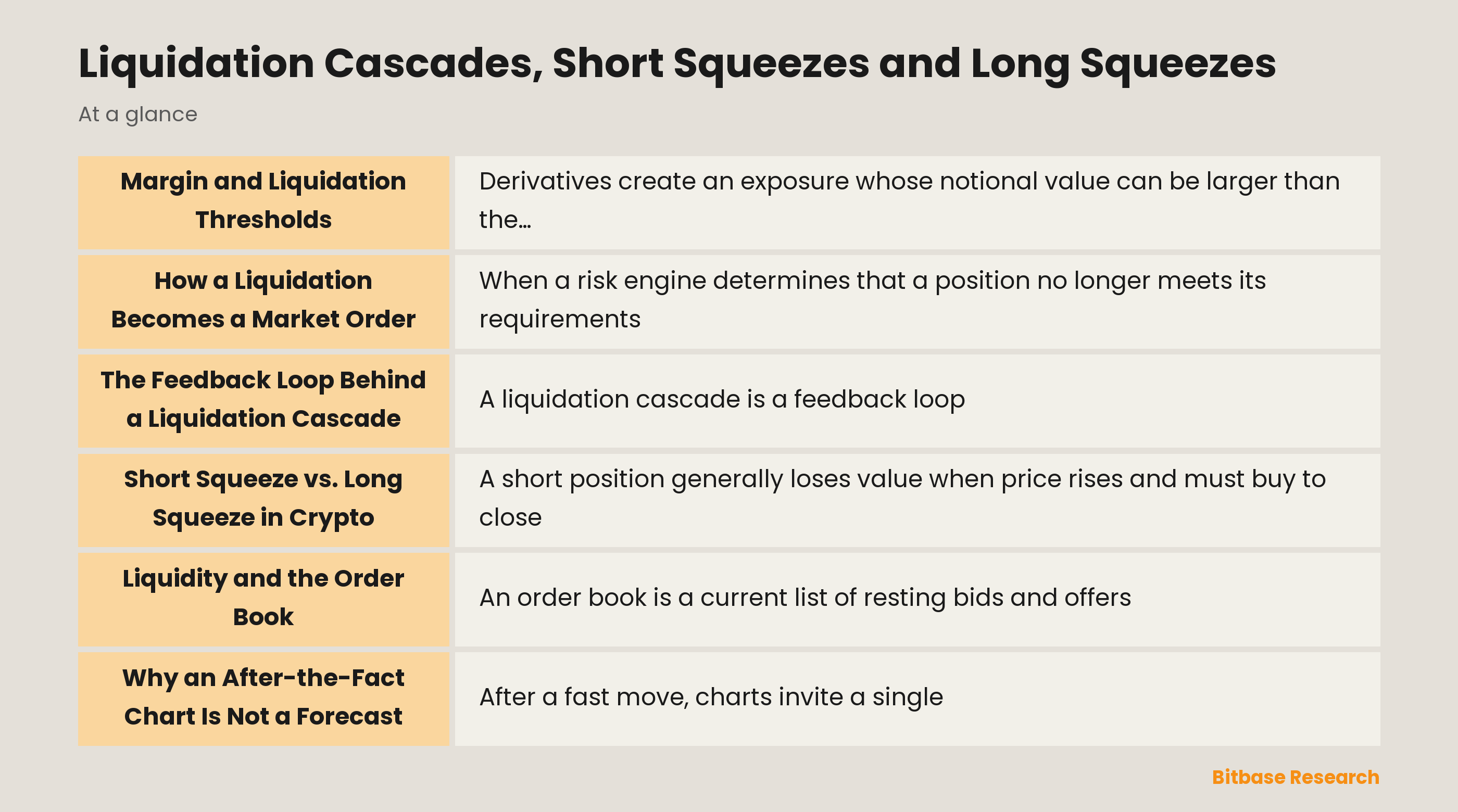
Derivatives create an exposure whose notional value can be larger than the collateral supporting it. Initial margin is the collateral required to establish a position, while maintenance margin is the minimum amount that must remain available under the relevant rules. As profit and loss changes, account equity changes too. Whether a threshold is reached can also depend on the contract, collateral valuation, unrealized profit and loss, and the venue’s risk model. Exact formulas, permitted leverage, contract units, and the distinction between isolated and cross-collateral arrangements differ by product and venue. There is no universal liquidation price that applies everywhere.
Many systems measure risk against a mark price, rather than only the most recent trade. That design can limit the effect of a brief anomalous print, but it also means that a displayed last trade is not necessarily the precise trigger for liquidation. A rapid move near a threshold can change both the value of a position and the margin required to support it. Traditional futures settings may use margin calls and clearing procedures, while some perpetual products can use automated reduction or closure. The stable idea is a threshold rule; the precise calculation, timing, and outcome remain venue-specific.
How a Liquidation Becomes a Market Order
When a risk engine determines that a position no longer meets its requirements, its purpose is risk control rather than a view about market direction. A general liquidation workflow may cancel open orders, reduce part of a position, close a position, transfer exposure, or use another documented process. Matching priority, partial-liquidation rules, and arrangements such as insurance funds or automatic deleveraging vary. It is therefore important to distinguish a venue’s forced-risk process from a person independently deciding to buy or sell. A forced closure is not a forecast and does not reveal the reason that the initial price move occurred.
Closing a liquidated long position requires selling, while closing a liquidated short position requires buying. The resulting order may be a market order or another order that is immediately executable against resting interest. In a fast market, execution is not guaranteed at the last displayed price. If the available quantity at the nearest price level is insufficient, the order can interact with further levels of the book, producing different execution prices across its size. Risk controls can limit exposure or address account deficits, but they do not make the market impact of a compulsory order identical across contracts, accounts, or venues.
The Feedback Loop Behind a Liquidation Cascade
A liquidation cascade is a feedback loop. Suppose an initial price move causes one group of positions to fall below a maintenance requirement. The resulting compulsory orders can demand liquidity in the same direction as the move. If they move the relevant price reference further, another group may reach its threshold, creating more compulsory orders. The sequence can slow or stop when opposing interest absorbs the flow, when thresholds are no longer nearby, or when other participants change the balance of orders. It does not require every position on one side of a market to be liquidated.
The term names a relationship, not a complete cause. An initial move can be associated with spot flows, news, hedging, options activity, index changes, or many other conditions. Different venues can calculate thresholds differently, public liquidation data can be incomplete or delayed, and a single rapid move can combine several effects. A cascade is a plausible mechanism only when the relevant rules, positions, price references, and executions are consistent with that account. A large volume figure or a fast candle by itself does not prove a liquidation cascade.
Short Squeeze vs. Long Squeeze in Crypto
A short position generally loses value when price rises and must buy to close; a short squeeze is upward feedback in which short closures or liquidations add buy-side demand. A long position generally loses value when price falls and must sell to close; a long squeeze is downward feedback in which long closures or liquidations add sell-side demand. The phrase short squeeze vs long squeeze crypto therefore concerns the direction of the move and the closing order that the affected side needs. It is not a moral judgment about either side, a measure of which outcome is more likely, or a signal to take an action.
Squeeze is often used loosely after volatile events. A short squeeze does not mean every short position was liquidated or that price must continue rising, and a long squeeze does not mean every long position was liquidated or that price must continue falling. Voluntary position changes, hedging, options activity, and spot-market flows can resemble or accompany either pattern. The directional label describes a possible feedback tendency and a process that may be reconstructed afterward. It neither ranks risks nor tells a reader how to respond to a price move.
Liquidity and the Order Book
An order book is a current list of resting bids and offers. Order-book depth describes the quantity available at particular price levels. A marketable sell order interacts with bids, and a marketable buy order interacts with offers. If an order is larger than the nearest available layer, it can continue to later levels. Slippage is the difference between an expected or reference price and the prices actually obtained as an order executes. Spreads, depth, and visible quotations can change while the order is being processed; displayed depth is a snapshot, not a promise of unlimited execution.
Liquidity is not the same thing as volume alone. Heavy turnover can coexist with limited displayed depth, wider spreads, or rapidly changing quotes. During volatility, liquidity providers may reduce, cancel, or reprice resting interest because the risk of quoting has changed; new interest may also appear and replenish the book. The effect of a compulsory order depends on its size relative to opposing interest, on the price reference used by the risk process, and on the details of matching. Saying that a market “had liquidity” requires a time, price range, venue, and data method, none of which is fully visible in a single candlestick.
Why an After-the-Fact Chart Is Not a Forecast
After a fast move, charts invite a single, tidy story. A price chart can show timing, but it cannot show the full causal chain. A public liquidation feed may cover only one venue, a reported execution may be delayed, an index may differ from the price used for a threshold, and open interest is an aggregate measure rather than a map of individual liquidation levels. A later explanation is stronger when it identifies the data examined, separates observed facts from inference, and states what remains unknown.
Forecasting is a different task. It would require knowledge of future order-book depth, quote cancellations, positions, threshold rules, external flows, and the relationship among price references—information that is incomplete and can change quickly. A past cascade does not provide a future threshold map. A reversal after a forced-flow episode can happen, or it may not; there is no mechanical rule. Labels such as cascade or squeeze should therefore not turn a historical chart into causal certainty or a prompt for behavior.
Risk Boundaries and a Vocabulary
The vocabulary is descriptive, not instructional. Initial margin supports opening exposure, maintenance margin is a continuing minimum, and a mark price is a risk reference that can differ from the last trade. Liquidation is a forced risk process, while a liquidation cascade is feedback among threshold breaches, compulsory orders, and price references. A short squeeze and a long squeeze identify opposite directions of possible forced closing flow. Order-book depth, slippage, and open interest help describe execution conditions and aggregate positioning, but none of these terms states what should happen next.
Leveraged derivatives can magnify losses, and the relevant contract rules, collateral treatment, price references, liquidity conditions, and legal availability can change. This explanation does not select or endorse an asset, a position, a platform, or a course of action. Its risk boundary is deliberate: market mechanisms can clarify how an event may unfold, but they cannot remove uncertainty, guarantee an outcome, or convert a retrospective narrative into advice.
Disclaimer: This article is educational content from Bitbase Academy, provided for information only. It does not constitute investment, trading, tax, or financial advice. Crypto assets are volatile; assess your own risk. Written as of August 2026; refer to the latest official information.
References
[1] CFTC: Customer Advisory—Understand the Risks of Virtual Currency Trading cftc.gov
[2] CME Group: The Benefits of Futures Margins cmegroup.com
[3] Coinbase Help: Liquidation management (International Derivatives) help.coinbase.com
[4] Coinbase Help: Order Matching help.coinbase.com
[5] Investor.gov: Types of Orders investor.gov