A lost seed phrase can feel like a single emergency, but that phrase often compresses several very different situations into one label. A record may be unavailable, a device may still hold an active session, an account layer may remain accessible, or the cryptographic authority itself may be absent. Those distinctions matter because lost seed phrase recovery options are not a universal reset process. They are a way to describe what kind of access, if any, already exists and what a system can actually verify. Clear language is especially important when fear, urgency, and unfamiliar technical terms make confident promises seem more persuasive than the underlying facts.
What a Seed Phrase Controls
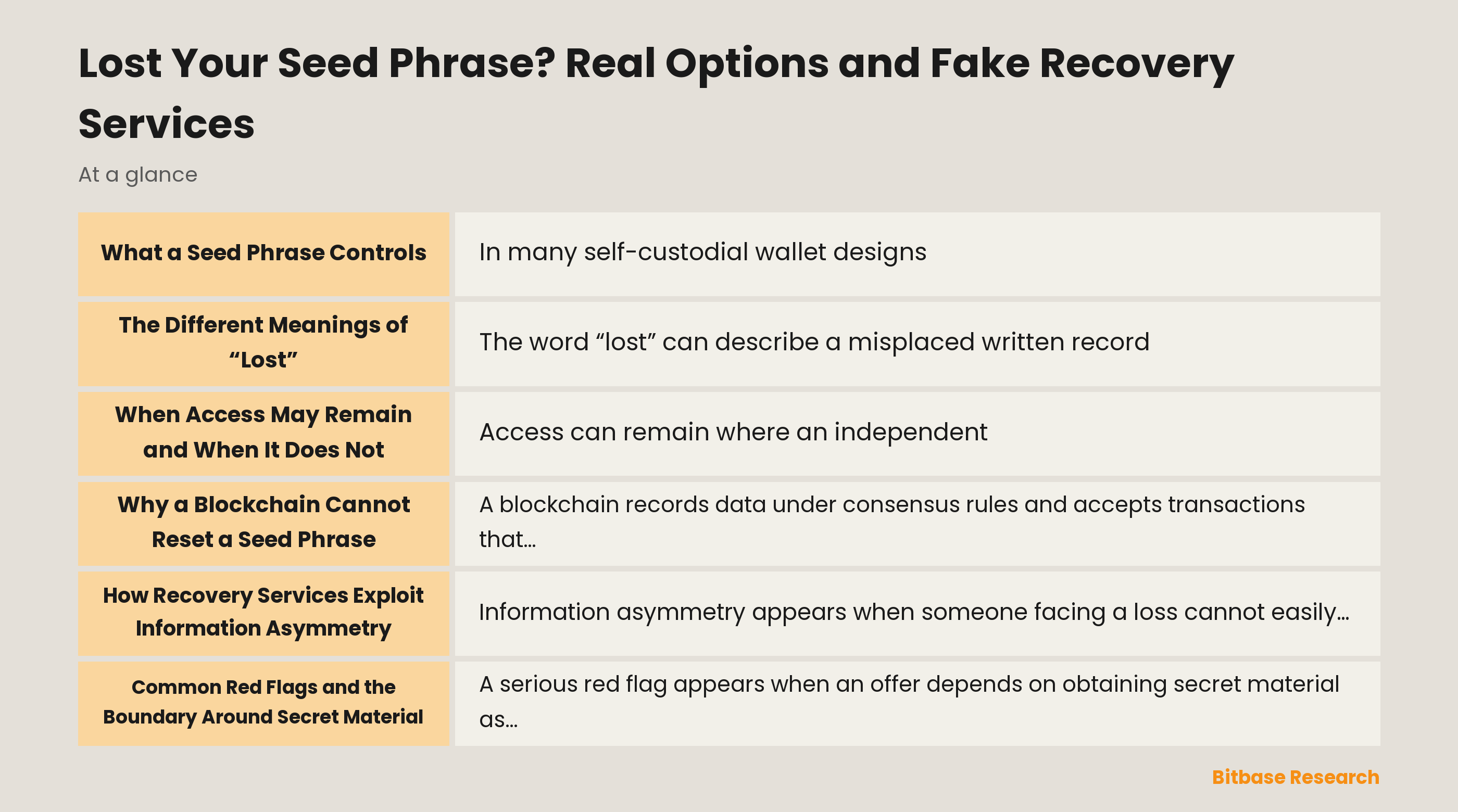
In many self-custodial wallet designs, a seed phrase is a human-readable representation connected to the secret material from which a wallet can derive keys. BIP39 describes one widely used mnemonic format for generating a deterministic wallet seed, but wallet designs and compatible formats are not all identical. The central idea is stable: the phrase is associated with cryptographic authority, not with a public customer profile held by a blockchain.
That distinction explains why the phrase has such a high security value. A public ledger can display addresses, transaction history, and balances according to its rules, while the secret needed to create a valid signature remains outside the ledger. There is no public directory that maps an address back to its seed phrase. Possession of the phrase or equivalent secret material can confer control, whereas public visibility does not reveal or replace that authority.
The Different Meanings of “Lost”
The word “lost” can describe a misplaced written record, an incomplete recollection, an unavailable device, a forgotten application password, a continuing signed-in state, or an account managed through a separate provider-controlled layer. These are not interchangeable events. Some concern an absent secret, while others concern a missing route to an account or a device that may still contain independently controlled access.
The differences also extend to technical design. A wallet may use a mnemonic format, another form of backup, multiple approvals, or settings that affect which keys are associated with the same underlying material. A custodial account can have administrative identity and access systems that are separate from an on-chain key. No single label captures all of those cases, and no public address alone establishes which one applies.
When Access May Remain and When It Does Not
Access can remain where an independent, already-authorized condition still exists, such as an intact application state, a provider-controlled account layer, or a separately designed authorization arrangement. In that circumstance, the relevant fact is continuing access through a particular system, not evidence that a blockchain can reconstruct an absent secret. The scope and meaning of that access depend on the system’s design and the conditions that were already in place.
For a genuinely self-custodial wallet, the situation is different when neither the seed phrase nor equivalent secret material remains available and no independent authorization exists. The network can still retain public transaction data and can still validate signatures, but it has no owner registry that can reissue a secret. Cryptographic security intentionally makes the secret infeasible to derive from public information. In some cases, the accurate description is simply that no remaining technical basis is visible for recreating that authority.
Why a Blockchain Cannot Reset a Seed Phrase
A blockchain records data under consensus rules and accepts transactions that satisfy its validation requirements. It does not normally record a person’s identity, retain a recoverable copy of each private credential, or decide who should receive a replacement secret. An address and its history can be observable forever without making the secret that controls it observable. Public data helps the network verify a submitted signature; it does not equip the network to generate one for someone else.
The idea of a reset belongs to systems with an administrative authority that can change an account credential under a defined policy. A self-custodial cryptographic secret does not have that central reset authority. If a ledger could manufacture a replacement from public evidence, the same mechanism would undermine the security model for every holder. The absence of a reset function is therefore not a support failure or a missing form; it follows from the division between public verification and private signing authority.
How Recovery Services Exploit Information Asymmetry
Information asymmetry appears when someone facing a loss cannot easily distinguish public blockchain data, wallet software behavior, account administration, and secret-key authority. A purported recovery service can use correct fragments of technical language, public transaction details, or a complicated explanation to make its claims sound exclusive. Visibility into an address can create an illusion of access, even though address visibility does not supply the cryptographic material required to control it.
The phrase wallet recovery service risks describes this gap more accurately than any single technology does. A persuasive offer may blur technical diagnosis, customer support, investigation, and collection of secret material into one supposed solution. Fees, urgency, and certainty can make the proposal feel concrete while leaving its central claim unsupported: that an outside party can create, infer, or safely obtain authority that the original system deliberately keeps private.
Common Red Flags and the Boundary Around Secret Material
A serious red flag appears when an offer depends on obtaining secret material as a condition of assessment, verification, synchronization, or recovery. Seed phrases, private keys, and signing capability are not ordinary case documents or identity proofs. They are control credentials. Once copied into a message, form, screen, or conversation, another party may possess the same authority that the original holder possessed, regardless of the stated purpose for requesting it.
Other warning signs can include a guaranteed outcome, an urgent deadline, a request for advance payment, a claimed affiliation that cannot be independently established, or a display of public transaction data presented as proof of private access. These signals matter because public information and private authority are categorically different. A clear boundary separates observing an address from possessing its control material, and many deceptive claims depend on concealing that boundary.
Security Language That Does Not Make Promises
Careful security language identifies the state being discussed instead of treating every loss as the same event. It can distinguish a missing record from continuing account access, a device issue from an absent cryptographic credential, and public ledger evidence from proof of control. It does not turn uncertainty into a promise, and it does not describe a third party as able to manufacture a secret simply because the relevant address can be seen.
This vocabulary keeps the subject grounded in design limits rather than hope or pressure. It acknowledges that access conditions vary, while refusing to convert that variability into an assurance that assets, secrets, or authority can be recovered. The useful conclusion is factual: confidence should be proportional to the evidence and to the system’s actual architecture, not to a persuasive claim, a visible balance, or a dramatic story about hidden technical power.
Disclaimer: This article is educational content from Bitbase Academy, provided for information only. It does not constitute investment, trading, tax, or financial advice. Crypto assets are volatile; assess your own risk. Written as of August 2026; refer to the latest official information.
References
[1] BIP 39: Mnemonic code for generating deterministic keys bips.dev
[2] Bitcoin.org: Vocabulary bitcoin.org
[3] Bitcoin.org: Securing your wallet bitcoin.org
[4] U.S. FTC: Worried about crypto exchange losses? Don’t pay money for help recovering money consumer.ftc.gov
[5] CISA: Phone Scammers Impersonating CISA Employees cisa.gov