Max pain, gamma squeezes and options expiry are three phrases that often appear together in crypto market commentary. They describe different mechanisms: a payoff calculation, a change in hedging pressure and a scheduled settlement event. None is a standalone price signal. Max pain is not a guaranteed magnet, a gamma squeeze is not the same as every short squeeze, and an expiry does not automatically create a directional move. The useful question is what the available data can support, and where the explanation stops being evidence.
What does max pain mean in crypto options?
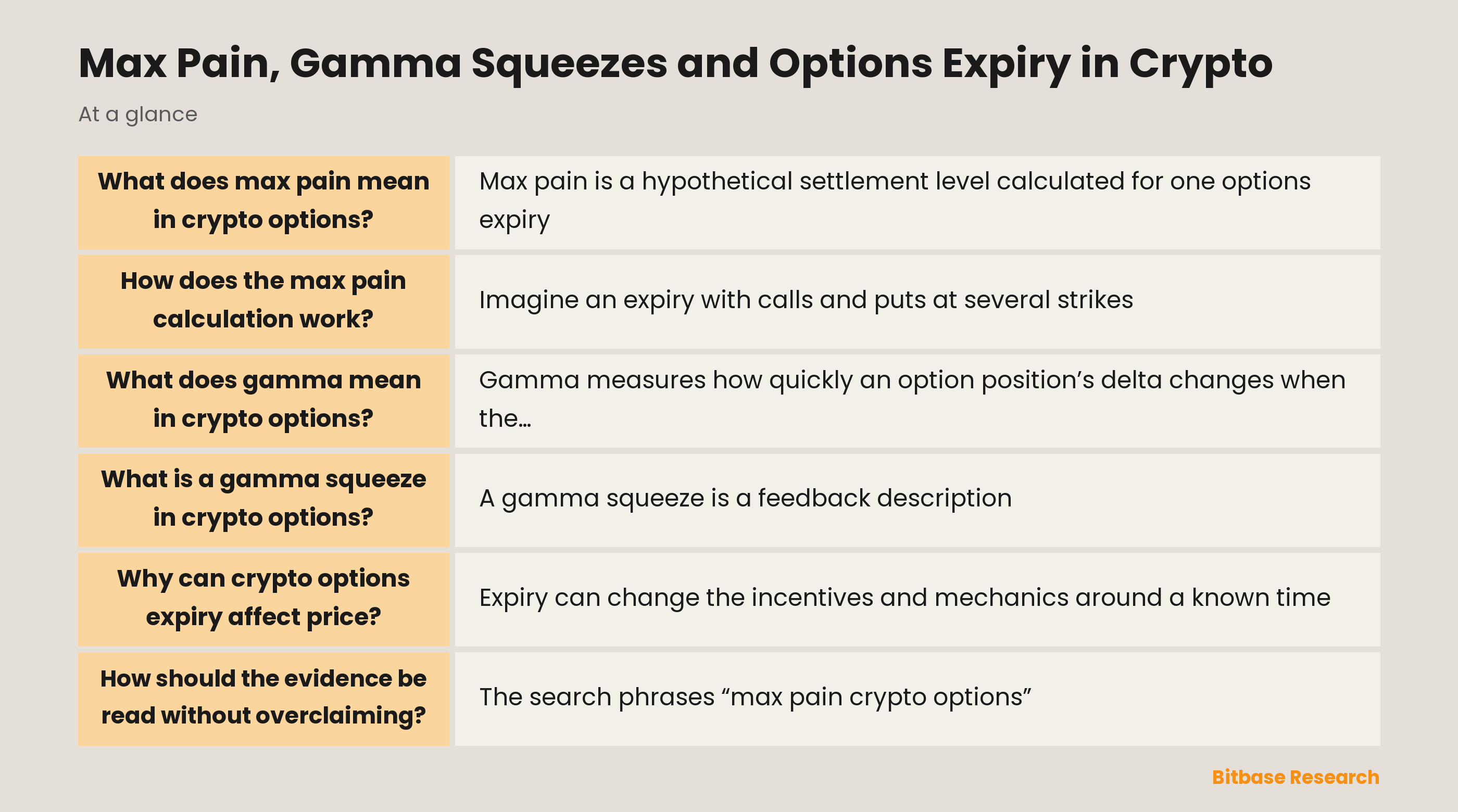
Max pain is a hypothetical settlement level calculated for one options expiry. A common calculation takes the open interest at each strike, estimates the intrinsic value of calls and puts at a range of possible settlement prices, adds the values together, and identifies the strike with the lowest aggregate value for option buyers. In that narrow sense, it is the point at which the group of option buyers would experience the most notional loss and option sellers would owe the least, under the assumptions of the calculation.
The phrase is easy to overstate. Open interest tells you that contracts remain open, not whether a particular participant is long or short, whether positions are hedged elsewhere, or whether the displayed strikes represent one coordinated book. Max pain also depends on the expiry, the strikes included, contract multipliers, settlement rules and the moment at which the open-interest snapshot was taken. It is a scenario computed from a distribution of contracts, not an observed force pulling spot toward a line.
How does the max pain calculation work?
Imagine an expiry with calls and puts at several strikes. For a candidate settlement price, an in-the-money call contributes the difference between settlement and strike, while an in-the-money put contributes the difference between strike and settlement. Those intrinsic amounts are multiplied by the relevant open interest and contract size, then summed across strikes. Repeat the process for every candidate strike; the minimum aggregate payout is labelled max pain.
This calculation can be useful as a compact description of where open interest is concentrated, especially when the expiry is close and the book is large enough to matter for liquidity. It does not reveal the full profit and loss of each participant. Premiums paid, volatility exposure, spreads, calendars, futures hedges, structured products and positions on another venue can all matter. Crypto venues can also use different settlement indexes or time-weighted procedures, so the number should be read with the contract specification beside it.
Max pain is therefore not a necessary destination. Price may finish far away because information, liquidations, spot demand, futures positioning, volatility repricing or simple lack of liquidity dominates the expiry book. Open interest can be closed, rolled or transferred before settlement. Even when price finishes near the computed strike, that coincidence does not prove that max pain caused the outcome.
What does gamma mean in crypto options?
Gamma measures how quickly an option position’s delta changes when the underlying price moves. A position with high gamma can change its directional exposure rapidly around the strike, particularly when the option is near the money and close to expiry. CME’s options education describes gamma as the change in delta per unit move in the underlying and notes that it is generally greatest near the strike. The sign belongs to the position: a long option has positive gamma, while a short option has negative gamma, even though the contract’s mathematical gamma is positive before position direction is applied.
For a delta-neutral market maker, the practical issue is hedge rebalancing. If the options book becomes more positive or negative in delta as spot moves, the hedge may need to be adjusted with spot, futures or perpetual contracts. A positive net gamma book tends to make those adjustments counter-move against the initial price move, which can dampen movement. A negative net gamma book can require buying as price rises and selling as price falls, which can add to movement. These are tendencies under a hedging model, not laws of market direction.
What is a gamma squeeze in crypto options?
A gamma squeeze is a feedback description, not a ticker label. One commonly discussed version begins when market makers are net short gamma, often because they sold options. If the underlying rises, the deltas of short calls can change in a way that requires more long underlying hedges. Their buying can reinforce the rise; if the move continues, the hedge requirement can grow faster near relevant strikes. The reverse pattern can amplify a fall when puts and the hedge direction line up.
The phrase only makes sense after the exposure is specified. A call option’s open interest does not tell you whether dealers are short those calls. A dealer may be long the option, may have offsetting structures, or may hedge with a different instrument. In crypto, an options market maker can use spot, futures or perpetuals, and the hedge may be split across venues. A spot short squeeze caused by futures or perpetual short covering can therefore happen without an options gamma mechanism. Conversely, options gamma can alter hedge flows without producing a dramatic squeeze in spot.
The evidence standard should be correspondingly high. A chart showing a large call wall, a rising price and an approaching expiry is not enough to establish a gamma squeeze. You would need a credible estimate of net gamma or dealer positioning, the relevant strikes and expiries, the hedge instrument, the market’s depth and a time window in which the predicted hedge flow could plausibly affect prices. Even then, the result is an explanation with uncertainty, not a reliable timing method.
Why can crypto options expiry affect price?
Expiry can change the incentives and mechanics around a known time. Traders may close or roll positions, options may settle or be exercised, market makers may reduce hedges, and short-dated gamma and theta can make exposures more sensitive. A large expiry can also coincide with a thin order book, a macro announcement or a futures funding reset. The observed move may reflect several flows at once, not “expiry” as a single cause.
Settlement details matter. Some crypto options use an index or a time-weighted average rather than one last trade. A time-weighted settlement can reduce the effect of a single print, but it does not remove all pre-settlement hedging or liquidity effects. The expiry date, settlement window, contract size, exercise style, underlying index and trading venues should be checked before comparing one event with another.
Expiry data is descriptive until it is connected to actual positioning. Open interest may be large while net delta is modest, or it may be concentrated in spreads that behave differently from naked calls and puts. A large notional expiry can also be small relative to spot and derivatives liquidity. Without those comparisons, a headline number says more about the size of a contract set than about its likely price impact.
How should the evidence be read without overclaiming?
The search phrases “max pain crypto options”, “gamma squeeze crypto options” and “crypto options expiry price impact” point to related questions, but they should not be treated as three ready-made trading signals. Start by identifying the exact expiry and settlement rule. Then record open interest by strike, changes in open interest, volume, implied volatility, estimated net gamma, spot and derivatives depth, funding or basis, and the instruments used for hedging. These variables help separate a payoff map from a potential flow.
Next, state what the data cannot show. Public open interest usually does not identify the beneficial owner, the dealer’s full hedge book or the direction of a complex spread. A max-pain chart cannot prove that anyone will defend a strike. A gamma estimate depends on assumptions about who is long or short and how positions are aggregated. A price move near expiry can be consistent with several explanations, so a careful account should list alternatives and avoid turning a post-event story into a forecast.
The strongest review is falsifiable. Ask what would weaken the explanation: no change in hedge demand, no concentration near the relevant strikes, a settlement rule that does not transmit the assumed flow, or a move that occurs outside the plausible hedge window. Compare the event with similar expiries, document the timestamp of every snapshot and separate observation from interpretation. This produces a more honest account of evidence strength without recommending a position or a direction.
The bottom line
Max pain is a hypothetical minimum-payout level derived from open interest for a specified expiry. It can summarize a contract distribution, but it is not a guaranteed magnet and does not reveal the whole market’s incentives. Gamma describes how delta changes, while a gamma squeeze requires a particular net exposure and hedge response. Options expiry can alter flows, but its price impact depends on settlement, positioning, liquidity and competing events.
Use these terms as labels for mechanisms to investigate, not as predictions. Separate spot short covering from options-driven hedging, distinguish contract open interest from dealer positioning, and report the evidence and its limitations together. That boundary keeps an educational explanation from becoming a timing method or investment advice.
Disclaimer: This article is educational content from Bitbase Academy, provided for information only. It does not constitute investment, trading, tax, or financial advice. Crypto assets are volatile; assess your own risk. Written as of August 2026; refer to the latest official information.
References
[1] Deribit Insights: Maximum Pain For Option Buyers Going Into Expiration deribit.com
[2] CME Group: Options Gamma The Greeks cmegroup.com
[3] Cboe: 0DTE Index Options and Market Volatility cboe.com
[4] CME Group: Options Analytics Greeks and Implied Volatility cmegroup.com
[5] Cboe: The Facts About Options cboe.com