An inheritance question changes the meaning of wallet control. In an ordinary arrangement, attention may stay on who can authorize a transaction today. In an inheritance context, it also matters to distinguish an address's cryptographic spending conditions from real-world questions of identity, consent, time, and authority. A multisig inheritance wallet is therefore a description of a possible authorization structure, not a promise that a particular person will receive or control an asset. It can be discussed without assuming that a key holder, a beneficiary, an executor, or a legal representative is the same person. The useful design question is what each condition can express, what it cannot prove, and where uncertainty remains.
Inheritance Contexts and Key Control
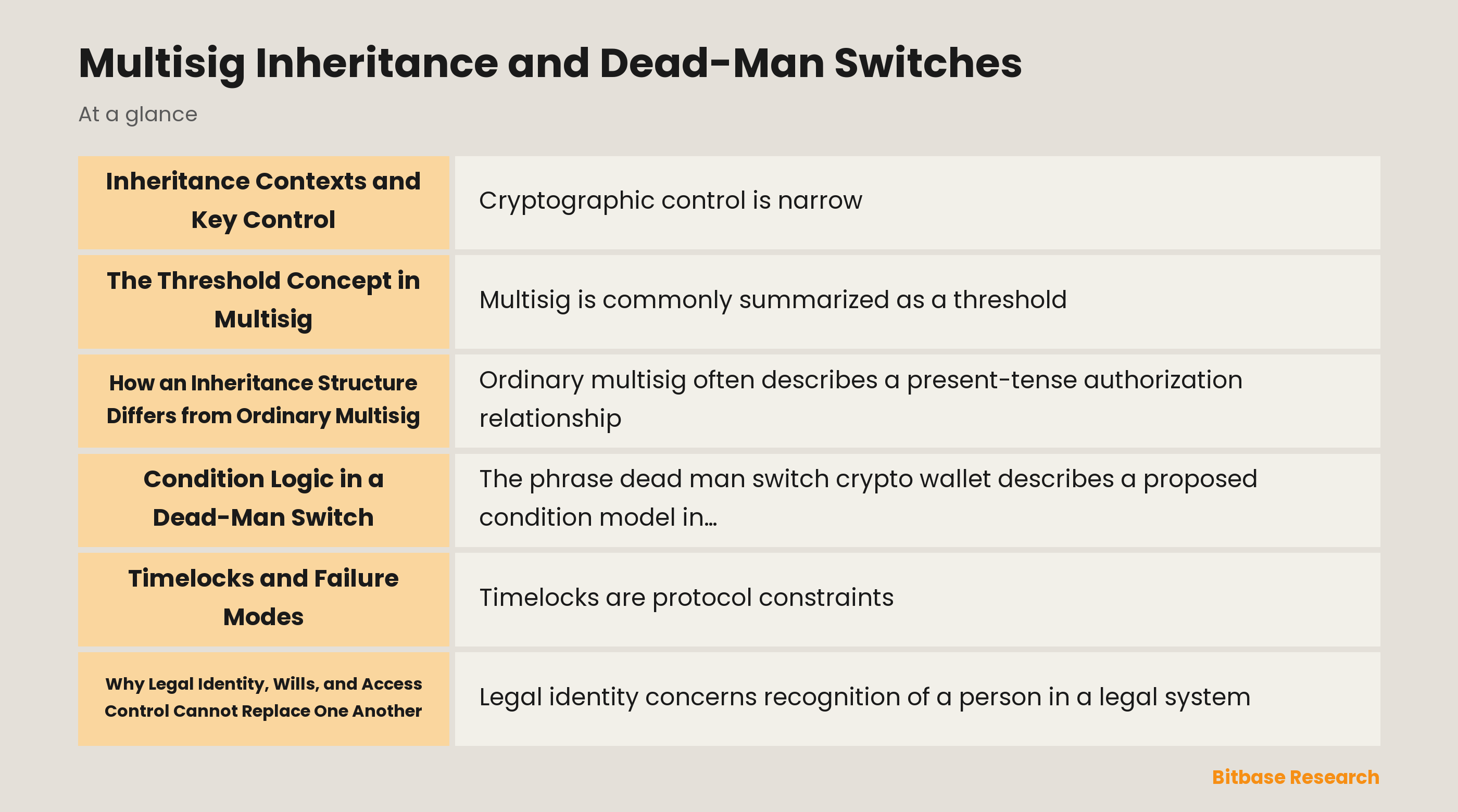
Cryptographic control is narrow. A key, or a collection of keys, can satisfy a condition defined by a protocol. That fact does not identify the human being behind a signature, show why that signature was made, or establish whether a person has authority outside the protocol. The distinction matters when inheritance language is attached to a wallet. Words such as heir, representative, family member, and key holder can describe overlapping people, but they do not name the same role by definition.
An inheritance context adds time and changed circumstances to the question of control. A person may be present but unavailable, alive but unable to act, or absent for reasons unrelated to death. A document may describe an intention while a signature condition describes only technical authorization. Treating either description as a complete substitute for the other hides a design trade-off: cryptography can evaluate defined inputs, whereas legal and personal circumstances require evidence and interpretation beyond an address.
The Threshold Concept in Multisig
Multisig is commonly summarized as a threshold: a condition accepts a stated number of valid signatures from a stated set of public keys. The notation M-of-N describes the number required and the number recognized by that condition. It does not itself say whether the keys are held by different people, by one person in separate contexts, or by organizations. It also does not assign a rank, a family relationship, or a legal entitlement to any key.
The threshold changes the shape of technical dependency. A lower required number may make an authorization condition easier to satisfy after one source becomes unavailable, while also reducing the number of separate confirmations the condition demands. A higher required number may demand more concurrent availability, while making a missing source more consequential. These are structural observations rather than judgments about what any person should use. The protocol sees valid signatures and condition satisfaction, not the surrounding reasons for either.
How an Inheritance Structure Differs from Ordinary Multisig
Ordinary multisig often describes a present-tense authorization relationship. Each recognized key contributes to one shared condition under the same general access rule. An inheritance-oriented description adds an intended change across time or circumstance. It may distinguish a current control condition from a later condition, or describe separate roles in ordinary language. Neither move automatically connects a later technical condition to a legally effective succession event.
That difference is important because the word inheritance can imply outcomes that a script cannot determine. A script cannot establish a person's identity, confirm a death record, resolve competing claims, interpret a will, or decide whether a signature was voluntary. It can only evaluate its own defined data. Calling a structure an inheritance structure can explain its intended context, but the label does not transform a cryptographic threshold into a complete record of ownership or authority.
Condition Logic in a Dead-Man Switch
The phrase dead man switch crypto wallet describes a proposed condition model in which a state changes after a signal has not been observed for a defined period. The phrase needs careful qualification. A missing signal is a technical observation, not evidence of death, incapacity, consent, disappearance, or legal authority. It may reflect an interruption, a device problem, an unavailable communication path, or another circumstance with no legal meaning.
Condition logic can express relationships among signals, elapsed time, signatures, and alternative branches. Its apparent clarity can obscure how much meaning lies outside the condition. A condition can test whether a specified input is present or whether a protocol time reference has passed; it cannot learn why an input is absent. The design trade-off is between a rule that is mechanically observable and the richer real-world judgment that the rule cannot make.
Timelocks and Failure Modes
Timelocks are protocol constraints, not continuous clocks that observe a person's life. Depending on the protocol design, a condition may refer to a block height, a timestamp convention, or a relative sequence. Those references can establish that a particular protocol threshold has or has not been reached. They do not establish the calendar meaning someone expected, and they do not prove that an external event happened at the same moment.
Failure modes arise when a technical condition and the surrounding context diverge. A signal can be absent for an unintended reason, a time condition can mature while a required authorization remains unavailable, or a technical path can be available while the real-world authority to act is disputed. Another failure mode is semantic: participants may use the same word for access, ownership, and inheritance even though each word points to a different question. Naming these distinctions helps keep a design discussion from implying an outcome.
Why Legal Identity, Wills, and Access Control Cannot Replace One Another
Legal identity concerns recognition of a person in a legal system. A will or related instrument concerns legally meaningful intentions and formalities. Access control concerns whether a technical condition accepts presented credentials. These categories may all be relevant to the same asset, yet they answer different questions. A valid signature does not by itself identify a legally entitled person, and a legally recognized person does not by itself satisfy a cryptographic condition.
Jurisdiction, governing documents, contracts, and facts can change the legal relevance of a will, an appointment, or an access event. For that reason, no participant can infer a universal succession result from a threshold, a timelock, or a missing signal. This article explains design trade-offs only and is not legal, tax, or estate-planning advice. It does not assess the validity of a document, the authority of a person, or the outcome of any estate.
Neutral Vocabulary and Boundaries
Neutral wording is especially useful in this area. Terms such as key source, recognized public key, threshold, signal, time condition, and technical path describe observable components without assuming a person's status. More loaded terms, including owner, heir, executor, and recipient, can have meanings defined by contracts or law. Using them without context can accidentally turn a technical description into an assertion about rights.
The boundaries are intentional. This discussion offers no operational steps, configuration, tool selection, custody choice, transaction guidance, key transfer, asset recovery, or legal procedure. It makes no promise that an asset can be accessed, recovered, transferred, or inherited. A multisig inheritance wallet and a dead man switch crypto wallet are useful phrases for examining limits between technical conditions and human institutions, not labels that settle those limits.
Disclaimer: This article is educational content from Bitbase Academy, provided for information only. It does not constitute investment, trading, tax, or financial advice. Crypto assets are volatile; assess your own risk. Written as of August 2026; refer to the latest official information.
References
[1] Bitcoin Improvement Proposal 11: M-of-N Standard Transactions github.com
[2] Bitcoin Improvement Proposal 65: OP_CHECKLOCKTIMEVERIFY github.com
[3] Bitcoin Improvement Proposal 112: CHECKSEQUENCEVERIFY github.com
[4] GOV.UK: Making a will: Make sure your will is legal gov.uk