Digital-asset custody is often described with language borrowed from securities and derivatives markets, but the labels need context. A blockchain address records ledger state and, on a public chain, observable transfers; a custodian's systems record the client positions, access rights, and obligations that it associates with that state. The address alone does not disclose a client agreement, identify every beneficial interest, or settle an ownership question.
That distinction frames an omnibus wallet vs segregated wallet comparison. It identifies a way of organising custody records or on-chain access, not a universal ranking. Meaning can change with the asset, the custodian's role, account terms, governing law, regulatory regime, and facts at issue. Rehypothecation adds a separate question about permitted use or reuse of assets or rights. Custody design can separately allocate technical control, bookkeeping allocation, and the place where a contractual duty is performed. Those layers can coincide in a simple arrangement, but they need not coincide in a more complex one. A custody relationship may also involve another entity that holds access means or records a position. Describing layers separately avoids treating a visible address as a complete description of custody.
Custody Records and On-Chain Addresses Are Different
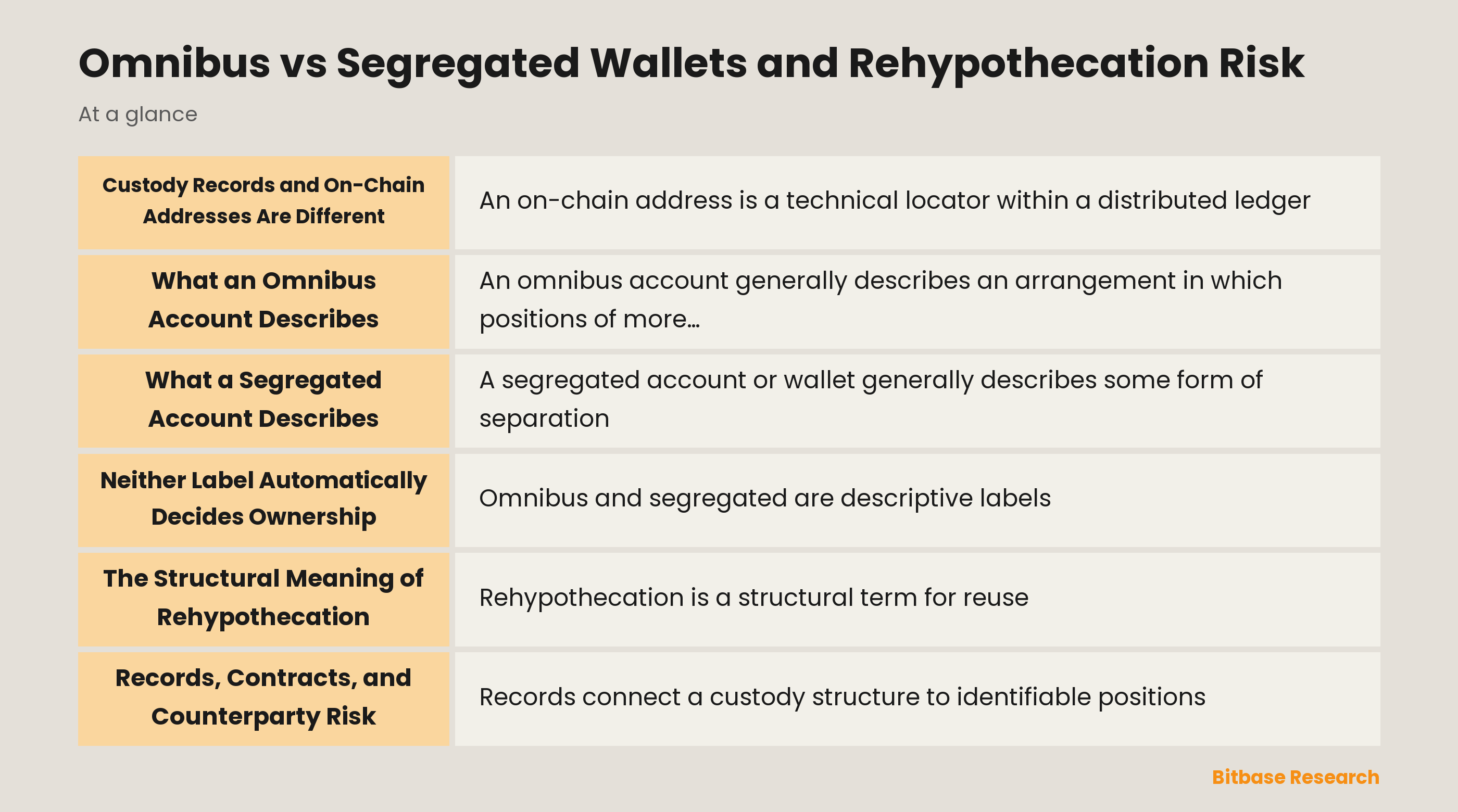
An on-chain address is a technical locator within a distributed ledger. Depending on the ledger, it can show a balance, transactions, and relationships that are publicly observable, but it does not normally contain a complete customer ledger. When a custodian controls an address, its internal books may map portions of the associated assets to many client positions, to one client position, or to other categories defined by its records.
Custody records are therefore not a duplicate of blockchain data. They can describe account balances, asset type, internal movements, access controls, reconciliation data, and contractual obligations that a blockchain cannot express by itself. An address label may describe how signing authority is arranged, yet it is not a substitute for the records and agreements that give the label practical and legal context.
What an Omnibus Account Describes
An omnibus account generally describes an arrangement in which positions of more than one client are aggregated within a common account, wallet, address, or control structure. Individual allocation is then represented in the custodian's internal ledger or another record system. In this sense, omnibus refers to aggregation among clients, not necessarily to a particular blockchain design or a single legal result.
Aggregation has several layers. Client positions may be recorded separately even when assets are held through one shared address, and a shared address may be separate from the custodian's own assets or may not be, depending on the arrangement. It is useful to distinguish client-to-client aggregation from mixing customer-linked assets with a firm's own assets, because the two descriptions answer different structural questions.
What a Segregated Account Describes
A segregated account or wallet generally describes some form of separation. The separation may be expressed through an individual client record, a distinct account title, an address associated with one client, a dedicated access-control arrangement, or a legal and operational boundary. The same word can therefore refer to different layers of a custody design rather than a single technical feature.
An address dedicated to one client can make the technical allocation more visible, while a separate internal record can identify a client position even when the address is shared. Neither fact alone establishes every right connected with the assets. Requirements concerning records, access means, use rights, reconciliation, and treatment on a firm's failure can arise from applicable rules and agreements rather than from the word segregated by itself.
Neither Label Automatically Decides Ownership
Omnibus and segregated are descriptive labels, not automatic ownership conclusions. The legal character of a customer relationship can depend on the governing agreement, applicable law, the identity and role of the entities involved, the nature of the asset, and the accuracy of records. A blockchain address may be important evidence of control or movement, but it does not answer all of those questions on its own.
Regulatory frameworks also use separation in different ways and for different populations. Some rules focus on recording each client's position, some require separation from a firm's own holdings, and some address operational or legal segregation in a defined setting. The presence of one type of separation does not demonstrate that every other type exists, and the effect of any requirement depends on the jurisdiction and the contract to which it applies.
The Structural Meaning of Rehypothecation
Rehypothecation is a structural term for reuse, pledge, transfer, or other deployment of an asset or a related right after it has been received, where the governing arrangement permits that result. The term does not establish that reuse has occurred at a particular institution. It instead describes a question about the scope of a right of use, the conditions attached to it, and the obligations that may remain after the right is exercised.
The phrase exchange rehypothecation risk commonly refers to exposure created when a service provider has contractual or regulatory authority to use customer-linked assets or claims. That question is separate from whether the custody structure is described as omnibus or segregated. A shared address does not itself prove a right of use, and a separate address does not by itself define all restrictions on use; the applicable agreement, rules, and records remain relevant.
Records, Contracts, and Counterparty Risk
Records connect a custody structure to identifiable positions. They can show how a quantity is attributed, whether the custody arrangement distinguishes client assets from house assets, and what obligations are recorded between the parties. Reconciliation and record quality matter because an address balance alone may not show the complete set of internal allocations, obligations, or third-party custody relationships.
Contractual terms can describe custody, use rights, account treatment, governing law, and the entities that hold or control assets. Counterparty risk is the possibility that an entity responsible for custody, recordkeeping, or a related obligation does not perform as required. The jurisdiction, contract, institutional relationships, and facts can all affect how claims, access, use, and priorities are analysed in a particular setting.
Neutral Vocabulary for Reviewing an Arrangement
Neutral vocabulary keeps the layers distinct. On-chain address describes a ledger location; internal ledger describes the custodian's allocation records; omnibus describes aggregation; segregated describes a stated separation; and right of use describes authority that may exist under an arrangement. These are descriptions of structure and should not be treated as shortcuts for a conclusion about a specific customer's legal position.
Jurisdiction, applicable regulation, contract language, entity identity, and factual records can change conclusions about ownership, use, priority, access, and treatment in a failure. Terms in this article are descriptive rather than determinations of rights in an individual case. The article does not constitute a legal opinion.
Before attaching a conclusion to either label, it helps to separate three questions: what the ledger shows, what the internal records allocate, and what the governing arrangement permits. Those questions can point in the same direction, but they are not interchangeable. The answer to one does not prove the answer to the others.
Disclaimer: This article is educational content from Bitbase Academy, provided for information only. It does not constitute investment, trading, tax, or financial advice. Crypto assets are volatile; assess your own risk. Written as of August 2026; refer to the latest official information.
References
[1] EUR-Lex: Regulation (EU) 2023/1114, Article 75 eur-lex.europa.eu
[2] ESMA: MiCA Article 75 interactive single rulebook esma.europa.eu
[3] FCA Handbook: CASS 6.2 Holding of client assets handbook.fca.org.uk
[4] FCA Handbook: CASS 3.2 Requirements handbook.fca.org.uk
[5] CFTC: Futures customer funds to be segregated and separately accounted for cftc.gov
[6] SEC: Rule amendments to the Broker-Dealer Customer Protection Rule sec.gov