Passkeys and social recovery are often placed in the same wallet conversation, yet they address different parts of account control. A passkey can participate in proving access, while social recovery can define who may authorize a change in access after a loss event. Their consequences depend on the account’s validation logic, the parties that can influence recovery, and the services on which each design relies.
Access, Recovery, and Authority Are Different Questions
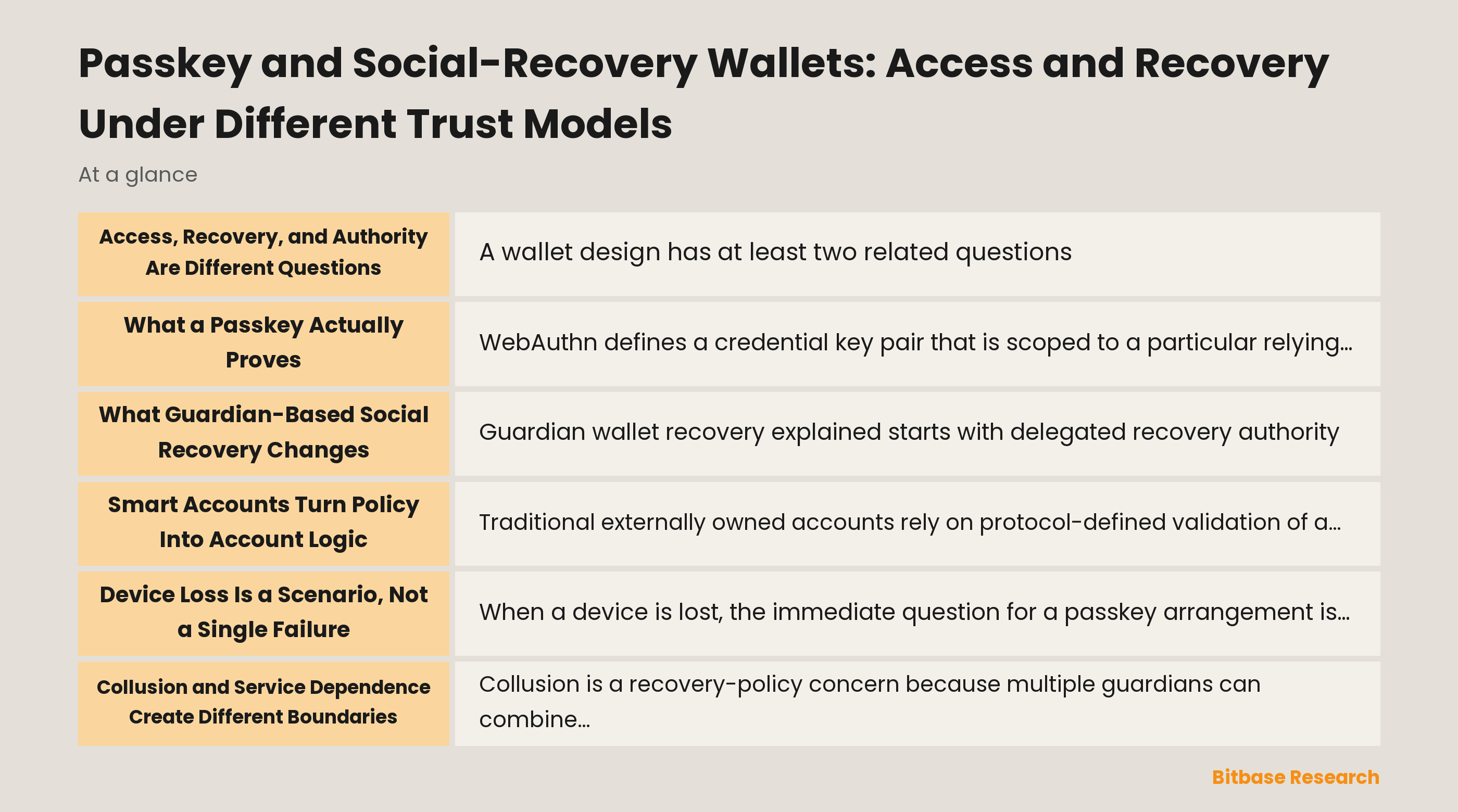
A wallet design has at least two related questions: what evidence is accepted for ordinary access, and what authority can alter that evidence when ordinary access is no longer available. Those questions can be implemented together, but they are not identical. An account may accept a particular credential for day-to-day validation while using a separate policy to replace, add, or revoke that credential after a recovery event.
The phrase passkey crypto wallet explained is useful only when it separates those layers. In WebAuthn terms, a passkey is a public-key credential used in an authentication ceremony with a relying party. In a wallet context, the relying party and the account logic determine what happens after that ceremony. A successful proof can be one input to account validation without being, by itself, a universal rule for changing control of an on-chain account.
Social recovery begins with a different question: if normal access is unavailable, whose evidence has authority to initiate or approve a change? Its answer is expressed as a recovery policy rather than as one user-held credential. That difference is why a comparison works best as a map of authority and failure paths, not as a contest between two labels.
What a Passkey Actually Proves
WebAuthn defines a credential key pair that is scoped to a particular relying party. The authenticator retains the credential private key and produces a cryptographic assertion after the required ceremony; the relying party verifies that assertion with the registered public key. The protocol therefore describes a relationship among an authenticator, a client environment, and a named relying party, rather than a portable claim that a person controls every account associated with an address.
User verification is local to the authenticator’s process. A biometric check or device unlock can authorize use of a credential without sending the biometric data to the relying party. This is meaningful for the access path, but it does not settle the recovery path. A wallet can treat the resulting assertion as evidence for a particular account action only if its software and validation rules are designed to recognize it.
Passkeys also carry a distinction between device-bound and synchronized credential arrangements. A device-bound credential is tied to the authenticator that created it, while a synchronized arrangement introduces a provider-managed synchronization and account-recovery path across devices in its ecosystem. Neither description answers every wallet question. It instead identifies which systems and credentials are relevant when a device is unavailable or when access to a synchronization account changes.
What Guardian-Based Social Recovery Changes
Guardian wallet recovery explained starts with delegated recovery authority. A guardian policy can name identities whose valid approvals are counted toward a rule, such as a threshold or a policy with several categories of authority. Guardians need not be described only as people: a technical interface can model on-chain accounts, other verifiable identities, or designated verification mechanisms. The important feature is that recovery authority is distributed across the policy’s participants and verifiers.
That distribution changes the question from “where is the credential?” to “what combination of evidence changes the account’s control state?” A recovery policy may separate the authority to begin a recovery, approve it, cancel it, or finalize a replacement of the ordinary controller. Whether those roles exist and how they interact are implementation details, but their distinction matters because they create different paths for a legitimate recovery and for an unauthorized control change.
Guardians do not eliminate trust; they relocate and structure it. The policy may depend on the availability, independence, identity verification, and willingness of its guardians. It may also depend on a contract module or verifier interpreting their proofs correctly. The result is not a generic guarantee against loss or compromise, but an explicit account-level allocation of recovery authority.
Smart Accounts Turn Policy Into Account Logic
Traditional externally owned accounts rely on protocol-defined validation of a private-key signature. Smart accounts can instead use contract code to define validation logic. ERC-4337 describes a model in which a smart contract account validates a UserOperation, while the surrounding execution path includes an EntryPoint and bundlers. This programmability can accommodate different signature schemes and recovery policies, but it also means that the account’s concrete code defines the relevant rules.
A passkey-oriented wallet can therefore be understood as a design in which WebAuthn-style proof is connected to account validation through additional software and contract logic. A guardian-oriented wallet can be understood as a design in which recovery proofs are checked against an account policy. These descriptions may coexist in one smart account: a passkey can be part of normal access while guardians govern exceptional changes in access authority.
The same flexibility makes implementation boundaries material. Contract upgrades, validation modules, off-chain verifiers, and the application interface can each affect how an account interprets an access or recovery request. Discussing a feature only by its front-end label leaves out the components that actually determine its authority boundaries.
Device Loss Is a Scenario, Not a Single Failure
When a device is lost, the immediate question for a passkey arrangement is whether another accepted credential or a credential synchronization and account-recovery path remains available. WebAuthn itself does not define a protocol for backing up or sharing credential private keys between authenticators. FIDO materials distinguish device-bound credentials from synchronized passkeys precisely because loss and restoration are handled through different mechanisms and dependencies.
For a social-recovery design, the same event raises a separate question: can the defined recovery authority alter the account’s ordinary controller, and can the account enforce the policy that governs that change? A device loss does not automatically imply a social-recovery action, nor does the presence of guardians make a passkey unavailable. The two models can intersect, but their triggering conditions and evidence sources remain conceptually separate.
The phrase crypto account recovery without seed phrase describes a possible user-facing goal, not one uniform technical method. One design may rely on credential-provider account recovery, another may rely on guardian evidence validated by a smart account, and another may combine both with additional policy logic. What is absent from the user interface does not remove the need to identify where recovery authority, proof verification, and state change actually reside.
Collusion and Service Dependence Create Different Boundaries
Collusion is a recovery-policy concern because multiple guardians can combine their authority when a rule counts their approvals. A threshold can prevent a single guardian from acting alone, yet it does not make coordinated guardian action impossible. The relevant threat model examines who can satisfy the policy together, whether those identities are truly independent, and whether another role can alter the policy or its verification conditions.
Service dependence appears in both designs, though at different points. Passkey use depends on a relying party’s origin and authentication flow, a client environment, and an authenticator; synchronized passkeys additionally involve a provider’s synchronization and account-recovery ecosystem. Social recovery can depend on guardians, identity or proof verifiers, application interfaces, contract modules, and the availability of the network path that carries valid recovery actions. Dependence is an architectural property, not a verdict on a design.
These boundaries can also change over time. If an account permits upgrades or policy changes, the authority able to enact those changes becomes part of the account’s recovery and access model. A precise explanation therefore distinguishes control of the credential, control of the recovery policy, and control of the code that interprets both.
A Threat-Model Lens Instead of a Safety Ranking
Passkeys and guardian recovery can be compared by asking which event is under examination. Credential theft, device loss, loss of a synchronization account, guardian unavailability, guardian collusion, application compromise, verifier failure, and account-logic defects each test different parts of the system. An answer that treats them as one problem risks overlooking which authority is operative in the scenario being discussed.
This lens also clarifies why a universal safety ranking would be misleading. A passkey arrangement can concentrate ordinary access around authenticator and relying-party assumptions, while a social-recovery arrangement can distribute exceptional authority across a policy and its participants. A combined smart-account design can add more routes and more controls at the same time. The meaningful comparison is the set of assumptions, not a claim that one label defeats every threat.
In short, passkeys concern how an account may accept a cryptographic access proof, and social recovery concerns how an account may authorize a replacement or change in that access after specified evidence is presented. Seeing those as separate but connectable layers makes device loss, collusion, and service dependence easier to analyze without pretending that any wallet design is objectively safest.
Disclaimer: This article is educational content from Bitbase Academy, provided for information only. It does not constitute investment, trading, tax, or financial advice. Crypto assets are volatile; assess your own risk. Written as of August 2026; refer to the latest official information.
References
[1] W3C: Web Authentication Level 3 w3.org
[2] FIDO Alliance: Authentication for Moderate Assurance Use Cases fidoalliance.org
[3] ERC-4337: Account Abstraction Using Alt Mempool eips.ethereum.org
[4] ERC-7093: Social Recovery Interface eips.ethereum.org