A privacy-preserving blockchain is a broad description rather than a single technical standard. It can describe a ledger or ledger-connected system that reduces the information exposed to the public while preserving some defined form of verification. A design might use cryptographic commitments, zero-knowledge proofs, restricted access, verifiable credentials, or other mechanisms. The meaningful question is not whether a label sounds private, but how information actually moves through the system: which data is public, which data is shared with selected parties, which data remains private, and what a verifier can establish from the available evidence.
Selective disclosure is one way to define that information flow. It seeks to reveal a limited claim rather than an entire underlying record when a verifier needs evidence for a stated purpose. It is not a method for avoiding accountability, oversight, or legal obligations. It is a design approach that makes the disclosure boundary explicit. This is an educational overview, not a recommendation to use, select, or rely on a particular privacy architecture.
Public and private information form a spectrum
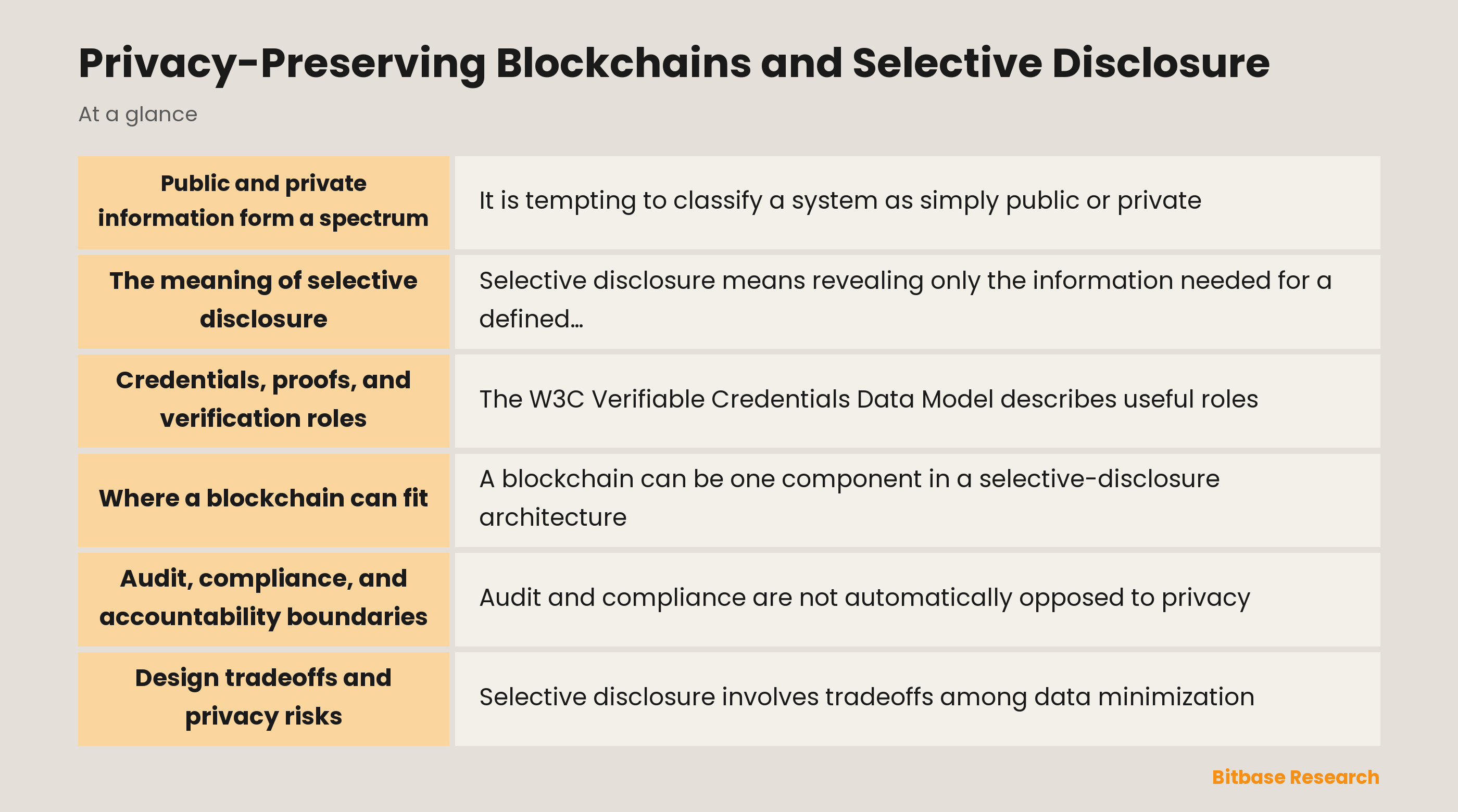
It is tempting to classify a system as simply public or private. In practice, disclosure forms a spectrum. A public ledger can make every recorded field available to general readers. Another design can make commitments or proofs public while withholding underlying values. A restricted system can limit read access to defined participants. A credential presentation can disclose one verified attribute while withholding unrelated fields in the original credential.
Each arrangement has different privacy and transparency properties. Publishing less data can reduce unnecessary exposure, but it can also make certain forms of independent inspection more difficult. Publishing more data can make some checks easier, while increasing the possibility that information is copied, combined, or correlated. Neither outcome is automatically correct without a defined purpose, threat model, and account of the people and systems involved.
The useful unit of analysis is a data element in context. An identifier, timestamp, credential attribute, commitment, or proof can be public, private, or selectively shared. The same system may expose metadata through network communications, logs, interfaces, or related databases. A privacy-preserving blockchain should therefore be assessed as a complete information system, not only as a ledger format.
The meaning of selective disclosure
Selective disclosure means revealing only the information needed for a defined claim instead of presenting an entire record. If a verifier needs to know whether a subject meets a stated condition, a selective-disclosure presentation can communicate that condition without revealing unrelated fields. The resulting scope depends on the credential format, proof system, protocol rules, and verifier request.
The goal is not to make a claim unverifiable. In many designs, limited claims are paired with cryptographic evidence that lets a verifier check their integrity or origin under specified rules. The verifier still needs to understand what the claim says, who issued it, whether it is current, and whether its own policy allows reliance on it. A technical check alone does not answer those broader questions.
Selective disclosure has limits. A single attribute can still be identifying when combined with other information. Repeated presentations can create correlations. Holders, issuers, verifiers, or intermediaries can retain records. A technology can narrow a particular disclosure, but it cannot eliminate every privacy question associated with collection, retention, access, linkage, and the surrounding system.
Credentials, proofs, and verification roles
The W3C Verifiable Credentials Data Model describes useful roles: an issuer makes claims about a subject, a holder possesses credentials and can form presentations, and a verifier receives material for processing. These roles are abstractions. One organization can perform more than one role, and a deployment can use a database, a distributed ledger, or another kind of registry.
A verifiable credential packages claims with mechanisms intended to make tampering detectable or otherwise support verification. A verifiable presentation is material a holder provides to a verifier. In some designs, a derived proof can disclose a limited subset of claims or establish a property of claims without revealing a complete original record. The W3C Data Integrity BBS Cryptosuites specification is one example of a standard that defines cryptographic mechanisms for selective disclosure and derived proofs.
Verification is intentionally limited in meaning. A verifier can check whether a proof or credential is valid under applicable rules and verification material. That does not by itself establish that every claim is true in the wider world. The W3C model distinguishes verifiability from the truth of encoded claims and expects a verifier to apply its own policies before relying on them. A proof supports a defined technical statement; it is not a substitute for source assessment, governance, or judgment.
Where a blockchain can fit
A blockchain can be one component in a selective-disclosure architecture, but it need not store every personal or sensitive detail. It might be a registry for public verification material, a record of a status change, a source of commitments, or a coordination layer. Sensitive details can instead remain in other systems while a verifier receives a credential or proof associated with clearly defined rules.
This separation is why “on-chain privacy” is not a single property. A proof recorded on a ledger can be publicly visible even when its witness is not. A registry can reveal identifiers or status information. An off-ledger service can handle issuance, presentation, status updates, or logging. Each component changes the disclosure pattern and must be examined separately.
The central question is not whether a blockchain is inherently private or transparent. It is how the chosen architecture handles specific data, who has access, what is persisted, and how sufficient verification evidence is obtained. Clear descriptions of those choices are more reviewable than broad claims of privacy.
Audit, compliance, and accountability boundaries
Audit and compliance are not automatically opposed to privacy. A system can provide defined evidence to an authorized verifier while avoiding unnecessary disclosure to unrelated parties. A presentation may establish that a stated condition has been met, while retention rules, review procedures, and decision records provide accountability for the result. The proper evidence depends on the governing rules and the scope of the claim.
However, selective disclosure does not decide what an auditor, regulator, or other authorized party may require. Legal duties vary by jurisdiction and context. A credential or proof can establish a narrow cryptographic fact, while an audit process may need additional records, explanations, controls, or human assessment. An excessively broad request for information can likewise create privacy and security risks even when it is technically convenient.
A responsible design states these boundaries directly. It defines what a verifier can check, what evidence is retained, how status is evaluated, and which party is responsible for each decision. It also records what the proof does not establish. This is more accurate than presenting privacy technology either as a barrier to oversight or as a complete solution for compliance.
Design tradeoffs and privacy risks
Selective disclosure involves tradeoffs among data minimization, usability, interoperability, verification needs, recovery processes, and accountability. Minimizing disclosure can reduce exposure, but a verifier still needs a clear and stable way to evaluate a presentation. Reusable identifiers can simplify administration but can increase correlation risk. Detailed logs can support review while creating another collection of sensitive information.
Cryptography addresses only one part of this design space. Software boundaries, key management, issuer practices, verifier policies, data retention, and user interfaces can all affect privacy. Network activity and device-level information can reveal patterns separately from the credential or proof. The NIST Privacy Framework treats privacy risk as a matter of managing how systems process data and how that processing can create problematic outcomes, which is a useful reminder that a proof is not the whole system.
Interoperability deserves similar care. Two systems can use a common credential format yet apply different schemas, validity checks, trust lists, or decision policies. A technically valid presentation can be insufficient for one verifier's purpose, while an over-detailed presentation can reveal more than necessary. Design documentation should make these choices visible rather than leaving them implicit.
Scope, limitations, and a careful reading framework
Privacy is not an on-or-off promise. A privacy-preserving design can reduce disclosure of defined data while still exposing other information. It may not prevent correlation across repeated events, observations outside the system, or information held by authorized parties. It may not resolve errors in issuance, misuse by a verifier, compromised infrastructure, or changes in governance.
Selective disclosure likewise does not mean that a verifier should accept every presentation automatically. The verifier needs to check relevant verification material, evaluate the issuer and claim, and follow applicable policies. The holder needs to understand what is presented and to whom. The issuer needs processes appropriate to the claims it makes. These responsibilities remain separate even where a proof is technically valid.
When reading a privacy-preserving blockchain proposal, start with the claim being verified. Identify what is public, what is retained by the holder or another system, and what a verifier can infer. Then map the issuer, holder, verifier, registry, and services that store or transmit related data. Finally, state the nonclaims: a proof has defined scope, does not establish every real-world fact, does not settle compliance duties, and does not eliminate correlation or metadata risks. This disciplined framing supports careful review without treating privacy technology as a means to bypass oversight or responsibility.
Disclaimer: This article is educational content from Bitbase Academy, provided for information only. It does not constitute investment, trading, tax, or financial advice. Crypto assets are volatile; assess your own risk. Written as of August 2026; refer to the latest official information.
References
[1] W3C: Verifiable Credentials Data Model v2.0 www.w3.org
[2] W3C: Data Integrity BBS Cryptosuites v1.0 www.w3.org
[3] NIST Privacy Framework 1.0 www.nist.gov
[4] NISTIR 8062: Privacy Engineering and Risk Management doi.org