A public blockchain can make a payment verifiable without making every detail equally useful to every observer. Private transaction designs move some data behind encryption, one-time addresses, commitments, or controlled disclosure. This article explains the mechanisms and their trade-offs. It does not provide instructions for hiding funds, avoiding identification, bypassing KYC, or evading a legal obligation.
Public Transactions Begin With Observable Data
A useful starting point for anyone searching for private transactions crypto explained is to ask what a public transaction actually exposes. Depending on the ledger, an observer may see an address, an input or output, an amount, a timestamp, a memo, a fee, and links to earlier or later transactions. The exact fields differ by protocol, but the public record is designed to let independent nodes verify that a state transition is valid.
Public does not always mean that a real-world name is printed beside an address. Most account-based systems are better described as pseudonymous: an address is a label, and its connection to a person or organization may come from an exchange record, a payment relationship, a public announcement, or a pattern of activity. Once a link is made, repeated transactions and associated metadata can make the address history easier to interpret.
Privacy is therefore not a single on-or-off property. Sender privacy asks whether an observer can identify the party authorizing a spend. Recipient privacy asks whether the destination can be linked to a person or to other receipts. Amount privacy asks whether the value is visible. Metadata privacy includes timing, memos, network information, and the relationships created when funds cross a transparent boundary. A design can improve one dimension while leaving another visible.
This distinction matters because a public ledger offers two different kinds of auditability. Anyone may inspect the published record, but everyone may also learn the same details. That is useful for some applications and excessive for others. A private transaction system tries to preserve enough evidence for consensus while limiting which facts are disclosed to the general public.
What a Shielded Address Changes
For a shielded address crypto explained definition, think of an address whose transaction data is protected by a protocol-level privacy mechanism rather than merely by choosing a new public label. In Zcash, shielded addresses and shielded transactions use zero-knowledge proofs so that nodes can verify the required rules without receiving every address and value in plaintext. A shielded-to-shielded transaction can protect the sender, recipient, amount, and encrypted memo from ordinary chain observers.
The boundary is important. Zcash documentation distinguishes transparent transactions, shielding transactions, deshielding transactions, and fully shielded transactions. A transparent endpoint can reveal information on that side of the transaction. Fees and the fact that a transaction was included in the public chain can remain visible even when the protected fields are not. Shielding a field is not the same as making the entire surrounding activity unobservable.
The proof system also changes what a validator checks. A node does not need to see the private amount in order to check that the transaction satisfies the protocol’s conservation and authorization rules. It verifies a cryptographic proof and the public parts of the transaction. This is a systems property, not a promise that a wallet, exchange, network observer, or application will never learn anything about the activity.
Monero uses a different design vocabulary. Its technical documentation describes recipient privacy through stealth addresses and amount privacy through Ring Confidential Transactions, while ring signatures provide a form of sender ambiguity. A Monero address contains public spend and view keys, and a received output is sent to a one-time public key. That is related to the goal of hiding recipient linkability, but it is not the same construction as a Zcash shielded address.
The phrase shielded address should therefore be treated as a protocol term, not as a universal label for every privacy feature. When comparing systems, identify which address type, proof system, output model, and transparent boundary are being discussed.
View Keys and the Scope of Visibility
The short version of view key crypto explained is that a view key separates some read or recognition capability from the ability to authorize a spend. It can let an authorized party inspect or detect transaction information without handing that party the spending key. This separation is useful for accounting, reporting, operational monitoring, and other situations where a transaction must be examined without granting control over the assets.
The exact scope is protocol- and implementation-specific. Zcash documentation describes viewing keys and selective disclosure, while also warning that support and visibility differ across address pools and software versions. Monero documentation describes a private view key as a way to recognize incoming transactions on an otherwise opaque chain. Neither example should be generalized into a claim that every view key reveals the same history, outgoing activity, memo, balance, or subaddress set.
A view key is not automatically harmless because it cannot sign a spend. It may reveal a valuable history, counterparties, timing patterns, encrypted memos, or a balance to the person who receives it. The recipient may also combine what the key reveals with public chain data or outside records. A key can be read-only in the authorization sense and still be highly sensitive in the privacy sense.
The safest conceptual model is a permission with a defined scope. Before treating a view key as evidence, an auditor or other reviewer needs to know which address, pool, account, output type, time range, and software version the key covers. They also need a way to distinguish a complete view from an incoming-only view. A cryptographic key does not by itself provide a universal label saying “this is the full history.”
Selective Disclosure Turns Privacy Into a Permission Model
Selective disclosure means that a participant reveals a chosen part of a protected record while keeping other parts undisclosed. The idea is broader than a blockchain. W3C privacy materials use the same general principle for verifiable presentations: share only the claims needed for a particular verifier, while preserving the ability to validate what was shared. NIST similarly frames privacy engineering around data minimization, disassociated processing, and controlled access to information.
In a transaction setting, the disclosed object might be a proof that a payment exists, a view of incoming outputs, a transaction amount, or a set of records relevant to a defined review. These are different statements. Showing one valid transaction does not prove that it is the only transaction. Showing incoming activity does not necessarily show outgoing activity. Showing an amount does not necessarily reveal the sender’s identity. The claim and the evidence must be kept together.
Selective disclosure can improve auditability because a reviewer may receive enough information to check a bounded assertion without receiving an entire wallet history. It can also create new risks. A stable identifier, timestamp, memo, address reuse, or repeated disclosure can allow two supposedly separate presentations to be correlated. W3C guidance explicitly distinguishes selective disclosure from unlinkability: hiding some fields does not automatically prevent correlation through the fields that remain.
Scope, provenance, and freshness matter as much as the cryptography. A reviewer should be able to tell who issued the evidence, what protocol version produced it, what period it covers, and whether the evidence is a snapshot or an ongoing authorization. Those are governance questions, not features that a privacy proof answers by itself. This article uses them to explain the auditability trade-off, not to prescribe a disclosure workflow.
What a Confidential Transaction Hides
For confidential transactions explained in one sentence, the central idea is amount privacy: a transaction can commit to values and prove that the values obey the ledger’s rules without publishing the amounts in clear text. Commitments bind the statement, while range proofs can show that a committed amount is in an allowed range. The network can then check balance constraints without learning the value represented by every commitment.
Amount privacy is only one layer. A confidential transaction may hide amounts while leaving sender and recipient addresses public. Conversely, a shielded design may protect addresses, values, and memos using a proof system that is not normally called a standalone confidential-transaction construction. The phrase is often used differently across protocols, so a precise explanation should say which fields are hidden and which proof properties are provided.
Monero’s RingCT is part of a broader privacy design that also includes one-time recipient keys and ring signatures. The combination addresses different questions: where an output was sent, which member of a ring authorized a spend, and how much value moved. Zcash shielded transactions also conceal value and address-related data, but they use a different transaction model and zero-knowledge proof system. These systems should be compared by privacy dimensions and trust assumptions, not by treating their labels as interchangeable.
Hidden amounts still leave evidence. A transaction can have a public identifier, a fee, a block position, a transaction size, timing information, or a relationship to a transparent entry or exit. Wallet behavior, network metadata, application logs, exchange records, and disclosure by a participant can also create linkability. Confidentiality of a field does not erase the rest of the system’s observations.
Auditability and Compliance Are Not Opposites
Public transparency and auditability are related but not identical. Public transparency makes the same record available to anyone. Controlled auditability makes a defined claim checkable by an authorized reviewer while limiting unrelated disclosure. Shielded addresses, view keys, commitments, and selective proofs can support the second model, provided that the scope and limitations are documented.
This is where privacy engineering meets compliance. NIST’s framework treats data minimization and access management as ways to manage privacy risk, while W3C privacy guidance emphasizes that selective disclosure can still leave correlation risks. FATF guidance takes a risk-based approach to virtual assets and virtual asset service providers. It calls for jurisdictions and covered entities to assess and mitigate money-laundering and terrorist-financing risks, and it notes that anonymity-enhanced features can make beneficiary identification more difficult in some contexts.
Those sources do not create one worldwide legal answer. Whether a privacy feature is permitted, restricted, reportable, or operationally acceptable depends on the jurisdiction, the entity, the asset, the service, the customer relationship, and the facts. Privacy technology is not a substitute for a legal analysis, a compliance policy, or a required identity check. Conversely, a compliance obligation does not require every unrelated piece of personal financial data to be made public.
The useful question is not whether a system is “private” or “compliant” in the abstract. Ask what a reviewer must establish, what evidence can establish it, what information is strictly necessary, who may receive it, how correlation is controlled, and what remains visible to the public. A system that cannot answer those questions may have strong cryptography but weak operational privacy.
How to Read a Privacy Claim Without Overpromising
When reading a privacy claim, start with five boundaries. First, identify the hidden field: sender, recipient, amount, memo, or metadata. Second, identify the observer: a full node, a wallet, a counterparty, an auditor, a regulated service, or a network monitor. Third, identify what remains public, including fees, timing, transaction size, and transparent endpoints. Fourth, check whether the feature is mandatory, optional, or dependent on address type and software support. Fifth, ask what can be disclosed later and whether that disclosure is narrower than a complete history.
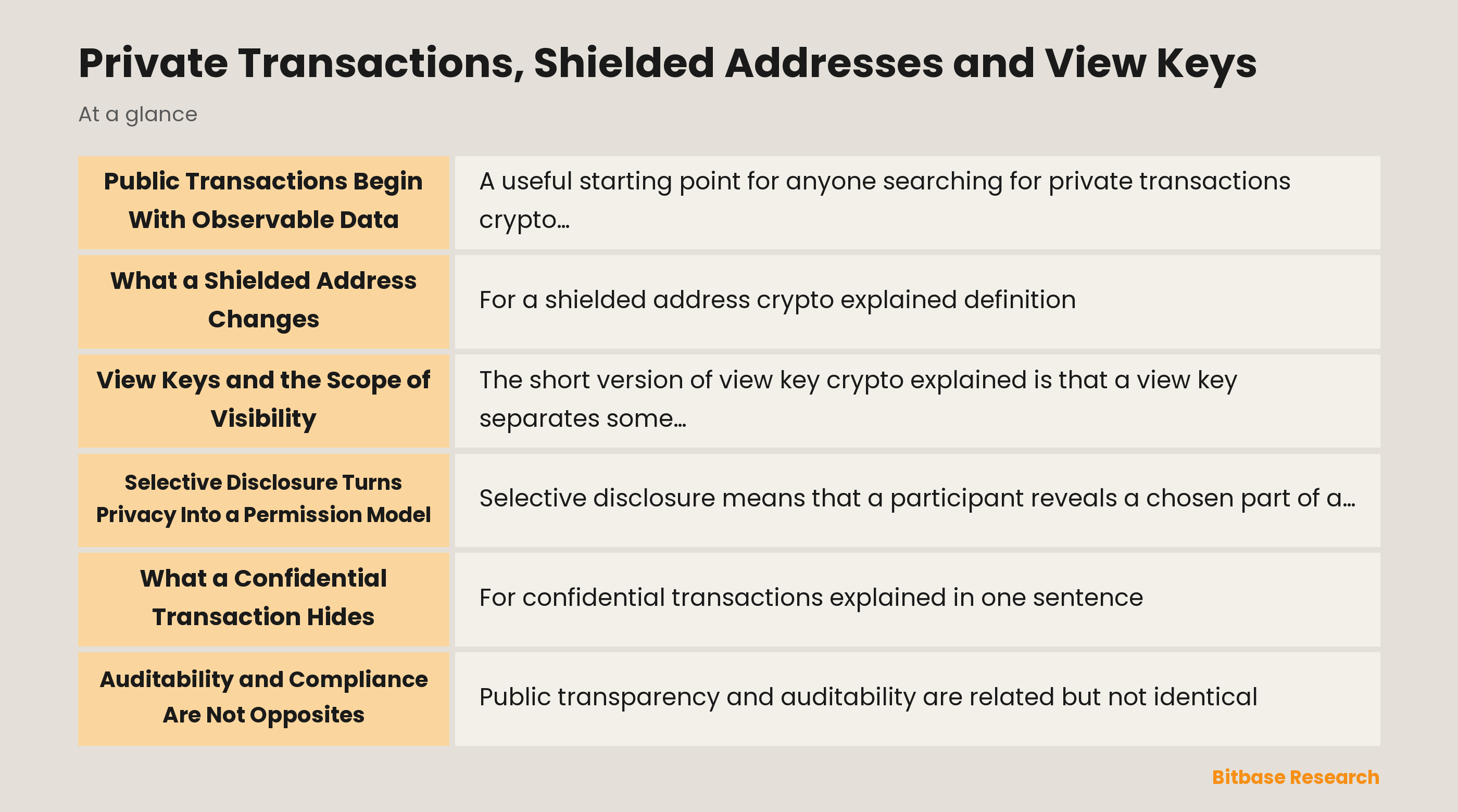
This checklist prevents several common category errors. A new public address is not the same as a shielded address. A view key is not the same as a spend key, but it is not risk-free. Confidential amounts are not the same as hidden counterparties. A valid proof is not a guarantee that all surrounding metadata is unlinked. And selective disclosure is not a promise that every law or service will accept the disclosed evidence.
Privacy-preserving transaction systems are best understood as designs for distributing knowledge. The protocol decides what validators must know, the wallet decides what the holder can inspect, and disclosure mechanisms decide what an authorized third party can verify. Each layer has assumptions and failure modes. A careful explanation makes those boundaries visible, uses current protocol documentation, and avoids turning a mechanism into a promise of invisibility or a way around lawful oversight.
Disclaimer: This article is educational content from Bitbase Academy, provided for information only. It does not constitute investment, trading, tax, or financial advice. Crypto assets are volatile; assess your own risk. Written as of August 2026; refer to the latest official information.
References
[1] Zcash: Shielded Addresses and Transactions z.cash
[2] Monero: Stealth Addresses getmonero.org
[3] Monero: Ring Confidential Transactions getmonero.org
[4] W3C: Data Privacy Vocabulary w3.org
[5] NIST: Privacy Framework nist.gov
[6] FATF: Updated Guidance for Virtual Assets and VASPs fatf-gafi.org