Proof of personhood is a family of ways to make a narrow claim: within a stated system and set of rules, an account or credential is intended to correspond to one distinct person rather than to an unlimited number of accounts controlled by the same party. The narrowness matters. A result about uniqueness is not automatically a result about legal identity, citizenship, age, good conduct, expertise, or eligibility. It is also not a statement that every person can participate on equal terms.
The topic appears in systems where a rule is meant to apply per person rather than per account. That design goal creates a difficult question: how can a system distinguish many independent participants from one participant presenting many identifiers? Technical tools can reduce particular risks, but they cannot remove the need for assumptions, error handling, and governance. This article explains the concepts and limits; it is not a recommendation.
The Sybil problem: one entity, many accounts
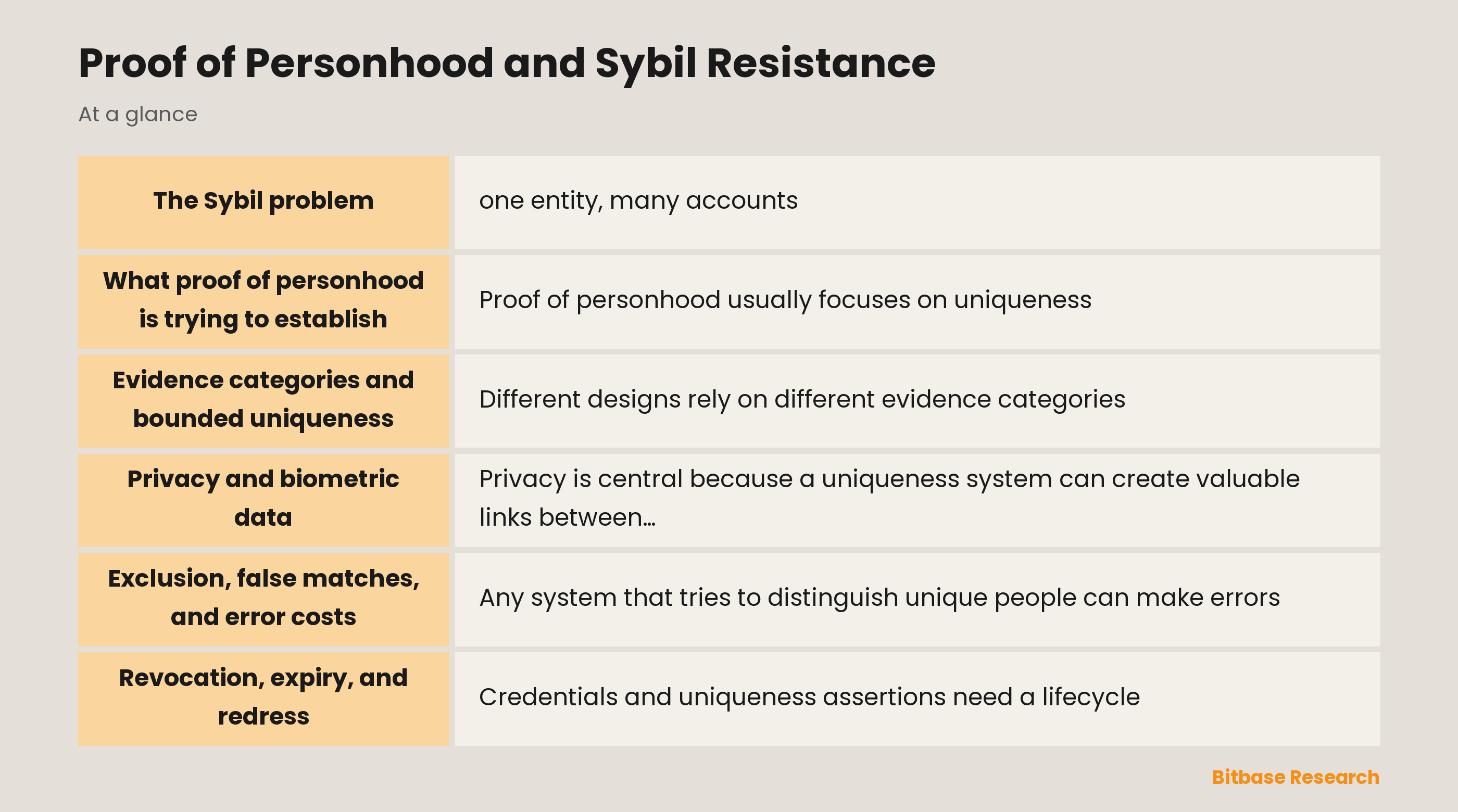
The Sybil problem is a distributed-systems problem. It occurs when one entity can present multiple apparent identities and thereby receive influence, access, or resources that a rule intended to distribute among independent participants. A system may see ten accounts, for example, while the accounts are controlled by one actor. If the system treats each account as an independent vote, reviewer, or recipient, its assumption of independence can fail.
The original formulation of the Sybil attack is useful because it separates a label from the thing behind the label. An account name, public key, or identifier can be cheap to create. It is therefore not, by itself, evidence that the accounts represent different people. The practical question is not whether an identifier is technically valid. It is what the identifier establishes, who can make that assertion, and what happens when the assertion is wrong.
Sybil resistance describes measures intended to make mass creation or coordinated control of apparent identities less effective. It is not a binary property. A mechanism might raise the cost of creating duplicates, make certain forms of duplication easier to detect, or limit the weight of repeatedly linked accounts. Its usefulness depends on the attack model. A defense that addresses duplicated credentials may not address coercion, account sharing, compromised devices, or a powerful issuer acting improperly.
What proof of personhood is trying to establish
Proof of personhood usually focuses on uniqueness: a bounded assertion that a person has not already received another valid proof under the system's rules. It differs from ordinary authentication. Authentication asks whether the current presenter controls a credential or secret. Proof of personhood asks an additional question about whether another valid credential should be counted as the same person for a particular purpose.
The claimed unit must be stated precisely. “One person” can mean one enrollment in a particular registry, one currently active credential, one person during a specified period, or one person eligible under a program's own conditions. None of those definitions is identical to a complete real-world identity. A system can also make a uniqueness claim without exposing a person's name to every verifier, but that does not make the claim consequence-free.
The words proof and person can sound stronger than the underlying process. In practice, a system combines evidence, policies, cryptographic checks, and operating procedures. The evidence may be examined by people, devices, software, or some combination. The policy decides what evidence counts, how duplicates are evaluated, how long a result remains valid, and who can challenge an outcome. A verifier then decides whether the resulting claim is sufficient for its own purpose.
Evidence categories and bounded uniqueness
Different designs rely on different evidence categories. One category uses an established identity document or record. Another uses social or community attestations, where several existing participants make claims about a person. A third uses device, hardware, or rate-limiting signals. A fourth uses a biometric, meaning a measurable human characteristic used as part of a comparison process. Some designs combine categories rather than relying on one signal.
Every category has a boundary. A government-issued record may connect a claim to a recognized identity, yet it can be unavailable to some people, outdated, stolen, or processed under rules that differ across places. Community attestations can carry local knowledge, but they can also reproduce exclusion or coordinated error. Device signals can be convenient, but one person may have several devices and several people may share one. A biometric comparison can help distinguish repeated presentations in a defined process, but it is not a universal identity label and it has measurement, security, and accessibility limits.
For that reason, uniqueness is best read as a conditional statement: given this evidence, this matching method, this threshold, this time period, and this governance process, the system treats two presentations as different people or as a possible duplicate. Changing any of those conditions can change the result. It is an inference from a system design, not an observable fact about a person in every context.
Privacy and biometric data
Privacy is central because a uniqueness system can create valuable links between a person, an identifier, and repeated interactions. A persistent public identifier may enable correlation even if it does not display a name. Repeated use of the same proof can reveal patterns: which services accepted it, when it was used, and which activities may be associated with one another. A design that keeps raw personal data off a public ledger can reduce one kind of exposure, but it does not by itself remove correlation risks elsewhere.
Biometric data deserves separate care. A biometric is not merely another password-like string. It can be sensitive, difficult or impossible to change after exposure, and affected by collection conditions, disability, aging, and differences in equipment. A system may retain a transformed representation rather than a raw image, but the privacy consequence depends on the full design: who receives data, what can be linked, how matching is performed, how long information is retained, and what legal or governance controls apply.
Privacy-preserving cryptographic techniques can limit which claim is revealed to a verifier. For example, a proof may be designed to show that a valid credential exists without exposing every associated attribute. Such techniques are not a substitute for clear data handling rules. An issuer, verifier, operator, or observer can still create linkability through identifiers, timing, network data, or repeated presentations. Privacy must be evaluated across the lifecycle, not only at the moment of cryptographic verification.
Exclusion, false matches, and error costs
Any system that tries to distinguish unique people can make errors. A false match occurs when two different people are treated as the same person. A missed duplicate occurs when one person is treated as more than one. The costs are not symmetric. A system focused only on preventing duplicate accounts may set a strict threshold that blocks legitimate people. A system focused only on broad inclusion may accept more duplicates. Neither outcome can be evaluated without knowing the purpose, the stakes, and the available review process.
Exclusion can also arise before a matching decision. People may lack a required document, device, connectivity, language support, accessibility accommodation, or safe way to interact with a particular process. Some may reasonably decline to provide sensitive information. These are not edge cases to be ignored after a technical design is complete; they affect whether a claimed “one person, one unit” rule is substantively fair in its stated setting.
An educational description should therefore avoid presenting a biometric or other evidence type as a universal answer. Accuracy measures, if any, are context-dependent and can conceal how errors are distributed among groups or use conditions. The relevant question is not simply whether a method works in an average case. It is how the system detects error, who bears the consequence, and whether a person has a meaningful way to contest an outcome.
Revocation, expiry, and redress
Credentials and uniqueness assertions need a lifecycle. An assertion may expire after a defined period, be suspended while a dispute is reviewed, or be revoked when a policy says it is invalid. Those actions are not only technical status changes. They require rules about evidence, authority, notice, recordkeeping, and appeal. A system that cannot correct a known error can turn a temporary classification mistake into a long-lived exclusion.
Revocation also has privacy tradeoffs. A verifier may need to learn whether a proof remains valid, but a status check can create another point of observation or correlation. Status information can be published, queried, or represented through different technical mechanisms. Each approach involves design choices about availability, timeliness, disclosure, and who learns that a check occurred. A claim of revocability is incomplete unless the process and its consequences are defined.
Redress is the human side of lifecycle management. It includes a way to report a suspected duplicate, a false match, loss of a credential, inappropriate use of data, or an improper decision. A useful redress process states who reviews the case, what evidence can be considered, what time limits apply, and how a decision can be challenged. It should also recognize that a person may be unable to provide the same evidence that caused the original problem.
Governance, scope, and limits
No proof-of-personhood design is neutral simply because it uses cryptography or automated matching. Governance determines the population covered, the definition of uniqueness, acceptable evidence, matching thresholds, data retention, auditability, revocation authority, and appeal rules. It also determines what is disclosed to verifiers and whether a person can use different context-specific identifiers without unnecessary linkage.
A sound analysis asks what exact problem a design addresses and what it leaves unresolved. It may help a particular rule resist duplicate accounts while leaving coercion, collusion, access inequality, or institutional misuse outside its direct scope. It may create a privacy-preserving presentation while still depending on an issuer or enrollment process that has significant power. These are design limitations, not reasons to assume either failure or success in advance.
Proof of personhood and Sybil resistance are therefore best understood as bounded tools for bounded problems. Their claims should be testable, their error paths should be visible, and their governance should be open to scrutiny. A uniqueness assertion can be useful in a defined context, but it should not be inflated into a universal measure of identity, reputation, or human value.
Disclaimer: This article is educational content from Bitbase Academy, provided for information only. It does not constitute investment, trading, tax, or financial advice. Crypto assets are volatile; assess your own risk. Written as of August 2026; refer to the latest official information.
References
[1] Microsoft Research: The Sybil Attack www.microsoft.com
[2] NIST SP 800-63A-4: Identity Proofing and Enrollment pages.nist.gov
[3] W3C: Verifiable Credentials Data Model v2.0 www.w3.org
[4] W3C: Decentralized Identifiers v1.0 www.w3.org