Institutional crypto activity is often described as if one provider does everything. In practice, safeguarding assets, coordinating credit and settlement, and arranging a bilateral trade are different functions. A qualified custodian is primarily about control and safekeeping. A prime broker is primarily about connecting execution, financing, collateral and post-trade operations. An OTC desk is primarily about privately negotiated execution and the risks of taking or arranging the other side. These roles can be bundled, but the risk does not disappear when the labels are combined.
Why institutions separate these roles
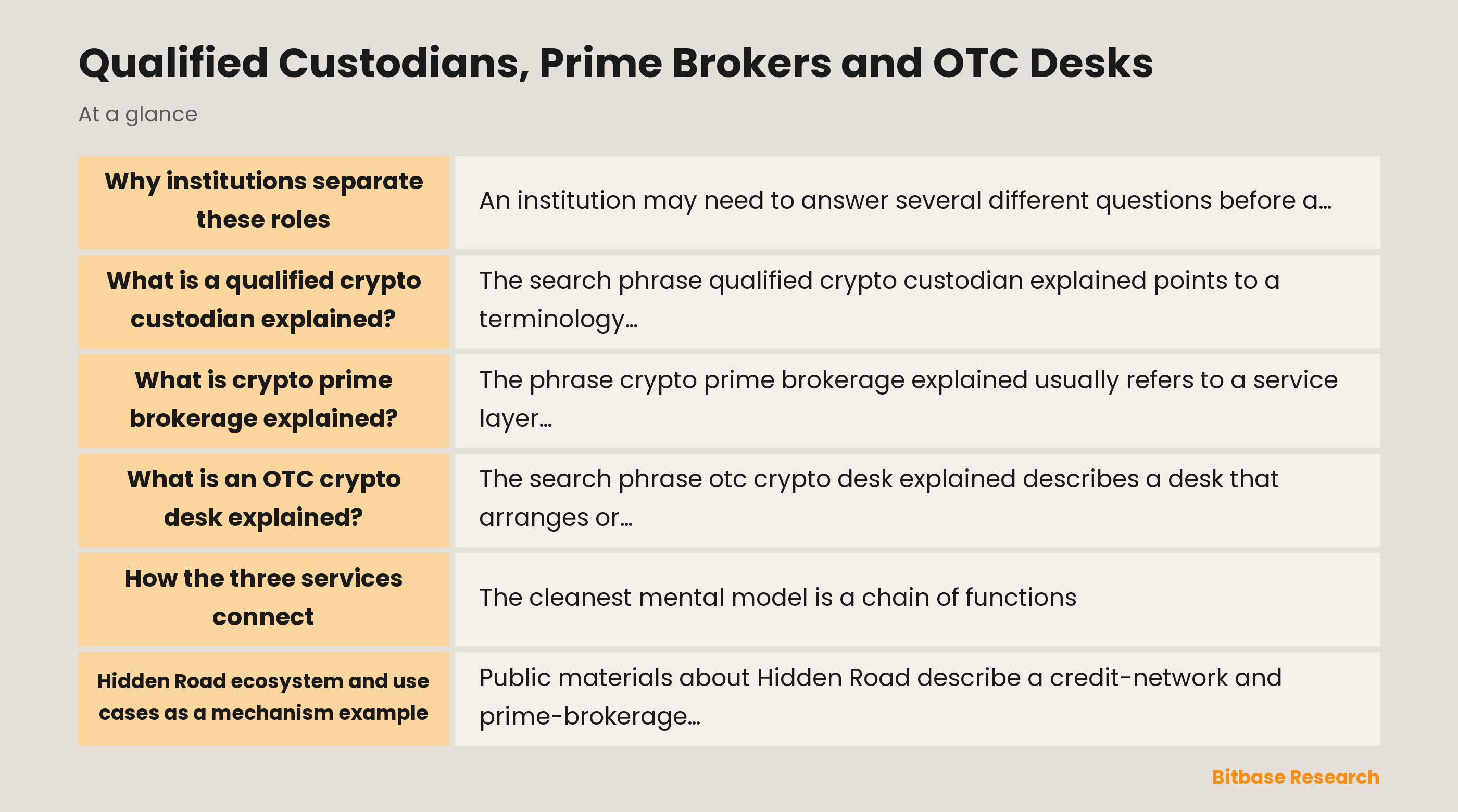
An institution may need to answer several different questions before a transaction is complete. Where are the assets held? Who can move them? Which entity extends credit or accepts collateral? Where is an order executed? Who faces the counterparty after execution? How are positions, margin calls and settlement obligations reconciled? A single logo can sit on top of these activities, but each question points to a different control surface.
That separation matters because failure can happen in different ways. A custodian can have a key-management or segregation failure even when a trade was priced correctly. A prime broker can calculate margin correctly while a liquidity provider or settlement counterparty fails. An OTC desk can provide a useful block quote while carrying inventory, information and delivery risk. Combining services may reduce operational handoffs, but it can also concentrate exposure in one legal entity.
The first reading habit is therefore functional: map the service, the legal entity, the asset or obligation being held, the permitted reuse of collateral, and the remedy if something goes wrong. “Institutional” is a description of the client segment, not a guarantee about solvency, regulation or asset protection.
What is a qualified crypto custodian explained?
The search phrase qualified crypto custodian explained points to a terminology problem. “Qualified custodian” can be a defined regulatory term in a particular rule, while “crypto custodian” is often used more broadly for a service that holds or controls digital assets. The two phrases should not be treated as interchangeable. Whether an entity qualifies depends on the jurisdiction, the client relationship, the asset’s legal classification and the specific custody framework.
At the functional level, a custodian safeguards assets and controls the process by which they can be moved. In a crypto setting, that can include key generation, signing policies, multiple approvers, address allowlists, hot and cold storage, chain support, transaction monitoring, reconciliations and handling of forks or network events. A strong operational description should say which of these services are actually provided and which remain with the client or another provider.
The risks sit close to control of the asset. Private-key loss, an unauthorized signature, a wrong network or address, an incomplete reconciliation, a failure to segregate client assets, and an unclear bankruptcy treatment can each produce a different loss path. A custody label does not remove smart-contract, protocol, bridge or asset-specific risks either. It also does not mean every asset, chain or activity is covered by the same legal protection.
Useful questions are concrete: Is the account held for the client or mixed with proprietary assets? Who has unilateral signing authority? Can the custodian lend, pledge or rehypothecate the asset? How are withdrawals delayed or reviewed? What records are supplied? Which events are outside the service? These questions turn a reassuring noun into an auditable control map.
What is crypto prime brokerage explained?
The phrase crypto prime brokerage explained usually refers to a service layer that helps an institution trade across multiple counterparties without rebuilding financing, collateral, settlement and reporting for every venue. A prime broker may coordinate execution access, credit limits, margin, securities or asset lending where permitted, collateral movements, clearing or settlement, and a consolidated view of positions. It is an operating and balance-sheet relationship, not simply an exchange account.
The advantage is coordination. One collateral framework can be easier to manage than separate requirements at many counterparties. Netting may reduce duplicated margin, and consolidated reporting may make exposures easier to monitor. A client may also keep relationships with several execution venues while a central relationship handles some post-trade obligations. The exact bundle depends on contracts, regulation, product type and whether the provider acts as agent, principal, lender, clearer or some combination.
The risks are correspondingly broader than custody risk. Financing creates credit exposure and can magnify losses. Margin terms can change under stress, collateral can become less liquid, and liquidation rights can produce losses at the worst time. Netting only helps if the relevant agreements are enforceable and the parties, accounts and products are actually covered. Reuse of collateral can create another layer of counterparty and recovery risk. A consolidated dashboard can also make a complex chain of exposures look simpler than it is.
The right diligence questions include: Which entity is the counterparty? What is financed and what is merely routed? Which assets are eligible collateral, at what haircuts and with what concentration limits? Can collateral be reused? How are disputes, default and close-out handled? Does the reported net position include off-platform obligations? These questions explain why prime brokerage can be valuable infrastructure without being a risk-free wrapper.
What is an OTC crypto desk explained?
The search phrase otc crypto desk explained describes a desk that arranges or executes a trade directly between counterparties rather than exposing the full order to a public order book. An OTC desk may quote from its own inventory, find another liquidity provider, or act in a riskless-principal or agency-like capacity. The specific legal and economic role must be read from the trade confirmation and terms, not inferred from the word “desk.”
This structure can solve a practical execution problem. A large or customized order may need discretion, a negotiated size, a defined settlement window, a particular asset or network, or a price that is agreed for the whole block. Keeping the negotiation bilateral can reduce visible order-book impact, but it does not guarantee a better price. The cost may appear as a spread, a fee, a funding charge, a credit requirement or less transparent price discovery.
OTC risk has several layers. If the desk is principal, it can carry inventory and market risk between quote, hedge and settlement. The client faces the desk’s ability to deliver, and the desk faces the client’s ability to pay. If the desk passes the order to another party, the chain of obligations and settlement timing matters. Wallet-address errors, sanctions and compliance checks, fraud, mismatched assets, delayed wires, chain congestion and disputes can all become operational loss events.
An OTC process should therefore make the basics explicit: who is buying from whom, when the price becomes binding, what happens if settlement is late, which network and asset representation are accepted, who bears fees and failed-delivery risk, and whether the desk can cancel or hedge before completion. Privacy and reduced market impact are execution features, not substitutes for counterparty diligence.
How the three services connect
The cleanest mental model is a chain of functions. The custodian safeguards and records the asset. The prime broker, when present, coordinates credit, collateral, multi-counterparty execution and post-trade obligations. The OTC desk provides a bilateral execution surface or arranges liquidity. A single provider may perform more than one function, but the contract should still identify each capacity.
Consider a generic block trade. The client’s asset is held under a custody arrangement. A prime relationship sets credit and collateral parameters. An OTC desk negotiates a block and confirms the counterparty. The trade then moves through delivery-versus-payment or another agreed settlement process, while the custodian records asset movement and the prime layer updates exposure and margin. If one entity performs all three roles, there are fewer handoffs but more questions about conflicts, segregation, default rights and recovery priority.
The relationships also create dependencies. A custodian may need instructions from a prime broker but should not automatically grant broad movement authority. A prime broker may rely on an OTC desk’s price and settlement information while still owning the client-facing exposure. An OTC desk may depend on a custodian or settlement network that it does not control. The map should show information flow, asset flow, credit flow and legal obligation separately.
This is why “one-stop” language needs translation. Ask which risk was removed, which risk was transferred, and which risk was merely made less visible. Convenience is an operational benefit; it is not evidence that custody, credit and execution are legally or economically independent.
Hidden Road ecosystem and use cases as a mechanism example
Public materials about Hidden Road describe a credit-network and prime-brokerage model that can connect institutional clients with multiple liquidity providers and venues, use margin netting, and coordinate financing or centralized market access. That is useful as a mechanism example because it shows what a prime layer is trying to do: reduce repeated bilateral setup and organize credit and post-trade obligations across a network. It is not a recommendation, and a public description is not proof that every risk has been removed.
The phrase hidden road ecosystem and use cases can be answered at the systems level. The ecosystem may include institutional clients, execution venues, OTC liquidity providers, collateral and settlement counterparties, custodians, compliance controls and reporting systems. A use case could be a client that wants exposure across several venues while maintaining a central collateral and margin relationship. The value is coordination; the remaining risks include eligibility, default, concentration, legal enforceability, data quality and the provider’s own balance sheet.
For the question how does hidden road work, a restrained answer is: a central credit relationship assesses limits and collateral; the client’s orders are executed or arranged across connected counterparties; positions and margin are reconciled or netted where the agreements allow; and settlement and reporting are coordinated after the trade. That description explains a workflow, not a promise about access, performance or safety. It also does not mean custody is identical to prime brokerage, or that a network removes the need to examine each counterparty and contract.
What to verify before treating the stack as “institutional”
Start with a role map. For every asset and obligation, record the legal entity, capacity, account location, control rights, collateral terms, settlement leg and failure remedy. Mark where an entity acts as custodian, agent, principal, lender, clearer or technology provider. A polished interface should not replace this map.
Then test stress scenarios. What happens if the custodian loses signing capability, a chain pauses, an OTC counterparty does not deliver, collateral falls sharply, a margin call arrives outside normal hours, or the prime entity enters resolution? Read the time limits, valuation source, haircut schedule, liquidation authority, close-out language and segregation provisions. Ask whether a net position is a legal net position or merely a convenient report.
Finally, separate facts from labels. “Qualified,” “prime,” “institutional” and “OTC” describe a framework or service role, not a guarantee of outcome. The practical standard is whether the arrangement makes asset control, credit exposure, execution risk, operational dependencies and recovery rights visible enough to monitor.
Qualified custodians focus on safeguarding and control, prime brokers coordinate credit and multi-counterparty post-trade infrastructure, and OTC desks arrange privately negotiated execution. They can work together, but each introduces a different risk surface. Treat the labels as a starting map, inspect the legal entity and contract behind every function, and keep custody, credit, execution and settlement questions separate when evaluating an institutional workflow.
Disclaimer: This article is educational content from Bitbase Academy, provided for information only. It does not constitute investment, trading, tax, or financial advice. Crypto assets are volatile; assess your own risk. Written as of August 2026; refer to the latest official information.
References
[1] SEC custody rule sec.gov
[2] SEC qualified custodian explainer sec.gov
[3] SEC crypto asset securities custody statement sec.gov
[4] BIS FSI cryptoasset service providers bis.org
[5] PIFS cryptoasset market structure study pifsinternational.org
[6] SEC OTC trading white paper sec.gov
[7] CoinDesk Research Crypto Liquidity 101 coindesk.com
[8] Hidden Road OTC prime brokerage mechanism hiddenroad.com