Macro shocks are often grouped together as “risk-off” events, but recessionary deterioration, banking stress, and carry-trade unwinds begin in different parts of the financial system. Each can change funding, liquidity, deleveraging pressure, settlement capacity, custody operations, and risk appetite. Those channels may overlap, yet overlap does not create a fixed rule for crypto markets or for any individual asset. A useful explanation starts by separating the mechanism, the time horizon, and the evidence that is actually available.
Three shocks, three starting points
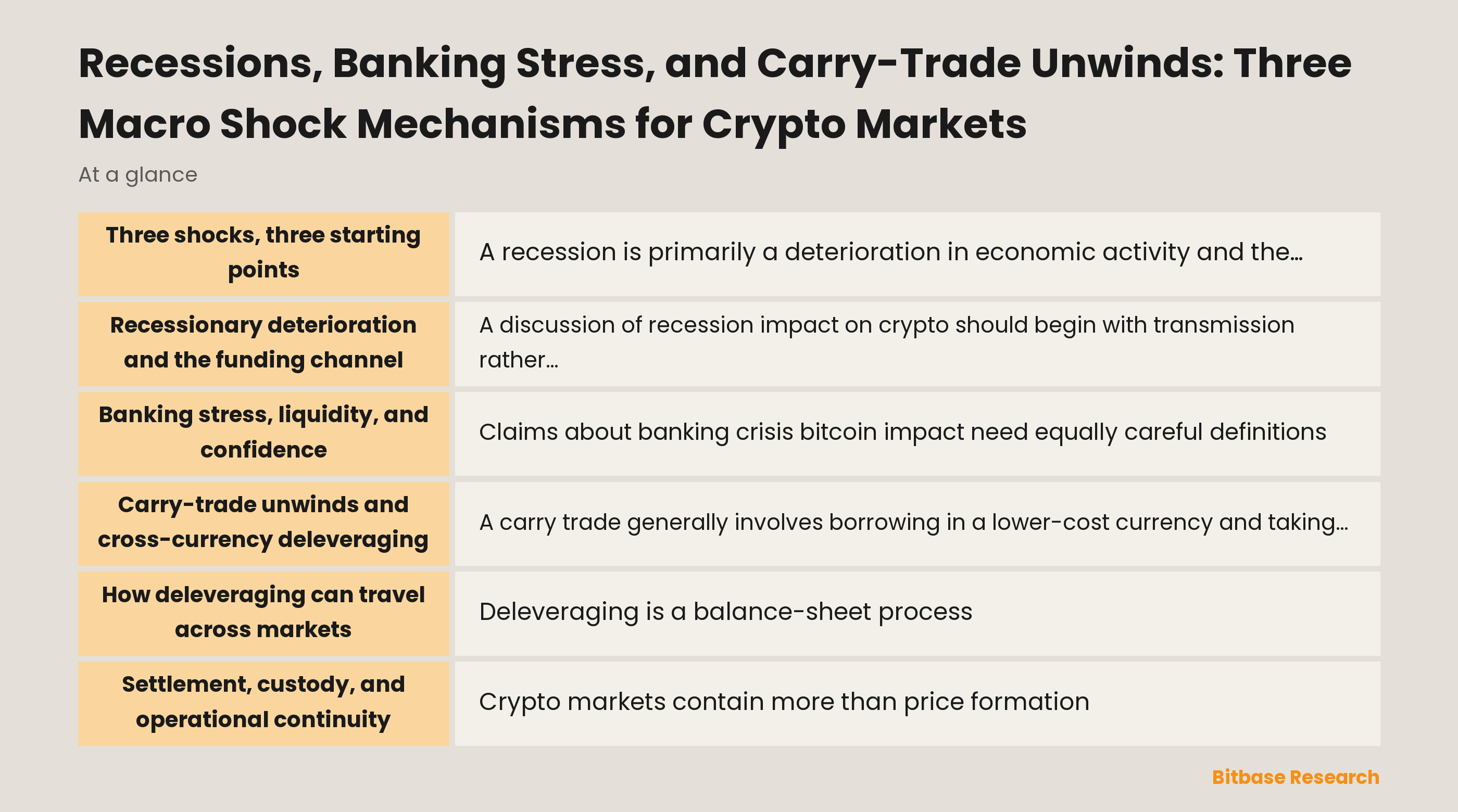
A recession is primarily a deterioration in economic activity and the expectations surrounding income, employment, investment, and credit demand. Its financial-market effects can emerge through weaker cash flows, changing credit assessments, shifts in policy expectations, or a broader reassessment of risk. The pace can be gradual, and the relevant evidence may arrive through several releases and institutional decisions rather than through one market event.
Banking stress starts elsewhere. It concerns confidence in intermediaries, the reliability of funding, the liquidity of assets used to meet withdrawals, and the ability of payment and credit channels to keep operating. A banking episode can develop while the broader economy is weak, strong, or uncertain, so it should not be treated as a synonym for recession. Its immediate concern is often the balance-sheet and operational condition of institutions rather than a single macroeconomic statistic.
A carry-trade unwind begins with the reversal of a leveraged cross-currency structure. The key ingredients are funding costs, exchange-rate moves, volatility, collateral, and the capacity of market participants to maintain exposures. It may happen alongside economic or banking stress, but it can also arise from a change in volatility or monetary expectations without either of those shocks. Keeping the starting point distinct helps prevent one broad label from standing in for several different mechanisms.
Recessionary deterioration and the funding channel
A discussion of recession impact on crypto should begin with transmission rather than a price conclusion. When businesses and households reassess income, financing needs, or uncertainty, lenders and market participants may revise their willingness to extend credit or hold less-liquid claims. That can alter the availability and cost of funding across many markets. Crypto-related firms and participants can be affected to the extent that they rely on those same funding, banking, capital-market, or payment channels.
The channel is not limited to formal borrowing. A weaker economic backdrop can change the terms on which institutions hold inventories, finance market-making activity, manage collateral, or allocate internal balance-sheet capacity. It can also change the timing of fundraising, lending, and settlement decisions. These effects are conditional: the relevant entities, legal structures, currencies, and sources of liquidity differ, and public information rarely reveals every private balance-sheet link.
Risk appetite is another possible link, but it should not be confused with a universal ranking of assets. Some participants may reduce exposures that they perceive as harder to value, finance, or liquidate under uncertainty; others may focus on different risks such as inflation, currency, or counterparty exposure. A recession therefore supplies a macroeconomic context and several possible constraints. It does not, by itself, settle how a crypto market must behave over a given horizon.
Banking stress, liquidity, and confidence
Claims about banking crisis bitcoin impact need equally careful definitions. Banking stress can affect the interfaces between traditional money and crypto markets, including deposit access, payment rails, settlement timing, credit lines, and the operational capacity of intermediaries. These interfaces matter because a market can have its own technical ledger while still depending on banks, custodians, issuers, brokers, or service providers for some entry, exit, conversion, or client-asset functions.
The Federal Reserve’s 2023 review of Silicon Valley Bank is a useful institutional example of the mechanisms involved: concentrated funding, interest-rate risk, liquidity management, governance, and rapid withdrawals can reinforce each other. That historical episode does not establish a template for crypto-market outcomes. It does show why a distinction is needed between the stress of a particular intermediary, the continuity of a payment or custody service, and the independent operation of a protocol’s validation rules.
Liquidity also has several meanings in this setting. An institution may lack immediately usable cash even when it owns assets, a market may have fewer willing counterparties at a moment of stress, and a client may face delays because a service provider is processing extraordinary demand. Those are related but not identical conditions. Separating them makes it possible to discuss settlement and custody pressures without implying that every operational disruption becomes a permanent market or technology failure.
Carry-trade unwinds and cross-currency deleveraging
A carry trade generally involves borrowing in a lower-cost currency and taking exposure to a higher-yielding currency or asset. The position can appear stable when exchange rates and volatility are contained, but it can become vulnerable when either changes, when funding costs are repriced, or when lenders and counterparties demand more collateral. The phrase yen carry trade crypto impact is best treated as an exposure-and-liquidity question, not as a standing relationship between the yen and a crypto asset.
An unwind can transmit through several steps. A participant facing losses, changing collateral terms, or a tighter risk limit may reduce positions and seek the funding currency needed to close the structure. If many participants respond at once, transactions can interact with thinner order books, wider spreads, or stricter financing conditions. The mechanism concerns balance-sheet adjustment and market liquidity; it does not require a claim that every asset was originally purchased with borrowed yen or will move in the same direction.
Measurement is a central limitation. The BIS notes that aggregate statistics can show borrowing and foreign-exchange derivatives without revealing every purpose of the transaction or the full identity of the end exposure. A visible move in a currency, a crypto market, or another risk asset therefore cannot by itself prove a carry-trade link. Analysts need to distinguish coincident timing from documented financing, collateral, and position data.
How deleveraging can travel across markets
Deleveraging is a balance-sheet process, not a property unique to one asset class. When collateral values fall, volatility rises, or funding terms change, leveraged intermediaries may need to reduce exposures, raise cash, or rebalance hedges. If their portfolios span currencies, derivatives, equities, credit, and crypto-related instruments, adjustments in one area can coincide with transactions in another. The connection may be direct, indirect, or absent; portfolio information and contractual details determine which description is justified.
Market liquidity can amplify that process without proving its original cause. Liquidity includes the availability of funding, the ability to transact near a reference price, the willingness of dealers to use balance sheets, and the capacity of settlement systems to process transfers. In stressed periods, each component can change at a different speed. A market may remain technically open while becoming more expensive to trade, while a separate service may experience operational congestion or delayed processing.
The practical analytical consequence is modest but important: a simultaneous move across markets is evidence of a shared episode, not a complete explanation of the links inside it. Documented margin calls, funding withdrawals, or service interruptions can strengthen a mechanism-based account, while missing data should narrow the claim. This avoids treating a broad deleveraging narrative as a substitute for evidence about who held which exposure and how it was financed.
Settlement, custody, and operational continuity
Crypto markets contain more than price formation. They can involve network validation, trading venues, custodial arrangements, stablecoin or other settlement assets, banks, payment providers, and compliance or identity processes. A macro shock can affect these layers differently. For example, a disruption in a fiat payment route may change the timing of transfers without changing a network’s consensus rules, while a congested service provider may not indicate that all custody arrangements face the same constraint.
Custody and settlement deserve separate attention because client access, asset control, transaction finality, and conversion can be organized through different legal and technical arrangements. Public-sector standards emphasize that governance, operational resilience, and interdependencies matter in financial-market infrastructure and crypto-asset activities. That is a reason to describe dependencies precisely, not a basis for assuming that every stress event produces a uniform operational outcome.
Timing matters as well. A bank funding concern may appear first through payments or client communication; a liquidity episode may emerge through market depth; a protocol-level issue may have a different schedule entirely. Combining those timelines too quickly can create a false causal story. A well-bounded account names the layer under discussion, states what is observed, and leaves unobserved dependencies as uncertainties rather than filling them with a confident narrative.
Why “safe haven” narratives do not generalize
The phrase “safe haven” is often used as if it described a permanent feature of an asset. In practice, it compresses several different questions: safe relative to which risk, over what interval, for whom, with what funding source, and through which market infrastructure? A response to a banking concern may differ from a response to a recessionary signal or a leveraged foreign-exchange unwind. Even within one episode, an asset can be discussed differently by long-horizon holders, short-horizon liquidity providers, and institutions managing collateral.
Narratives can also select one observable feature while omitting the conditions around it. A market may be liquid for one participant and constrained for another; it may be accessible through one custody arrangement and delayed through another; it may reflect a change in risk appetite at one moment and a funding need at another. These differences are why correlations and headlines cannot establish a general safe-haven property or a deterministic sequence of reactions.
The most durable conclusion is therefore a framework, not a forecast. Recessions, banking stress, and carry-trade unwinds can each reach crypto markets through funding, liquidity, deleveraging, settlement/custody, and risk-appetite channels, but their pathways, evidence, and timing differ. Describing those distinctions makes uncertainty visible and keeps a macro explanation from becoming a promise about what any market will do next.
Disclaimer: This article is educational content from Bitbase Academy, provided for information only. It does not constitute investment, trading, tax, or financial advice. Crypto assets are volatile; assess your own risk. Written as of August 2026; refer to the latest official information.
References
[1] International Monetary Fund: Global Financial Stability Report, April 2023 imf.org
[2] Federal Reserve: Review of the Supervision and Regulation of Silicon Valley Bank (2023) federalreserve.gov
[3] Bank for International Settlements: Sizing up carry trades in BIS statistics bis.org
[4] Bank for International Settlements: The market turbulence and carry trade unwind of August 2024 bis.org
[5] Financial Stability Board: High-level Recommendations for Crypto-asset Activities and Markets (2023) fsb.org
[6] CPMI-IOSCO: Application of the Principles for Financial Market Infrastructures to stablecoin arrangements bis.org