A transfer that lands in the wrong place is not one problem with one answer. It is five different problems, and what separates them is the layer the mistake landed on: the recipient, the network, a platform's internal bookkeeping, a smart contract, or an address nobody holds a key for. This article works through those five layers, says what each one actually depends on, and marks the ones that are final. It also names the scam that waits for people who go looking for a way out.
Start with the ledger, not with a search engine
Before anything else, establish what actually happened, and take it from the chain rather than from memory. A block explorer for the network you used will show the transaction, whether it confirmed, the sending and receiving addresses, and which asset moved. Every judgement below rests on reading that record correctly.
Confirmation means the network accepted the transaction and wrote it down. It does not mean the transfer went where you intended. Validity is a question about signatures and balances and says nothing about intent, so a transaction can be entirely valid and entirely wrong at the same time.
What is irreversible is the ledger entry itself. Nobody can un-write a confirmed transaction, and a public chain has no support desk with an undo button. Anything that looks like a reversal is in fact a second transfer, sent back by whoever controls the coins now.
So the useful question is never whether this can be reversed. It is who or what controls the destination address now, and whether that party has both the ability and a reason to send the funds back. Ability means a key or a line of code; reason means a person or a policy. Read every case below through those two words.
Right network, wrong recipient
The plainest version of the mistake: the address was well formed, the network was correct, and the funds are now sitting with someone else on the same chain. Nothing malfunctioned. The chain did exactly what you signed.
Recovery here depends on the party at the other end and on nothing else. If the address belongs to someone you can identify, a counterparty, a merchant, an acquaintance, then this is an ordinary conversation with an ordinary outcome, which may be yes and may be no. If you cannot identify the address, you have no lever at all: an explorer will show you its activity but it will not give you a name, and no amount of tracing changes who holds the key.
Most typos never get this far, because address formats carry checksums. ERC-55 encodes roughly 15 check bits into the capitalisation of an Ethereum address, so wallets can reject a mistyped one before sending; by the standard's own estimate a mistyped address still slips through about 0.02% of the time. Bitcoin bech32 addresses go further, using a code that is guaranteed to catch any error affecting at most 4 characters.
Two habits follow. Paste addresses rather than typing them, then compare the first and last characters against the source, because clipboard-swapping malware substitutes a valid address that every checksum will happily accept. And note what BIP-173 tells implementers: do not auto-correct addresses, because a corrected-but-wrong address is a perfectly valid destination and the funds go there.
Right address, wrong network
Every EVM chain uses the same address format, for a reason that is easy to miss. An Ethereum address is the last 20 bytes of the hash of your public key, and that derivation has nothing to do with which chain you are on. The same key therefore controls the same address on Ethereum, on the rollups and on every other EVM chain in existence.
That is convenient, and it is also precisely why this mistake is so easy to make. A wallet will accept the address on any of those chains without complaint, because on all of them it is a legitimate address.
On chain, nothing crossed anything. EIP-155 folds a chain identifier into the data you sign, so a transfer on one chain is simply not a transfer on another. Your tokens are not in transit and they are not stuck between networks; they are a balance in the ledger of the chain you actually used, at the address you actually named.
Whether you get them back turns on one question: do you hold the key to that address. If you sent from a self-custody wallet to an address of your own, adding the destination network in that wallet and then paying its fees usually brings the balance into view. You will need the native coin of that chain to move anything, which is a small chicken-and-egg problem of its own. If you sent to a deposit address issued by a platform, you do not hold that key, and that is a different case entirely.
One thing does not carry over: the asset. Control of an address is chain-agnostic, but a token is not. What you sent exists only in the ledger of the chain you sent it on, so reaching it means working on that chain, with its network settings, its fee coin and its explorer. Nothing you do on the chain you meant to use will produce it.
Deposits to a platform: unsupported network or missing memo
A deposit address printed by a centralised platform is controlled by that platform, not by you. That single fact changes the shape of the problem: nothing here is settled by cryptography and everything is settled by internal process, so there is no general answer and no honest answer that begins with yes.
In the unsupported-network version, you sent an asset over a chain the deposit address was never configured to credit. On chain the transfer is fine. In the platform's books nothing happened, because the software watching for deposits was not watching that chain. What matters then is whether the platform controls that address on that chain and whether it runs a manual recovery process at all. Some do, some do not, some do only above a size threshold and charge for the work. That is policy, not physics.
In the missing-memo version, the network routes many customers through one shared address and tells them apart with an extra field. XRP Ledger destination tags are the clearest example, and the specification is blunt about what they are: tags have no direct function on the ledger, they exist only to tell off-ledger systems how a payment should be processed. Send without one and the money arrives at the right address carrying nothing that says whose it is.
Two things follow. First, this is why a receiving address can switch on a setting that requires a destination tag, which makes the ledger reject a tagless payment outright rather than accept one nobody can credit. Second, when that setting is off you are back to a human process: a support queue, a set of logs, a set of rules. The useful thing you can supply is the transaction hash from the explorer. Certainty is not on offer.
Contract addresses, and addresses nobody holds
Sending tokens to a smart contract is a different failure again, and it is the one people most often assume is fixable, on the theory that the contract can simply send them back. Sometimes it can. Usually it cannot.
Contract accounts have no private key. They are controlled by their code, and code does only what someone wrote into it. If a contract contains no function that moves an arbitrary token out, then nobody can move that token: not the deployer, not the auditors, not a court.
The problem compounds because the ERC-20 transfer function does not notify the recipient. That gap is the stated motivation for ERC-223: with a plain ERC-20 transfer, tokens arrive at a contract as a balance the contract never learns about, and if it was not written to handle them they can stay there permanently. The most common instance of all is sending a token to the address of its own token contract.
Exceptions exist and they are deliberate. The contract behind one of the largest stablecoins, for example, includes a rescue component: a designated rescuer role can call a function that moves out any ERC-20 sent to the contract by mistake. Somebody chose to build that. Whether a given contract has an equivalent is knowable in advance by reading its verified source on an explorer, and it is the only thing that decides this case.
At the far end are addresses nobody holds a key for. An Ethereum address is 20 bytes of data and nothing more; there is no rule that a matching key exists, or ever existed. Burn addresses are used precisely because no one is expected to be able to spend from them. Send funds there, or to an address generated from a key that was never written down, and there is no counterparty to persuade, no process to open and nothing worth buying. It is finished, and saying so plainly is more useful than hope.
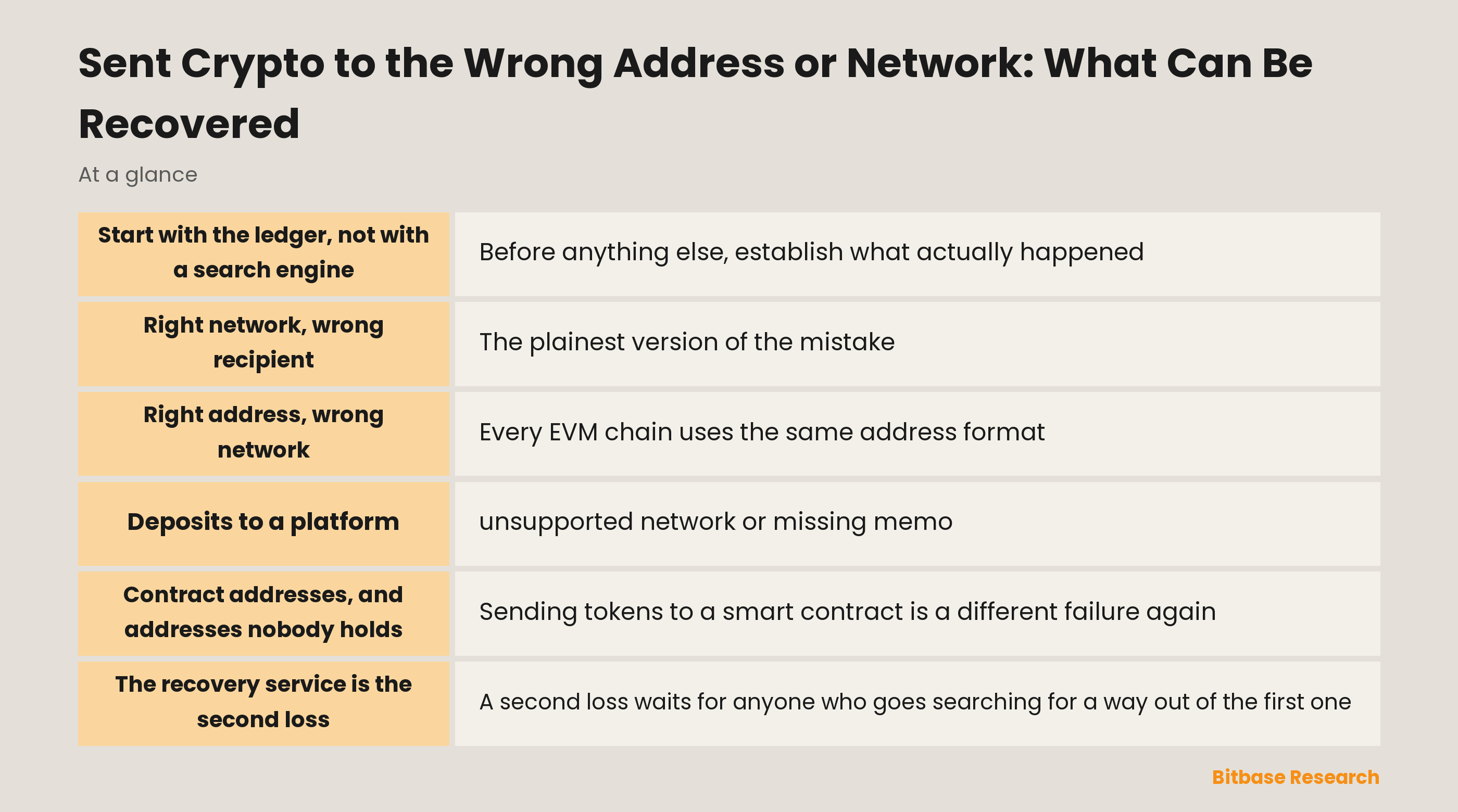
The recovery service is the second loss
A second loss waits for anyone who goes searching for a way out of the first one, and it is well documented. The FBI Internet Crime Complaint Center has warned repeatedly about businesses that advertise cryptocurrency tracing and promise to recover lost funds: they charge an up-front fee, then either stop answering or produce a thin report and ask for more money.
The structural tells are simple. IC3 states that private-sector recovery companies cannot issue seizure orders, and that law enforcement does not charge victims a fee for investigating a crime. So anyone who invokes an agency in order to sell you a service has already told you what they are, and anyone who wants payment before doing anything has told you the rest.
Then there is the ask itself. A seed phrase or a private key is custody: whoever holds it can move the funds, which is the entire design of the system. No genuine recovery process needs yours, under any circumstances, for any reason. A request for a seed phrase is not a step towards recovery. It is the theft.
Notice what the five cases above have in common. Every one of them turns on facts you can check yourself, for nothing, on a public explorer: which address holds the funds now, whether that address is a contract, whether the contract has a rescue function, whether the network was even the one you meant. Nobody has to be paid in advance to read a public ledger.
The bottom line
Nothing about a confirmed transfer can be undone, so the only live question is who controls the destination and whether they can and will send the funds back. A wrong recipient on the right chain depends on a person you may not be able to identify. The same address on the wrong EVM chain depends on whether you hold the key there and can pay that chain's fees. A platform deposit over an unsupported network, or without a required memo, depends on that platform's internal process, which is a policy rather than a right. A contract address depends on whether someone wrote a rescue function into the code, and most did not. An address nobody holds a key for is final. Read the transaction on an explorer, work out which of the five you are in, and treat anyone selling hope for an up-front fee or a seed phrase as the second attack rather than the way out.
Disclaimer: This article is educational content from Bitbase Academy, provided for information only. It does not constitute investment, trading, tax, or financial advice. Crypto assets are volatile; assess your own risk. Written as of August 2026; refer to the latest official information.
References
[1] Ethereum Improvement Proposals, ERC-55: Mixed-case checksum address encoding eips.ethereum.org
[2] Bitcoin Improvement Proposals, BIP-173: Base32 address format for native v0-16 witness outputs github.com
[3] ethereum.org, Developer documentation, Ethereum accounts ethereum.org
[4] Ethereum Improvement Proposals, EIP-155: Simple replay attack protection eips.ethereum.org
[5] Ethereum Improvement Proposals, ERC-223: Token with transaction handling model eips.ethereum.org
[6] XRP Ledger, official documentation, Source and Destination Tags xrpl.org
[7] Circle, stablecoin-evm repository, Rescuable.sol github.com
[8] FBI Internet Crime Complaint Center, Alert I-081123-PSA, Increase in Companies Falsely Claiming an Ability to Recover Funds Lost in Cryptocurrency Investment Scams ic3.gov