A Solana transaction can be described at several layers at once. A message describes proposed instructions and their context, a signed transaction carries authorization for that message, an RPC response reports what one service accepted or observed, and a cluster record is evidence at a stated commitment level. Those layers can produce different status phrases without contradicting one another. Reading an expiration or dropped-transaction message therefore begins with identifying which layer produced it. A local timeout, an RPC error, a status response, and a finalized record describe different points on a submission path, rather than one universal conclusion about the resulting state.
Transaction status and the submission path
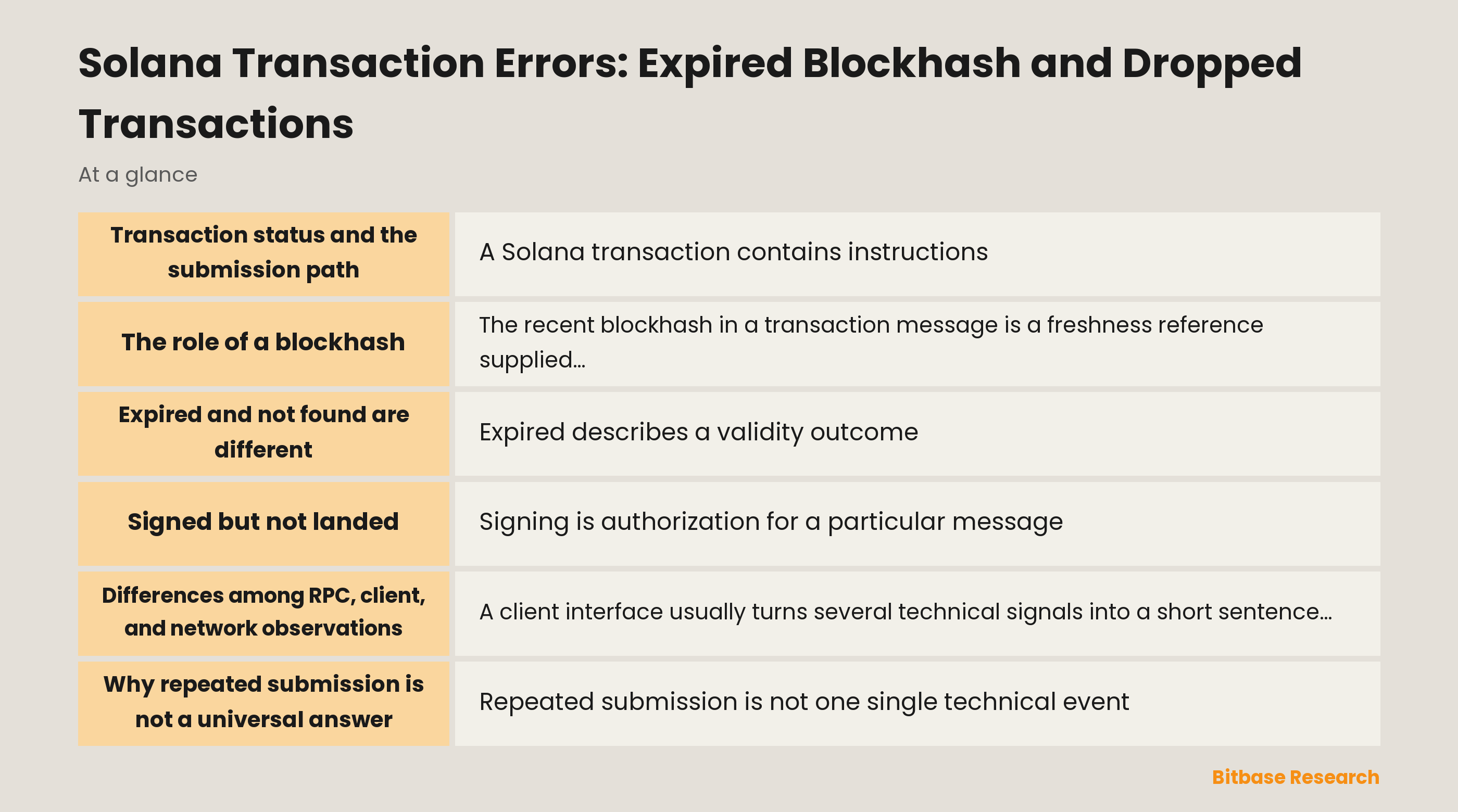
A Solana transaction contains instructions, account signatures that authorize changes, and a recent blockhash. The network treats its instructions as one atomic unit when it processes the transaction: an instruction failure prevents the intended state changes from being committed together. Before that outcome exists, however, the transaction can pass through distinct stages of formation, signing, relay to an RPC node, reception by network participants, processing, and observation at a commitment level. A status label is meaningful only when its stage is clear.
The sendTransaction RPC method reports the first transaction signature when the RPC service accepts the signed payload for relay. Official documentation expressly separates that immediate acceptance from processing or confirmation by the cluster. In ordinary discussion, dropped transaction often names the absence of a later cluster record after an earlier submission-related event. It is not a single consensus status with one fixed cause. The phrase may be used by a client, an RPC service, or an observer, each of which can be referring to a different missing transition in the path.
The role of a blockhash
The recent blockhash in a transaction message is a freshness reference supplied by the network. The getLatestBlockhash method returns both a blockhash and a lastValidBlockHeight, connecting the reference to a height boundary rather than to a guaranteed wall-clock duration. This lets the protocol evaluate whether a transaction carrying that reference is still within the processing window. The blockhash is part of the message being evaluated, so it belongs to the transaction’s identity and validation context rather than to a later explorer display.
Block height, slot progression, and elapsed time are related but should not be treated as interchangeable clocks. The exact processing-age parameter, the number of slots described by documentation, and the elapsed time represented by those slots depend on the relevant protocol and software version as well as network conditions. For that reason, a recent blockhash is best understood as a version-dependent validity window. The durable fact is the presence of a boundary; an exact duration is not a universal promise.
Expired and not found are different
Expired describes a validity outcome: the recent blockhash is no longer usable for a transaction to be processed under the applicable rules. It concerns the transaction’s time-bounded reference, not a generic label for every failed relay or missing record. When people use the search phrase solana transaction expired, they are often naming a client-visible outcome that maps to this lifecycle boundary. The phrase alone does not identify what any particular RPC node received, nor does it describe a separate transfer outcome.
Blockhash not found solana is a search phrase that often combines a display string with the network name. An actual blockhash-not-found message can express that a node, at its current view and commitment, cannot resolve the referenced hash for the relevant validation context. That observation is not automatically identical to proof that the last valid block height has passed everywhere. Node state, commitment, API version, timing, and client wording can change how the same broad condition is presented, so the two phrases should not be collapsed into one invariant diagnosis.
Signed but not landed
Signing is authorization for a particular message; it is not a record that the message reached a block. Likewise, an RPC service accepting a payload for relay is not a record that the cluster processed it. A signed transaction can therefore be discussed as signed and still lack a processed, confirmed, or finalized observation. That gap does not by itself reveal whether a payload was never received by a relevant participant, was not retained in a visible status scope, or became invalid before it could be processed.
The JSON-RPC status methods make the limits of an observation explicit. getSignatureStatuses returns current statuses for supplied signatures, and its default search is limited to a recent status cache unless transaction-history searching is included. getTransaction returns a confirmed transaction by signature or null when it is not found or not confirmed at the requested commitment. A null response is consequently a scoped response, not a universal statement that no event ever existed in every node’s retained view.
Differences among RPC, client, and network observations
A client interface usually turns several technical signals into a short sentence for a person to read. An RPC response is instead a report from a particular node, with a context slot, an API version, configuration, and a requested commitment. A network observation refers to the state that the relevant commitment makes visible. These are related observations, but they are not the same object and they need not become visible at the same moment.
Version dependence matters at each layer. Solana node software, client libraries, RPC configuration, transaction-version support, commitment defaults, status retention, and interface wording can all evolve. A sound interpretation therefore identifies the observer and the scope of the observation before attaching meaning to an error label. It does not assume that a phrase from one interface is a portable description of every node, every commitment, or every software release.
Why repeated submission is not a universal answer
Repeated submission is not one single technical event. It can mean relaying the same signed bytes again, presenting a different message, or creating a later message with different validation context. Those cases have different identifiers, timing, and possible state effects. A transaction that is already being considered by the network and a distinct later transaction are not interchangeable merely because they express similar intentions. Repetition can therefore make the relationship between a visible signature, a status record, and an intended state change harder to interpret.
For the same reason, a generic retry prescription would blur receipt, propagation, validation, execution, and commitment into one idea. Expiration language does not by itself establish that a later message would have the same identity or effect as an earlier one. In analytical terms, the important distinction is whether available evidence refers to the same transaction message, a separate message, or only a local attempt to relay data. The article’s subject is that distinction, not a procedure for sending another transaction.
Stable troubleshooting vocabulary and risk boundaries
Stable vocabulary helps keep the layers separate. Message names the instructions, accounts, recent blockhash, and other data being authorized. Signature identifies a signed transaction for status-oriented APIs. Submission names an RPC relay event, while processing, confirmation, and finalization name different levels of network observation. Commitment is the requested visibility threshold used by RPC methods. Expiration concerns the freshness reference, and dropped commonly describes an incomplete observed path rather than a protocol verdict with one standardized meaning.
The boundary of these terms is as important as their definitions. A technical status does not establish account ownership, the intent of a sender, an asset balance, a service’s conduct, or a remedy for a missing record. It also does not turn a client message into proof of what every validator or data-retention system observed. Status language is evidence about a limited processing path, interpreted through a version, an observer, a commitment, and a time. Keeping that boundary clear avoids turning a narrow network signal into a broader claim.
Disclaimer: This article is educational content from Bitbase Academy, provided for information only. It does not constitute investment, trading, tax, or financial advice. Crypto assets are volatile; assess your own risk. Written as of August 2026; refer to the latest official information.
References
[1] Solana Documentation: Transactions solana.com
[2] Solana JSON-RPC: getLatestBlockhash solana.com
[3] Solana JSON-RPC: isBlockhashValid solana.com
[4] Solana JSON-RPC: sendTransaction solana.com
[5] Solana JSON-RPC: getSignatureStatuses solana.com
[6] Solana JSON-RPC: getTransaction solana.com