A soulbound token is a label commonly used for a token designed to remain associated with a particular account rather than moving freely between accounts. The idea can be useful for representing a bounded claim or relationship, but the label alone does not establish that a claim is true, current, fair, or meaningful. It also does not turn an account into a complete identity. A token is a technical record with rules set by its implementation and surrounding governance.
On-chain reputation refers to attempts to use records visible to, or verifiable through, a ledger as inputs to a reputation judgment. That phrase contains two separate layers. The first layer is a record: a token, attestation, event, or reference. The second is an interpretation: a decision about what the record says about a person or account. Keeping those layers separate is essential. This article explains the structure and limitations of the idea; it is not a recommendation.
What a soulbound token means in technical terms
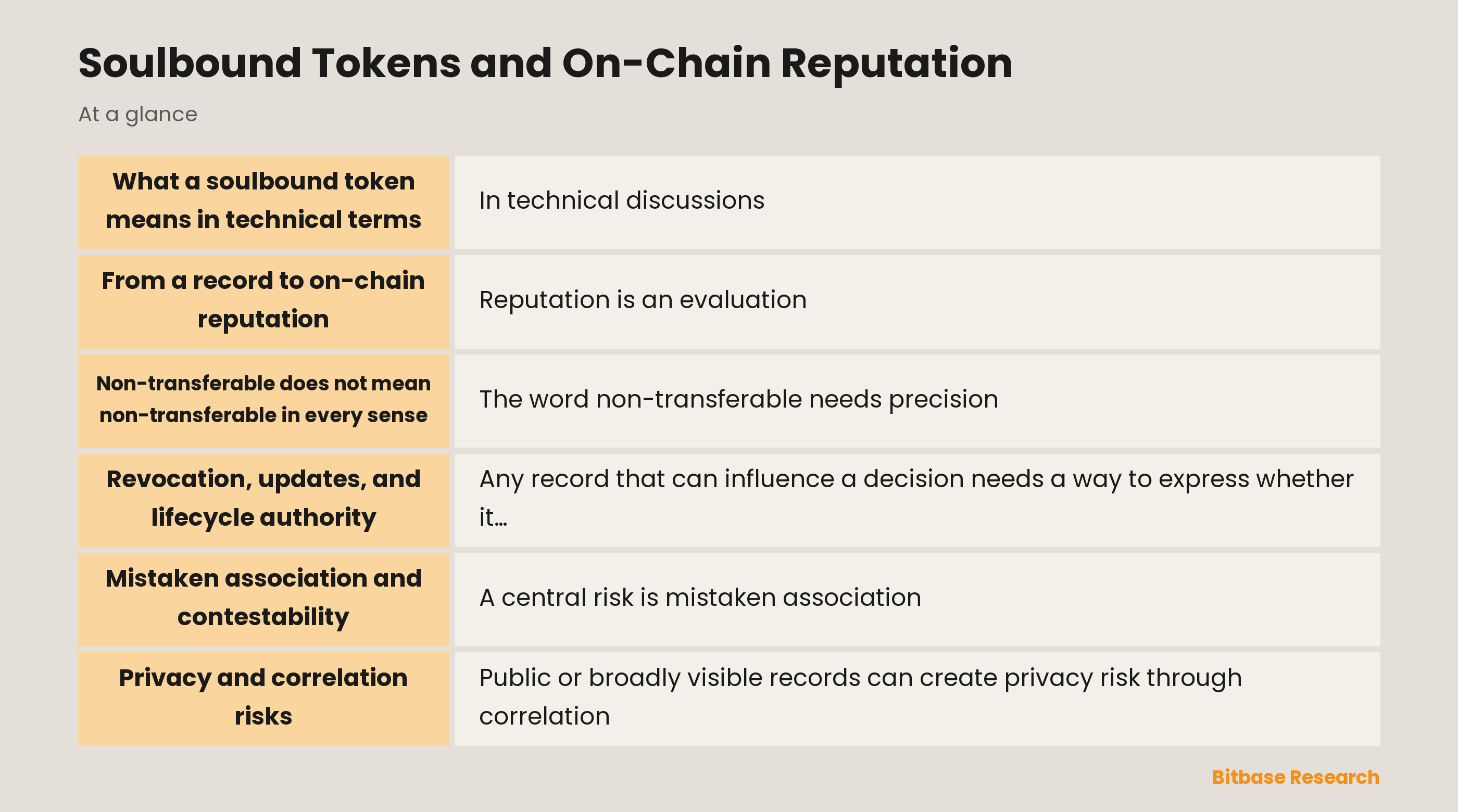
In technical discussions, a soulbound token generally means a non-fungible token that is bound to a receiving account and is intended to be non-transferable under specified conditions. ERC-5192, for example, describes a minimal extension to ERC-721 in which a token can report a locked state. When it is locked, transfer functions are required to reject transfers. This is a statement about an interface behavior, not a statement about the truth or quality of data associated with the token.
The exact term is broader than one standard. Some implementations may use a permanent lock, some may allow an unlock event, and some may use an entirely different contract pattern. A design may also record a reference rather than personal details directly. Therefore, “soulbound” should never be read as a guarantee that the token is permanent, private, or universally recognized. The relevant questions are which transfer functions are restricted, who can change the state, and what the surrounding system treats the record as meaning.
Non-transferable behavior can prevent a straightforward sale or transfer through the covered token interface. It cannot by itself prove that the account is controlled by the same person over time. Accounts can be lost, delegated, shared, compromised, or connected to arrangements outside the token contract. A non-transferable token is best understood as an account-bound record, not as a complete binding between a human being and a digital identifier.
From a record to on-chain reputation
Reputation is an evaluation, not just a data field. A record might say that an issuer made a claim, that an event occurred, or that a relationship existed at one time. A verifier then decides whether the issuer is relevant, whether the claim is still current, whether the evidence is adequate, and how much weight to assign it. The same record can therefore have different meanings in different contexts.
An on-chain reputation system may make some records easier to inspect or verify, but visibility does not solve the interpretation problem. A record can be incomplete, incorrectly associated with an account, issued under weak rules, or later superseded by new information. A public history can also overemphasize what was easy to record while omitting context that was not recorded. Treating a visible record as an automatic measure of trustworthiness confuses data availability with justified judgment.
The phrase on-chain reputation should also not imply a single shared score. A ledger can support many records and many independent interpretations. One organization may consider a claim relevant while another does not. W3C's verifiable-credential model makes a similar separation: an issuer makes claims, while a verifier applies its own policy when deciding whether to accept them. Technical verification can show that a record is authentic under a chosen mechanism; it cannot decide every social, legal, or ethical question about the subject.
Non-transferable does not mean non-transferable in every sense
The word non-transferable needs precision. At the contract layer, it can mean that a particular token's transfer call reverts while the token is locked. At the account layer, it does not prevent control of the account itself from changing hands. At the information layer, it does not prevent a claim from being copied, referenced, reissued, or inferred from another source. At the social layer, it does not prevent someone from describing a relationship in a different system.
This distinction matters when discussing portability. A record bound to one account may be hard to move even when the underlying person needs to change identifiers because of key loss, security concerns, accessibility needs, or a move between systems. Conversely, allowing a migration path can introduce new questions about proof, authority, and duplicate records. Portability is not simply the opposite of non-transferability. It is a lifecycle and governance question about whether, when, and how a legitimate association can be updated.
Technical interoperability also has limits. ERC-5192 defines a narrow interface for locked ERC-721 tokens. It does not define common semantics for every credential type, issuer, appeal process, privacy feature, or reputation interpretation. A system may recognize the interface while disagreeing about the meaning of the token. A standard can improve consistent detection of one behavior without making all downstream judgments consistent.
Revocation, updates, and lifecycle authority
Any record that can influence a decision needs a way to express whether it remains current. A token might be burned, marked as invalid by a related registry, superseded by a newer record, or left unchanged while external information changes. Each option has different consequences. A burn event may signal one state transition, but it does not necessarily remove historical traces from a public ledger. A separate status record may preserve history, but it also adds dependencies and privacy questions.
Authority must be explicit. ERC-5484 illustrates this point by including consent and burn-authority concepts for account-bound tokens. Different designs can assign lifecycle power to an issuer, a recipient, both, or another defined party. None of those choices is automatically fair or safe. An issuer-only revocation mechanism can correct an erroneous issuance, yet it can also concentrate power. A recipient-controlled mechanism can support autonomy, yet it may not satisfy a verifier that needs a reliable status signal. Governance must define the purpose and the safeguards rather than treating revocation as a simple technical switch.
Updates deserve the same attention. A claim may become outdated without becoming false, and a correction may need to preserve enough context to explain why it happened. Systems should specify which changes create a new record, which change status, and which require independent review. Without a clear lifecycle, an on-chain reputation record can remain visible after its interpretation has changed.
Mistaken association and contestability
A central risk is mistaken association: a record may be connected to the wrong account, the wrong person, or the wrong interpretation. The source of error can be an issuer mistake, a compromised account, an ambiguous identifier, faulty matching, misleading metadata, or a verifier's inference. Non-transferability does not prevent these failures. In some cases, it can make a mistaken association more difficult to escape because the record remains linked to the affected account.
Contestability is therefore not an optional feature. A person affected by a reputation-related record needs a defined way to question its issuance, status, or interpretation. That process should identify who can review a challenge, what evidence is considered, whether a correction is possible, and how a verifier learns that a record is disputed or no longer current. The process must be meaningful even when the affected person cannot easily reproduce the original evidence.
An appeal path does not require every disagreement to be resolved in favor of the subject. It does require that a system avoid treating a token's existence as the end of the inquiry. A record may be cryptographically authentic and still be inaccurate, incomplete, coercively obtained, or inappropriate for a particular decision. Sound governance distinguishes authenticity from validity and validity from fairness.
Privacy and correlation risks
Public or broadly visible records can create privacy risk through correlation. Even when a token contains no name, its account association, timestamps, interactions, or linked metadata may enable observers to connect activities. Repeated presentation of the same identifier can make this easier. A system that stores minimal data directly on a ledger may reduce exposure, but links to external data, predictable identifiers, and status checks can still reveal patterns.
Privacy is not solved by calling data pseudonymous. An identifier can be pseudonymous while still being highly linkable. It is also not solved merely by moving personal data off-chain. Off-chain storage changes where risks are handled; it does not remove the need for access controls, retention decisions, consent rules, and safeguards against correlation. The W3C DID specification specifically cautions against personal or correlatable data in identifier documents, illustrating why the full information flow matters.
For reputation uses, privacy and accuracy can pull in different directions. More visibility may make independent checking easier, while less visibility may reduce unwanted linkage. There is no universal technical setting that resolves this tradeoff. A responsible design states what is exposed, to whom, for how long, and how an affected person can seek correction or limitation.
Portability and the limits of a shared reputation record
Portability means more than exporting a token identifier. A person may need to carry a claim, demonstrate its status, preserve context, and avoid being locked into one issuer's interpretation. Yet a portable record can also magnify correlation if it becomes a universal label reused across unrelated settings. A design must balance continuity with context separation rather than assuming that more reuse is always better.
Similarly, an on-chain reputation record cannot supply all the context needed for high-impact judgments. It cannot by itself establish intent, circumstances, rehabilitation, competence, legal identity, or creditworthiness. Different communities can legitimately apply different standards, provided their policies are clear and contestable. The technical record is an input to a decision, not a substitute for accountability in the decision.
Soulbound tokens and on-chain reputation are therefore best treated as limited design patterns. Non-transferable behavior can be useful for a narrowly defined account-bound record. It does not make the record self-explanatory, error-free, private, or portable in every relevant sense. The quality of a system depends on its semantics, lifecycle authority, redress process, privacy choices, and the care with which verifiers interpret its claims.
Disclaimer: This article is educational content from Bitbase Academy, provided for information only. It does not constitute investment, trading, tax, or financial advice. Crypto assets are volatile; assess your own risk. Written as of August 2026; refer to the latest official information.
References
[1] ERC-5192: Minimal Soulbound NFTs eips.ethereum.org
[2] ERC-5484: Consensual Soulbound Tokens eips.ethereum.org
[3] ERC-721: Non-Fungible Token Standard eips.ethereum.org
[4] W3C: Verifiable Credentials Data Model v2.0 www.w3.org
[5] W3C: Decentralized Identifiers v1.0 www.w3.org