
Staking rewards are often described with one headline number, but that label can hide several different questions. A nominal reward records additional asset units. Supply issuance changes the denominator against which ownership is measured. Purchasing power concerns what units can acquire. Fee and reward attribution asks who is entitled to a flow at all. Keeping these concepts separate is the starting point for a careful explanation, not a promise of return or a reason to stake.
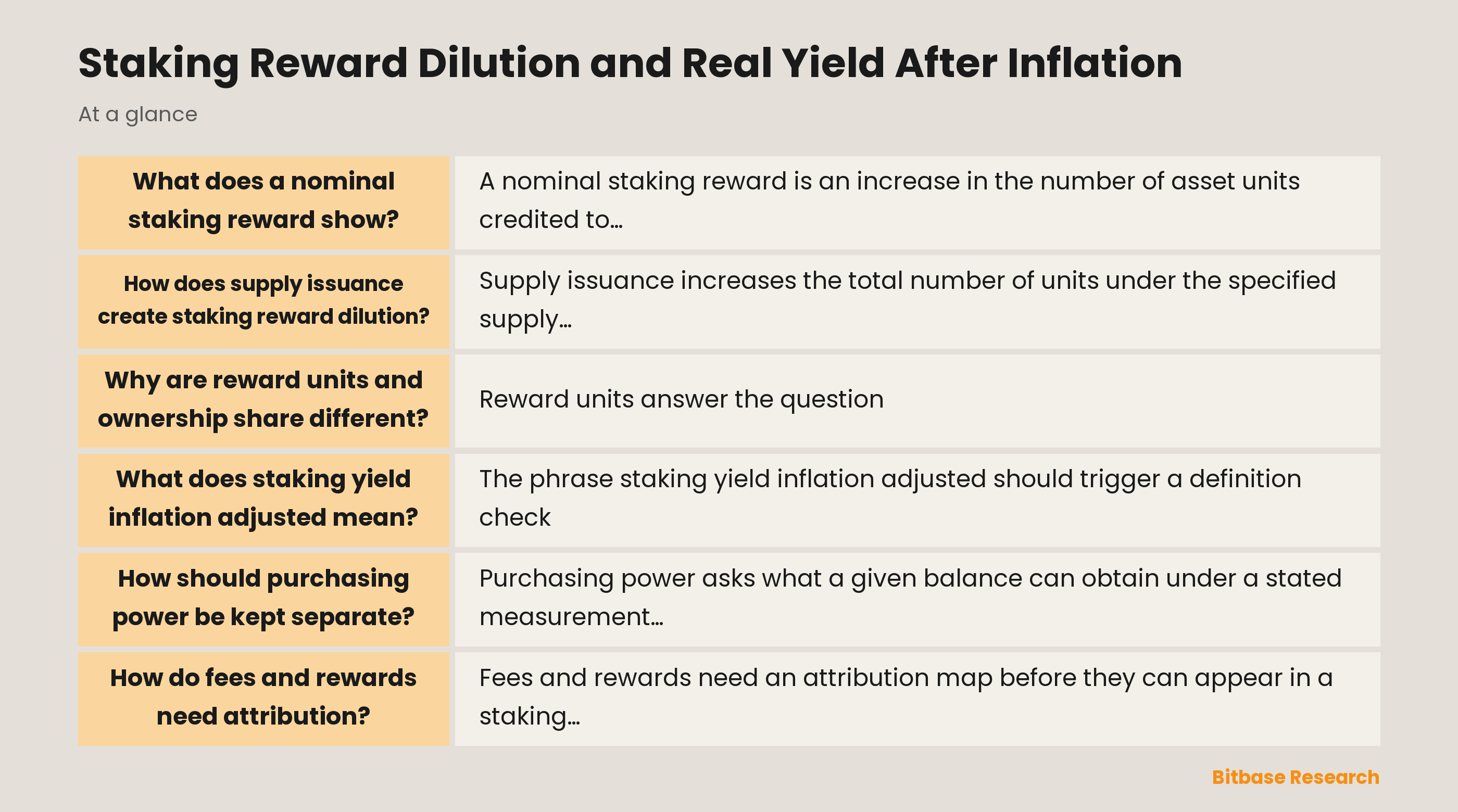
What does a nominal staking reward show?
A nominal staking reward is an increase in the number of asset units credited to a defined address, role, or reward claim over a defined period. It is a statement in token units before it becomes any broader economic conclusion. The record should identify the asset, the period, the recipient, the rule that authorized the credit, and whether the amount is earned, accrued, claimable, or already received.
That distinction matters because a credit can arise from different mechanisms. A protocol may issue units to participants who fulfill consensus duties, assign a share of a separate fee flow to a role, or apply a distribution rule that depends on delegation and performance. Calling every such credit “yield” can obscure whether the amount is new issuance, transferred value, a share of fees, or a mixture whose components have different sources.
An illustrative nominal-reward identity is `R_nominal = R_issuance + R_fee + R_other - P`. This is not a protocol formula or a forecast. `R_nominal` is the defined token-unit change for one reporting boundary, `R_issuance` is attributable issuance, `R_fee` is an eligible fee-related allocation, `R_other` is a separately documented receipt, and `P` is a documented penalty or reduction. The identity only works after each term has a recipient and rule.
How does supply issuance create staking reward dilution?
Supply issuance increases the total number of units under the specified supply definition. Whether that creates staking reward dilution for a particular holder depends on where the issued units go. If a holder receives none of an increase while the denominator grows, that holder’s proportional claim on the defined supply can fall even though the holder’s unit balance has not changed.
The key word is proportional. Dilution in this sense is about a relationship between an individual balance and a supply denominator, not an automatic statement about a market price, a purchasing basket, or an account’s cash flow. A token holder can have more units and still need a separate calculation to determine whether their relative supply share rose, fell, or stayed broadly aligned with issuance.
An illustrative share identity is `q = B / S`, where `q` is a defined ownership share, `B` is the balance attributed to the reporting entity, and `S` is the stated supply denominator at the same observation point. To assess a change, a report compares internally consistent versions of those variables before and after the period. It must not silently switch between circulating, total, liquid, bonded, or another supply convention.
Why are reward units and ownership share different?
Reward units answer the question, “How many additional units were credited?” Ownership share answers, “What proportion of the defined supply does the entity represent?” The first is a numerator event; the second requires both numerator and denominator. Conflating them can make an increase in units look like a complete measure of economic position when it only describes one component.
Participation can affect the comparison because a distribution rule may direct some issuance to particular roles while other holders receive none. However, the result still depends on eligibility, reward attribution, missed duties, compounding assumptions, and the supply convention. A general article should describe those dependencies rather than implying that all participating or non-participating holders experience the same change.
An illustrative relative-share change can be expressed as `Delta_q = q_after - q_before`. Here, `q_before` and `q_after` must be calculated from balances and supply definitions that match their respective observation times. The expression is descriptive, not predictive: it does not establish future issuance, future participation, future policy, or any holder’s future outcome.
What does staking yield inflation adjusted mean?
The phrase staking yield inflation adjusted should trigger a definition check, not a shortcut calculation. It is sometimes used to compare a nominal reward with token supply issuance, and sometimes used to refer to a change in an external purchasing-power measure. Those are distinct exercises. The first concerns relative token supply; the second requires an independently defined price or cost-basket framework.
For supply-share analysis, a writer can state the question narrowly: did the entity’s balance change in a way that preserved, increased, or decreased its share of the stated supply definition? That analysis can be conducted in asset units. It says nothing by itself about what those units will exchange for, because exchange value depends on factors outside the issuance ledger.
For purchasing-power analysis, the target must be specified. “Real” can mean purchasing power against a selected goods basket, a reporting currency, another asset, or a protocol-specific service. Each choice supplies a different denominator and a different interpretation. Without naming the denominator, period, source, and conversion convention, an inflation-adjusted label remains too ambiguous to support a conclusion.
How should purchasing power be kept separate?
Purchasing power asks what a given balance can obtain under a stated measurement basis. It is affected by market conditions, liquidity, the asset used for comparison, and the composition of the chosen basket. Supply issuance may be relevant context, but it does not mechanically determine purchasing power, and a nominal reward does not prove that purchasing power increased.
This separation also prevents a common category error: treating a supply-based dilution measure as if it were a consumer-price or reporting-currency result. A balance can be analyzed for its share of a token supply without making any claim about a purchase, a sale, a conversion, or a valuation. Conversely, a purchasing-power study cannot be reproduced from token issuance alone.
An illustrative purchasing-power ratio is `p = V / C`, where `p` is a defined purchasing-power measure, `V` is the value of the balance under a disclosed valuation convention, and `C` is the stated cost or comparison denominator. This is only an illustrative framework. It requires external assumptions and data, so it should never be inferred from a protocol reward line or presented as a guaranteed real yield.
How do fees and rewards need attribution?
Fees and rewards need an attribution map before they can appear in a staking analysis. A user-paid fee might be removed from circulation, directed to a public pool, assigned to a block-producing role, distributed across a validator set, or split across several destinations. Likewise, issuance can be sent to participants, reserves, governance-controlled accounts, or another rule-defined recipient. Labels such as “network revenue” are incomplete without that map.
The relevant test is not whether value appeared somewhere in the network, but whether a specified reporting entity had a rule-based claim to it. Reward eligibility can depend on the role, stake weight, delegation terms, performance, timing, and protocol state. A fee-related amount may also require further allocation before it reaches the entity being analyzed. Gross ecosystem activity and attributable receipts are therefore different concepts.
An illustrative attribution identity is `A_entity = E_issuance + E_fee + E_distribution - E_reduction`. `A_entity` means only the flow attributable to the defined entity; each `E` term must be supported by an applicable rule and observation record. The identity does not convert all issuance into income, all fees into validator revenue, or all credited units into a real economic return.
What is an emissions adjusted yield crypto framework?
An emissions adjusted yield crypto framework is useful only if its adjustment is named precisely. It may compare a recipient’s nominal units with aggregate issuance, compare an ownership share before and after a period, or combine a token-unit analysis with an outside purchasing-power denominator. Those are different models with different inputs and should not be compressed into one universal “real yield” label.
A transparent framework begins with a ledger of definitions: the reporting entity, period, asset unit, supply convention, attribution rule, treatment of compounding, and treatment of penalties or unclaimed rewards. It then reports the narrow result supported by those definitions. If the purpose is supply-share analysis, it should not imply a valuation result. If the purpose is purchasing-power analysis, it should disclose the external basis instead of disguising it as protocol data.
The practical conclusion is intentionally limited. Nominal rewards, issuance-driven dilution, ownership share, purchasing power, and fee attribution can inform one another, but none substitutes for the others. A careful reader should ask which question the metric answers, which assumptions it requires, and what it leaves unresolved. That discipline supports understanding without making a staking recommendation, return promise, protocol ranking, or strategy claim.
Disclaimer: This article is educational content from Bitbase Academy, provided for information only. It does not constitute investment, trading, tax, or financial advice. Crypto assets are volatile; assess your own risk. Written as of August 2026; refer to the latest official information.
References
[1] Ethereum.org: Proof-of-stake rewards and penalties ethereum.org
[2] Ethereum consensus specifications github.com
[3] Ethereum Staking Launchpad: FAQ launchpad.ethereum.org
[4] Cosmos SDK distribution module docs.cosmos.network
[5] Solana staking overview solana.com