A protocol can be busy, charge real fees, and still send none of that money to the people holding its token. Value accrual is the question of whether a mechanical path runs from what users pay to what holders own, and how much travels down it. This article separates the layers of money a protocol touches, explains what a fee switch is and why so many stay off, and takes apart the number people call buyback yield.
What token value accrual actually claims
Value accrual is a claim about plumbing, not about price. It says that when the system takes in money, some defined share of it ends up with token holders under a rule that does not depend on anyone's goodwill. If you cannot name the rule, the code or the vote that enforces it, and the account it draws from, there is nothing to analyse yet.
This is where utility and value get confused. A token can be genuinely necessary, the only accepted payment for a service or the only asset a system will take as a bond, and still carry no claim on anything that system earns. Being needed and being paid are separate properties, and a token can have the first without the second for its entire life.
Regulators draw the same line from the other side. The UK Financial Conduct Authority separates tokens redeemed for access to a specific product or service from tokens carrying rights such as ownership, repayment of a sum, or an entitlement to a share in future profits, and places only the second group inside its perimeter. The 2026 SEC and CFTC interpretation describes its non-security categories the same way: assets that do not have intrinsic economic properties or rights, such as generating a passive yield or conveying rights to future income, profits or assets.
So the useful question is not whether a token is useful. It is which of four things happens when the system takes in money: the money never touches the token, the money is used to buy the token, the money has to be paid in the token, or the money is paid out to holders of the token. Those four sit at very different distances from a holder, and most arguments about value accrual are really arguments about which one is in play.
Who takes the money: fees, supply-side income and protocol take
Start with what a user actually pays. Call it total fees. It is the top line, and on its own it says very little about the token, because most of it is usually somebody's cost of doing business rather than anybody's profit.
The second layer is supply-side income, the share paid to whoever provided the service. On a network that is the validators and block producers, and transaction fees exist precisely to compensate them. On a venue built from pooled inventory it is the liquidity providers, who are paid to leave their assets where the trading happens. This is not leakage. It is the price of keeping the supply side present, and it is money that has left before anyone else can consider it.
What remains is the protocol take, the slice the system keeps for itself, usually landing in a treasury that governance controls. This is the only layer a value-accrual mechanism can draw on. In a large number of designs it is zero, not by accident but because the contracts were written that way.
A fourth thing can happen to the top line that fits none of the above, which is destruction. A network can write a burn into its own fee market so that part of every payment reaches nobody at all; one widely used design splits each payment into a base fee that the protocol destroys and a priority fee that the block producer keeps. When you read a figure labelled revenue, work out which of these four layers it is measuring before you compare it with anything.
What a fee switch is, and why so many stay off
A fee switch is a governance-controlled parameter that diverts a share of fees away from the supply side, or away from being burned, and toward the protocol or its token holders. In most designs it is written into the contracts from the beginning and set to zero. Turning it on is a vote, not a rewrite.
The first reason it stays at zero is legal. A token that conveys no claim on income sits in the category regulators treat as outside the securities perimeter, and a token that pays holders a share of what an enterprise earns looks like the thing that sits inside it. The 2026 SEC and CFTC interpretation describes one class of digital security as an instrument entitling the holder to receive economic distributions from a central party that manages a business on holders' behalf. A project can create that fact pattern for itself by flipping a switch, and it is far easier to create than to undo.
The second reason is competitive. The take rate is the part of the price that buys the user nothing. Raising it asks users and suppliers to accept a worse deal in a market where the software can usually be copied and the liquidity can move the same afternoon. Where a protocol's take is thin, that is often the market clearing rather than an oversight waiting to be corrected.
The third reason is that the switch is a governance decision, and governance is a group of people with conflicting interests. A holder who wants distributions, a supplier who wants the fee share left alone, and a founding team weighing legal exposure will not vote the same way. This is why the claim that the fee switch could be turned on carries so little weight on its own: an option that other people hold is not a cash flow you own.
The routes value can take to reach a token
Where value capture does exist, it takes one of a small number of shapes. They differ in how directly they touch a holder, and in how much has to go right for them to keep working.
Burning destroys tokens, funded either by fee income or out of a treasury. Nobody is paid, and the mechanical effect is that each surviving token is a larger fraction of the remaining supply. It is the route that depends least on anyone's follow-through, but it hands a holder nothing directly, and it tightens supply not at all if new issuance elsewhere runs ahead of it.
Buying back spends real money in the market to acquire the token. What happens next decides everything: tokens that are burned leave the supply, tokens parked in a treasury can come back, and tokens recycled into rewards are simply a different payment method. That difference is often buried in a governance forum rather than fixed in code.
Distributing pays holders directly, either in whatever currency the fees arrive in or in the token itself, and usually only to holders who lock their position for a period. It is the most direct route to a holder and, for exactly that reason, the one that attracts the closest regulatory attention.
Two quieter routes deserve a name. Some systems require the token to be posted as a bond before an operator can do the profitable work of validating, sequencing or making markets, and staking a network's own asset to join its consensus is the standard case. Others accept only the token as payment for access. Neither route pays a holder anything at all. Both change how much of the supply is free to move at a given moment, which is a different mechanism with different ways of failing.
Buyback yield: what the number measures and what it does not
Buyback yield borrows its arithmetic from equities, where the definition is precise. A major index provider computes the buyback ratio behind its buyback index as the cash paid for share repurchases over a trailing twelve-month window, divided by the market capitalisation at the start of that window, with a three-month lag built in so that company reports have been published. Every element of that is backward-looking.
Run it with round numbers. A protocol spent 24 buying back its token over the past year, and the token's total market value at the start of that year was 800, so the ratio is 24 / 800 = 3%. Now let fee income halve, so the programme spends 12 across the following year against the same 800: the ratio is 1.5%. Nothing about the design changed. The number moved because the money did.
That is the first thing the figure is not. It is not a rate anyone promised, and it is not an entitlement. It is a report of money already spent, with no accrual behind it, no schedule you can enforce, and nothing owed to you if the spending stops tomorrow.
The second thing is that both the budget and the rule are unstable. Buybacks funded out of fees rise and fall with usage, and usage in this market moves a long way in a single quarter. The programme itself sits under the same governance that controls the fee switch, so it can be paused, resized or pointed somewhere else by the same kind of vote that created it. A yield you can calculate is not the same as a yield you are owed.
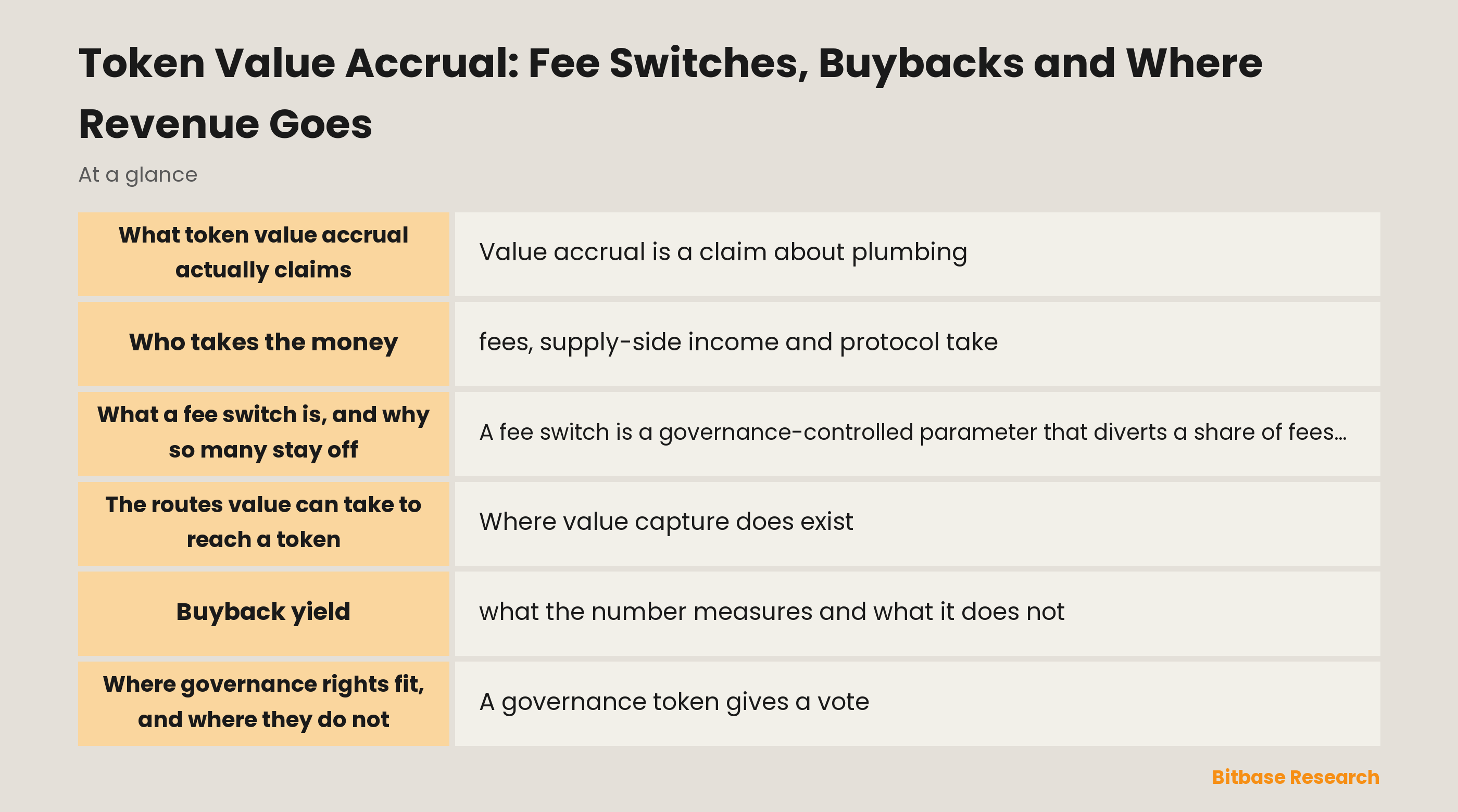
Where governance rights fit, and where they do not
A governance token gives a vote. The 2026 SEC and CFTC interpretation describes governance tokens as letting holders vote on matters such as software upgrades and treasury expenditures, while placing them in a category defined by not conveying rights to future income, profits or assets. Both halves of that description matter, and they are usually quoted one at a time.
A vote over a treasury is an option on a decision, not a claim on a balance. The content is real, because the treasury is real and the fee switch is a parameter somebody has to vote on. Converting that content into something a holder actually receives still needs a proposal, a majority, and a set of counterparties who may well prefer that the money stay where it is.
It also assumes the vote is contestable. The Bank for International Settlements has described a decentralisation illusion in this market, noting that platform governance typically revolves around holders of governance tokens who are often the developers themselves, and that consensus mechanisms tend to concentrate power in large holders. Where a small group can decide, a vote held by everyone else is closer to a formality than a right.
None of this makes governance worthless. It makes governance a claim on process rather than a claim on cash, and the two belong in different columns when you are writing down what a token actually is.
The bottom line
Value accrual is a plumbing question: name the money, name the rule that moves it, and name who can change that rule. What users pay is not what a protocol keeps, because the supply side is paid first and part of the top line may be destroyed rather than collected. A fee switch is a parameter usually set to zero for legal and competitive reasons, and an unflipped switch is an option held by other people rather than an asset held by you. A buyback yield is a backward-looking ratio of money already spent, funded by income that varies and governed by a vote that can be retaken. And a token can be indispensable to a system while carrying no claim on a single unit of what that system earns, which is why being needed and being paid have to be checked separately.
Disclaimer: This article is educational content from Bitbase Academy, provided for information only. It does not constitute investment, trading, tax, or financial advice. Crypto assets are volatile; assess your own risk. Written as of August 2026; refer to the latest official information.
References
[1] Application of the Federal Securities Laws to Certain Types of Crypto Assets and Certain Transactions Involving Crypto Assets (SEC and CFTC interpretation, 17 March 2026) federalregister.gov
[2] Cryptoassets: our work, How we define cryptoassets (Financial Conduct Authority) fca.org.uk
[3] EIP-1559: Fee market change for ETH 1.0 chain (Ethereum Improvement Proposals) eips.ethereum.org
[4] DeFi risks and the decentralisation illusion (BIS Quarterly Review, December 2021) bis.org
[5] S&P 500 Buyback Index Methodology (S&P Dow Jones Indices, November 2024) spglobal.com