
Validator decentralization is not one count and not one leaderboard. A network can have many validator keys while a smaller number of operators, custodians, pools, hosting providers, client implementations, or governance actors still concentrate meaningful control. A useful report separates those layers, states its threshold and entity-mapping rules, records the observation window, and treats every metric as a partial view. This article explains the Nakamoto coefficient, validator client diversity, validator concentration risk, and blockchain node decentralization without making a real-time ranking or a recommendation about any network.
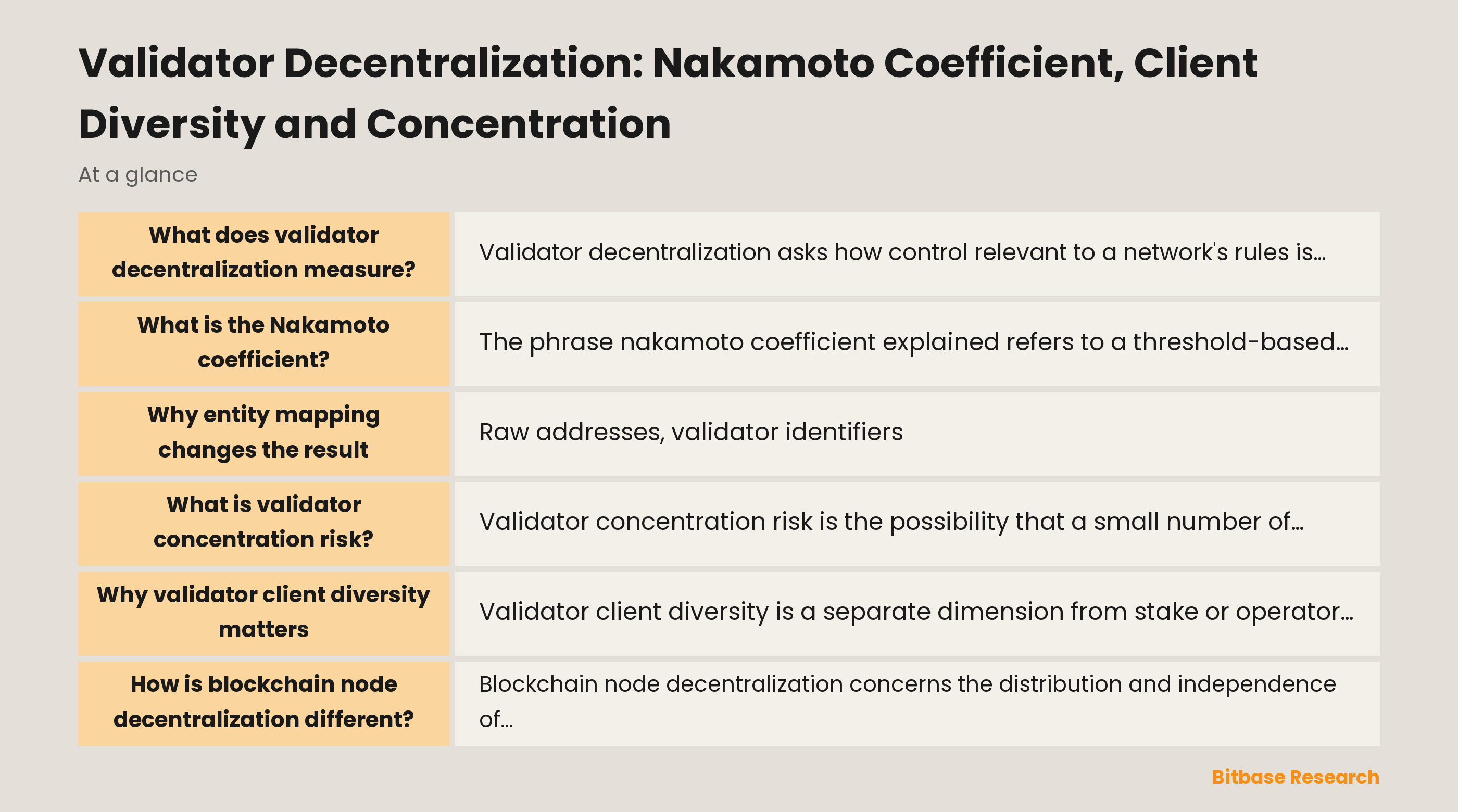
What does validator decentralization measure?
Validator decentralization asks how control relevant to a network's rules is distributed, but the word “control” has several layers. In a proof-of-stake system, validator keys may sign messages, operators may run infrastructure, pools or custodians may influence delegated stake, and a smaller set of legal or organizational entities may coordinate more than the key count suggests. In proof-of-work or permissioned systems, the relevant units differ again. A report must name the system role before it counts anything.
The most visible unit is often the validator or node count. It is useful, but it is not a direct measure of independent decision-makers. One organization can operate many validators; one validator client can hold multiple key pairs; a cloud or hosting provider can serve many otherwise separate operators; and different keys can be controlled by the same entity. A larger number of records can coexist with concentrated authority.
The question also changes with the threat model. A reader may care about who could censor transactions, halt progress, influence finality, cause a liveness failure, coordinate a software upgrade, observe network traffic, or control a data source. The actors and thresholds relevant to those outcomes can differ. “Decentralized” is therefore a family of claims, not a property proven by a single chart.
What is the Nakamoto coefficient?
The phrase nakamoto coefficient explained refers to a threshold-based concentration metric. In a stated subsystem, it asks for the smallest number of independent entities whose combined weight reaches or exceeds a stated control threshold. Weight can mean staked voting power, block-production share, hash rate, delegated stake, governance voting power, or another mechanism-specific input. The coefficient is only meaningful with all four pieces: the subsystem, the threshold, the weight definition, and the entity-mapping rule.
The threshold is not universal. Different protocols have different fault, censorship, liveness, finality, or governance conditions. A report might analyze more than one threshold to show how concentration changes as the condition changes. It must not silently borrow a threshold from one protocol and apply it to another. The question is not “how many validators exist?” but “how many independently controlled entities are needed for this explicitly defined outcome?”
The coefficient is a snapshot of a model, not a permanent verdict. A stake distribution, delegation relationship, operator map, pool structure, or protocol rule can change after the observation date. It also says little by itself about client bugs, geographic concentration, legal exposure, governance processes, or the availability of public data. A higher number can be informative, but it does not finish the decentralization analysis.
Why entity mapping changes the result
Raw addresses, validator identifiers, and nodes are technical records, not automatically independent entities. One person or organization can control many identifiers; a service may operate keys for many customers; and an organization can split operational roles among several legal entities while retaining coordinated control. Conversely, grouping too broadly can merge genuinely independent operators. Entity mapping is an inference and should be documented as such.
An auditable mapping records what evidence supports aggregation: public operator disclosures, documented delegation relationships, onchain governance, infrastructure ownership, or an explicit “unknown” bucket. It should distinguish verified links from plausible links and should not silently turn an address label into certainty. When mappings are incomplete, a report can provide bounds or scenarios instead of one overstated exact number.
Time matters here as well. Snapshot date, lookback window, entry and exit rules, and treatment of inactive or slashed validators can change the input distribution. A dashboard that updates continuously may revise historical labels or backfill records. Readers should expect a methodology version, an observation timestamp, and a change log whenever a coefficient or concentration figure is compared across periods.
What is validator concentration risk?
Validator concentration risk is the possibility that a small number of correlated entities can affect a network outcome more easily than the validator-key count implies. Correlation can arise from common ownership, delegated capital, shared infrastructure, common software, common geography, common legal jurisdiction, shared governance, or aligned economic incentives. It is a risk framework, not a claim that every large participant will act together.
The relevant outcome must be explicit. Concentration relevant to block proposal can differ from concentration relevant to voting, censorship, data availability, transaction relay, bridge security, governance, or upgrade activation. A network can have a broad set of nodes but a narrower set of block builders, relay providers, oracle signers, or administrators. Measuring only one layer may miss a different bottleneck.
Counts should be presented with shares and assumptions. A table that says “many validators” without the distribution of their weights can hide a heavy tail. A table that shows top-weighted entities without explaining the mapping can overstate certainty. Good reporting uses multiple views: key-level distribution, operator-level scenarios, threshold analysis, and a list of unmeasured dependencies.
Why validator client diversity matters
Validator client diversity is a separate dimension from stake or operator concentration. Client software implements network rules and communicates with other nodes according to a specification. Multiple independently maintained implementations can reduce the chance that a single software bug, attack path, or maintenance failure affects most of the network at once. Having multiple packages available is not enough; their adoption and independence also matter.
A client chart needs more than package names. It should distinguish execution and consensus roles where the protocol has them, identify whether implementations are independently developed or closely related forks, state the unit being measured, and record what part of the network can be observed. Node counts, validator weight, operator use, and installed software can produce different distributions. No one chart should be treated as the complete security model.
Client concentration can create correlated technical risk even when stake is widely distributed. Conversely, several clients do not remove risk if one implementation dominates, teams share a critical component, update processes are highly correlated, or operators cannot respond independently to a failure. Client diversity is about reducing common-mode failure, not about proving that every network participant is independent.
How is blockchain node decentralization different?
Blockchain node decentralization concerns the distribution and independence of machines that store, validate, relay, index, or otherwise serve network data. A node count can reveal useful capacity and participation information, but public node discovery has limits. Some nodes are private, some public endpoints represent multiple backends, and crawlers see only the peers they can discover. Different crawlers can therefore report different totals.
Node geography and hosting add another layer. Many IP addresses can reside in one hosting provider, network, region, or jurisdiction; conversely, one operator can use several locations. A location map does not prove operator independence, and an operator map does not prove network-path independence. Reports should describe what their data can observe, which locations or providers are inferred, and which parts of the network remain invisible.
Nodes, validators, and clients overlap but are not interchangeable. A validating node may not hold a validator key. A validator may use outsourced infrastructure. A client may run on nodes that do not participate in consensus. Using the phrase blockchain node decentralization responsibly means stating the role, observation method, and link—if any—to the security claim being made.
How should a decentralization report be read?
Start with a four-part header: the outcome being assessed, the subsystem, the snapshot time, and the unit of analysis. Then ask how addresses or keys were grouped into entities, which threshold was applied, what weight was used, and which data sources or observability limits apply. A result without those elements is difficult to reproduce or compare.
Next, read the metrics together rather than looking for one winner. A threshold coefficient can describe weighted concentration; an entity map can show assumptions; a client distribution can reveal common-mode software risk; and node observations can show visibility and infrastructure diversity. Each can expose a different weakness, and none automatically resolves the others.
Finally, keep the conclusion conditional. Nakamoto coefficient explained is a way to summarize one defined concentration problem. Validator client diversity describes exposure to common software failure. Validator concentration risk and blockchain node decentralization add further layers. A careful report identifies what its metrics do and do not cover, records their assumptions, and avoids turning a changing technical snapshot into a timeless label or a market judgment.
Disclaimer: This article is educational content from Bitbase Academy, provided for information only. It does not constitute investment, trading, tax, or financial advice. Crypto assets are volatile; assess your own risk. Written as of August 2026; refer to the latest official information.
References
[1] Ethereum.org: Client diversity ethereum.org
[2] Ethereum.org: Nodes and clients ethereum.org
[3] Ethereum Staking Launchpad: FAQ launchpad.ethereum.org
[4] Quantifying Decentralization: The Nakamoto Coefficient news.earn.com