
Validator economics is an accounting and risk framework for explaining how a validator-related operation records protocol rewards, fee-related receipts, commission, costs, and losses over a stated period. It is not a promise of income, a reason to stake or operate, or a shortcut for comparing protocols. A credible analysis states who receives each item, which rule creates it, which unit is used, and which assumptions could change the result.
What does validator economics measure?
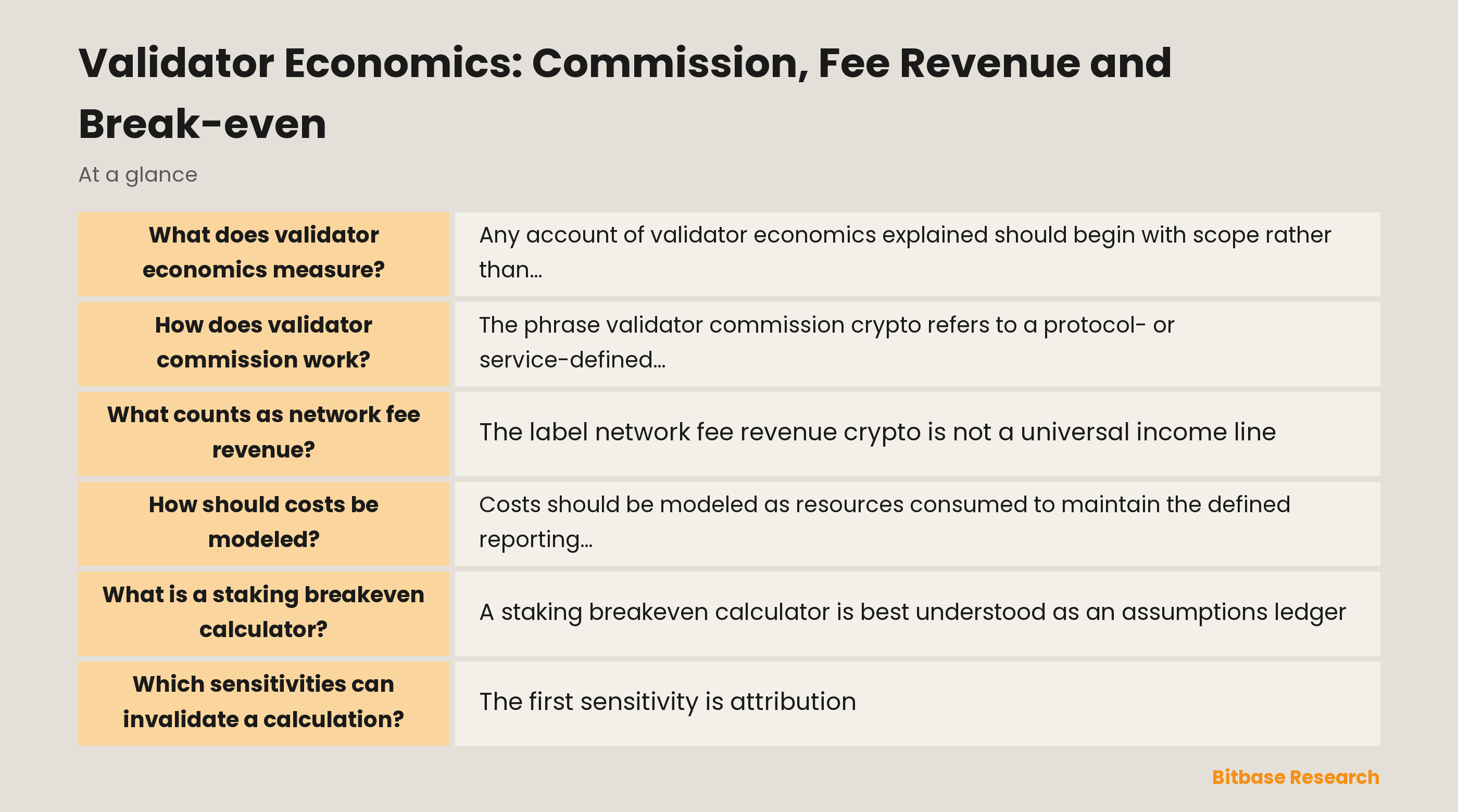
Any account of validator economics explained should begin with scope rather than a headline return. The subject is the flow of resources associated with validation under a particular protocol and reporting period. That flow can include protocol-defined rewards, a fee-related allocation, an operator’s share of a delegated reward pool, operating expenses, and losses linked to missed duties or adverse protocol events. Each item has a different recipient, rule, and timing.
The protocol layer matters because validation is not a generic revenue machine. Some reward components depend on attesting, proposing, voting, or another consensus duty. Some fee components are assigned to a proposer, a validator set, a community destination, or no operator at all. A useful analysis therefore separates a protocol’s gross distribution rules from the financial record of one operator, rather than treating every user fee or every issuance event as its revenue.
The reporting boundary must be explicit. It should state whether the model covers self-staked exposure, delegated stake, a service entity, or a wider business unit; whether it records token units, a reporting currency, or both; and whether it recognizes an item when earned, credited, received, or converted. Changing any of those choices can change the apparent result without changing the underlying network event.
How does validator commission work?
The phrase validator commission crypto refers to a protocol- or service-defined share of a specified reward pool that is allocated to the validator operator before the residual is attributed to delegators. It is not automatically a share of every source of value associated with a validator. The relevant question is always: commission on which eligible rewards, under which delegation rule, after which deductions, and at what recorded rate?
An illustrative commission identity, not a protocol formula, is `I_commission = c × R_eligible`. In that expression, `I_commission` is the operator’s commission income, `c` is the stated commission rate, and `R_eligible` is only the reward pool that the applicable rules make commissionable. A sound model never silently substitutes total network fees, total issuance, or all validator-linked receipts for `R_eligible`.
Commission also has a time and policy dimension. A report should preserve the effective rule, the rate used for the period, any disclosed constraints on changes, the identity of the receiving entity, and the treatment of self-delegated rewards. If those fields are absent, a commission label can conceal a change in the eligible pool, the allocation order, or the ownership structure. Describing those mechanics is analysis, not an endorsement of delegation or operation.
What counts as network fee revenue?
The label network fee revenue crypto is not a universal income line. A protocol may direct a portion of transaction-related value to a block proposer, distribute it across validators by a stated rule, send it to a communal destination, remove it from circulation, or apply a combination of those paths. The same user-facing word, “fee,” can therefore refer to amounts with very different recipients and accounting treatment.
An illustrative gross-flow identity, not a protocol formula, is `G = R_protocol + R_fee + R_other - P`. Here, `G` is a defined gross validator-related flow, `R_protocol` is a protocol reward component, `R_fee` is the portion of fee-related value actually credited under the relevant rules, `R_other` is any separately documented eligible receipt, and `P` is a performance or protocol penalty. The identity is useful only after every term has a documented source and recipient.
Gross flow is not the same as operator income. A fee may belong to a different role, be subject to later allocation, arrive in another asset, or be offset by an obligation. Reports should identify the origin, recipient, asset unit, recognition point, and distribution rule for each component. A dashboard that calls all user-paid fees operator revenue skips the most important part of the accounting question.
How should costs be modeled?
Costs should be modeled as resources consumed to maintain the defined reporting boundary, not as a vague deduction applied after a yield estimate. Depending on the scope, the categories may include infrastructure, connectivity, monitoring, security controls, personnel, administrative support, software services, and a documented allocation of shared overhead. The model should say whether a cost is fixed for the period, varies with activity, or is contingent on an event.
The unit of account deserves the same care as revenue. A protocol may credit a reward in one asset while invoices, labor, or service commitments are recognized in another unit. Converting both sides at an unspecified time can create an apparent gain or loss that reflects the chosen reporting basis rather than the operation’s protocol performance. A careful record preserves the original unit and discloses the conversion convention where one is used.
Loss exposure should not be hidden inside an ordinary running-cost line. Missed duties can reduce rewards or create penalties, and some protocol violations can produce a much larger loss than a routine expense. An analysis can reserve a clearly labeled expected-loss variable for scenario work, but it should separately describe adverse-event exposure, correlation risk, and the assumptions that make an average loss estimate inappropriate.
What is a staking breakeven calculator?
A staking breakeven calculator is best understood as an assumptions ledger, not as a forecasting device. It asks whether a defined flow is sufficient to cover a defined set of costs and initial commitments in a stated unit and period. The word “staking” does not remove the need to identify the recipient of rewards, the commission base, the treatment of self-stake, or the difference between protocol-level receipts and an operator’s own income.
An illustrative unit-economics identity, not a protocol formula or a forecast, is `N_period = R_self + I_commission + F_operator - C_fixed - C_variable - L_expected`. `N_period` is the net flow for the stated period; the reward and fee terms must be limited to amounts actually attributable to the reporting entity; the cost terms must use the disclosed scope; and `L_expected` is a scenario variable rather than a guarantee. A separate illustrative break-even identity, not a promise, is `T_breakeven = K_initial / N_period` only when the modeled `N_period` is positive and the initial commitment `K_initial` is defined in the same unit.
Neither identity establishes that break-even will occur. A complete calculation retains an input register, a period convention, a recipient map, a formula version, an output unit, and a sensitivity note. Leaving variables unpopulated is often more truthful than importing a current headline rate or a price assumption that does not belong to the stated question.
Which sensitivities can invalidate a calculation?
The first sensitivity is attribution. A change in active stake, performance, validator weight, the protocol’s reward rule, the role selected to receive fees, or the share of rewards that is commissionable can alter a modeled result. These are not cosmetic inputs: they determine whether an observed receipt belongs in the numerator at all. Protocol upgrades and governance changes can also revise the rule set on which a previous calculation depended.
The second sensitivity is cost and loss scope. A model can appear stable if it omits staff time, security work, shared overhead, an outage response, or an adverse-event category, yet those exclusions still shape the conclusion. Asset denomination and recognition timing can alter a reporting-currency view even when token quantities do not change. The correct response is to disclose the basis and test it, not to choose the most favorable presentation.
The final sensitivity is dependency between assumptions. A correlated software incident can affect performance and loss exposure at the same time; fee conditions can move independently of protocol rewards; and a policy change can alter both distribution and commission terms. Test directional alternatives around the stated variables and flag a model as fragile when a modest assumption change reverses `N_period`. This is risk disclosure, not a prediction of what any network or asset will do.
How should a validator economics report be read?
Read the inputs before the output. A reliable report identifies the protocol documentation or onchain records used, the observation period, the accounting unit, the entity receiving each flow, the formula version, and the handling of missing data. It also distinguishes a protocol rule from an operator assumption. Without that trail, a net figure cannot be audited or compared responsibly.
Compare like with like. Two reports can use the same words while covering different stake bases, recipient roles, commission pools, fee paths, cost boundaries, and loss treatments. A comparison is meaningful only after these definitions are aligned. If alignment is impossible, the reports should remain separate rather than be compressed into a ranking or a universal “best” result.
The narrow conclusion is the useful one: validator economics explained is a method for tracing conditional flows and their limitations. It does not establish a future reward, a break-even outcome, asset value, or a reason to stake, delegate, run infrastructure, buy, sell, or trade. The appropriate output is a transparent set of assumptions and sensitivities that another reader can inspect, challenge, and update as protocol rules change.
Disclaimer: This article is educational content from Bitbase Academy, provided for information only. It does not constitute investment, trading, tax, or financial advice. Crypto assets are volatile; assess your own risk. Written as of August 2026; refer to the latest official information.
References
[1] Ethereum.org: Proof-of-stake rewards and penalties ethereum.org
[2] Ethereum Staking Launchpad: FAQ launchpad.ethereum.org
[3] Ethereum consensus specifications github.com
[4] Cosmos SDK distribution module docs.cosmos.network
[5] Cosmos Hub validator FAQ docs.cosmos.network