
Reported trading volume is often treated as a quick signal of market activity. It can show how much trading was recorded during a period, but it cannot by itself show who traded, why they traded, whether accounts were related, or whether a reported number captures the economic significance of the activity. Those distinctions matter when volume is used to describe liquidity, interest, or the quality of price discovery.
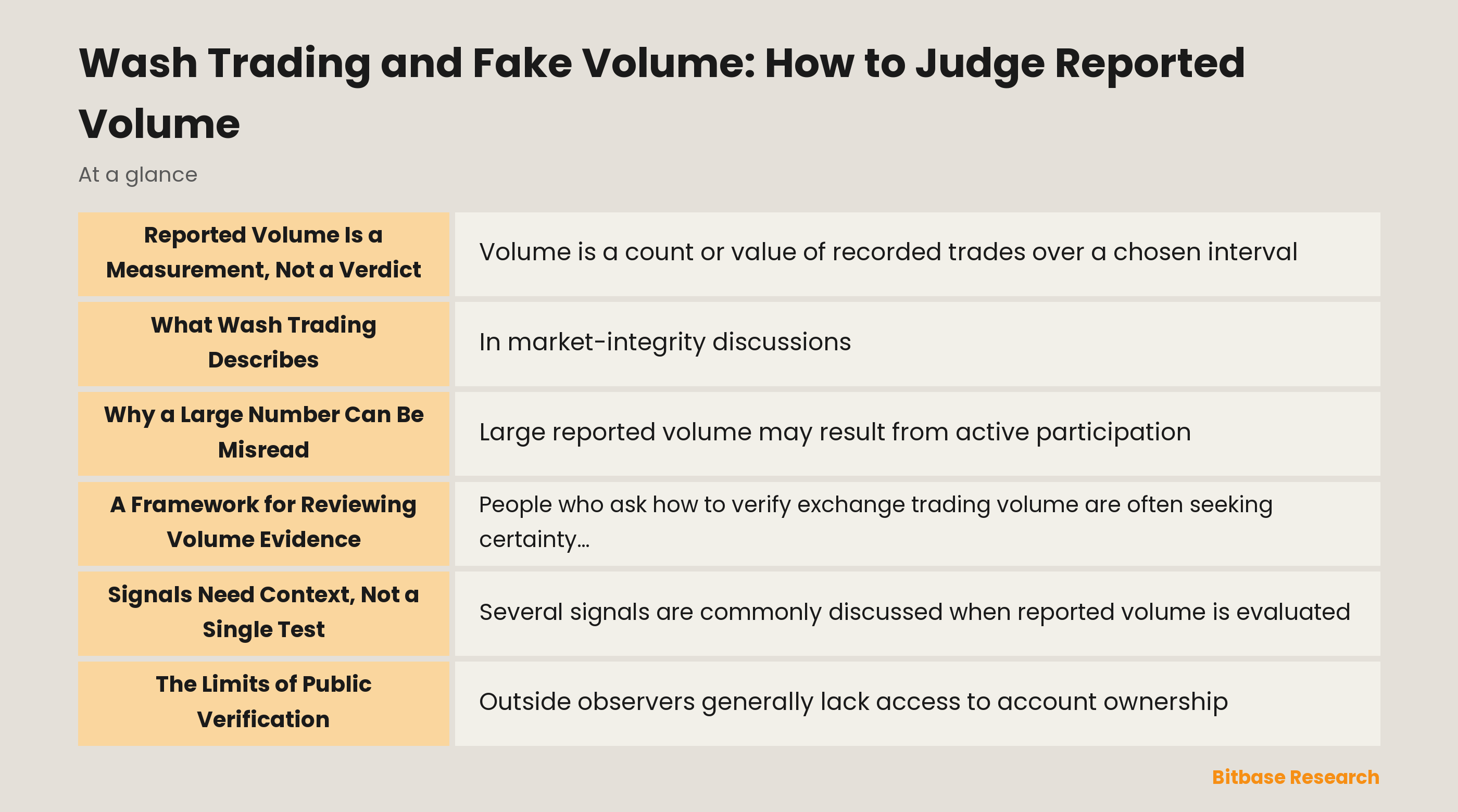
Reported Volume Is a Measurement, Not a Verdict
Volume is a count or value of recorded trades over a chosen interval. Before interpreting it, it helps to identify the unit being counted. A figure may refer to base-asset units, quote-currency value, contracts, or notional exposure. It may cover a single market, a group of trading pairs, a venue’s spot activity, derivatives activity, or an aggregate assembled by a third party. Two numbers labeled “daily volume” can therefore describe different things.
The time window also changes the picture. A short interval can be dominated by a temporary burst of activity, while a long interval may smooth out meaningful changes in participation. A total can include activity across pairs with very different market structures. For that reason, an observed total is better understood as the output of a reporting definition than as a self-explanatory measure of demand.
The phrase exchange volume authenticity captures a useful question, but it should not imply that one public number can settle it. Authenticity is not a single field in a data table. It involves the relationship between reported trades, the underlying market process, the reporting method, and the evidence available to someone outside that process. Public data can support careful questions; it rarely provides complete visibility into economic ownership or intent.
What Wash Trading Describes
In market-integrity discussions, wash trading generally refers to transactions that create the appearance of trading without the normal transfer of market risk or a meaningful change in the trader’s position. The exact legal definition and consequences depend on the relevant market and jurisdiction. As a concept, it focuses on the difference between a transaction that looks like activity in a record and activity that represents independent economic interest.
The search phrase wash trading on crypto exchanges should therefore be approached as a neutral market-structure question, not as an accusation about a particular venue. Crypto markets can involve many account types, trading pairs, liquidity providers, and settlement arrangements. Public trade records usually do not reveal whether accounts are related, whether activity was coordinated, or how a platform’s matching and fee systems were configured.
That lack of visibility is important. A matching pattern may appear unusual without establishing that it was designed to mislead. Conversely, a smooth-looking volume chart does not independently prove that every transaction reflected unrelated decision-making. The concept is useful because it directs attention to economic substance and market signals; it is not a shortcut to judging named entities from a dashboard.
Why a Large Number Can Be Misread
Large reported volume may result from active participation, a large number of small transactions, concentration in a few trading pairs, market-making activity, derivatives turnover, or a reporting convention that differs from another source. It may also reflect differences in whether a source counts each side of a match, includes certain products, converts values at a particular reference price, or aggregates related markets. These design choices can make comparisons look more certain than they are.
Volume also says little on its own about depth. A market may record substantial turnover while the available quantity near a reference price changes quickly. Another market may have lower turnover but a more stable relationship between displayed interest, executed trades, and price movement. Neither observation alone establishes quality or misconduct. They show why volume should be examined alongside several other attributes rather than promoted as a standalone score.
Repeated patterns deserve context as well. Uniform trade sizes, unusually regular timing, or activity clustered around a small set of pairs can be reasons to investigate the data definition further. They are not proof of a particular cause. Automated strategies, minimum order rules, fee schedules, data rounding, and market fragmentation can produce patterns that look mechanical. A careful analysis states the alternative explanations instead of converting a pattern into a verdict.
A Framework for Reviewing Volume Evidence
People who ask how to verify exchange trading volume are often seeking certainty from publicly visible data. A more proportionate goal is to review the consistency and limits of the available evidence. First, specify what the number claims to cover: the product type, relevant pairs, time interval, valuation method, and whether the measure is gross or net of any categories. Without that definition, comparison begins on unstable ground.
Next, consider whether separate public observations broadly fit together. A reported volume series can be viewed alongside changes in prices, quoted spreads, visible depth, trade-size distributions, and activity in comparable markets. The point is not to demand that every metric move in lockstep. Markets can respond differently to news, inventory changes, and trading strategies. The point is to identify whether the explanation of the number remains coherent across multiple observations.
Method transparency matters too. A data publisher that explains collection methods, timestamps, asset symbols, treatment of unavailable data, and revisions gives readers more context for interpreting an estimate. Transparency does not certify the underlying activity, and a lack of public detail does not establish wrongdoing. It does, however, affect how much confidence an outside observer can reasonably place in a comparison.
Signals Need Context, Not a Single Test
Several signals are commonly discussed when reported volume is evaluated. These include the concentration of trading in particular pairs, the distribution of trade sizes, the persistence of activity through different market conditions, the relationship between trades and visible liquidity, and the alignment of prices across sources. Each signal is a clue about a data-generating process, not an independent finding about intent.
For example, a market with many similar-sized trades may warrant a closer look at market rules or data aggregation. Yet the same pattern could arise from standardized order sizes, automated execution, or minimum increments. A market with high turnover and modest visible depth might prompt questions about order-book snapshots, hidden liquidity, derivatives offsets, or the time at which each measure was recorded. It cannot establish a conclusion without information that public data may not contain.
Price behavior also needs restraint. Small price moves during substantial turnover can have several explanations, including offsetting interest, highly liquid reference markets, or measurement timing. Large price moves with modest turnover can reflect thin liquidity, fragmented activity, or changes in available orders. Neither relationship provides a universal test. The useful question is whether the observations are explained, consistently measured, and accompanied by enough disclosure to understand their limitations.
The Limits of Public Verification
Outside observers generally lack access to account ownership, beneficial ownership, internal surveillance records, full order histories, and the contractual terms of liquidity arrangements. These gaps make it difficult to distinguish independent trading from related or coordinated activity solely from a public feed. Even detailed blockchain records have limits: an on-chain transfer does not necessarily identify the person making a trading decision, and many trading records are not settled directly on a public chain.
Data vendors also make choices about symbol mapping, duplicate feeds, decimal precision, outlier handling, and the time at which a value is captured. A disagreement between two vendors may reveal a methodological difference rather than an error in either source. Public figures can be delayed, revised, incomplete, or calculated with different assumptions. The resulting uncertainty is a feature of the evidence environment, not a reason to fill gaps with confident claims.
Regulatory and enforcement materials can clarify concepts and describe alleged conduct in specific matters, but they should be read with their scope in mind. A rule may apply to a particular regulated product, and an enforcement release may describe allegations or a settlement in a particular case. Those sources can inform a general discussion of market integrity without becoming a template for judging unrelated platforms.
How to Reach a Proportionate Conclusion
A sound conclusion separates observations from interpretations. It can say that a public volume figure uses a stated method, that another public source uses a different method, or that certain relationships cannot be assessed from available data. It should also state what remains unknown: account relationships, internal controls, order-level context, and the reason a trade occurred. This approach makes the analysis more useful because its confidence matches the evidence.
Rather than asking whether one metric gives a final answer, ask what combination of independently described evidence would increase or reduce confidence in an interpretation. Consistent definitions, transparent methods, cross-source comparisons, and stable context can make a reported number easier to understand. They still do not transform an external review into an audit or a legal finding.
The central lesson is modest but important: reported volume is information, not proof. Wash trading is a meaningful market-integrity concept, while public volume data has genuine analytical value. The responsible way to hold both ideas is to examine definitions, compare evidence, preserve uncertainty, and avoid claims that the available record cannot support.
Sources
- CFTC Futures Glossary: “Wash Trading” and “Volume”
- IOSCO, Policy Recommendations for Crypto and Digital Asset Markets
- SEC enforcement release on alleged artificial trading volume
Disclaimer: This article is educational content from Bitbase Academy, provided for information only. It does not constitute investment, trading, tax, or financial advice. Crypto assets are volatile; assess your own risk. Written as of August 2026; refer to the latest official information.
References
[1] CFTC Futures Glossary: Wash Trading and Volume cftc.gov
[2] IOSCO: Policy Recommendations for Crypto and Digital Asset Markets iosco.org
[3] SEC enforcement release on alleged artificial trading volume sec.gov