Crypto options are derivative contracts whose value is connected to a defined underlying reference, such as a cryptoasset or an index. They use familiar option vocabulary, but the vocabulary alone is not a complete contract specification. A reader needs to distinguish the economic ideas—right, obligation, strike price, expiration, and premium—from the particular rules written for an individual instrument. This page explains those ideas as neutral building blocks. It is not a recommendation to use, avoid, or evaluate any contract.
What an option represents
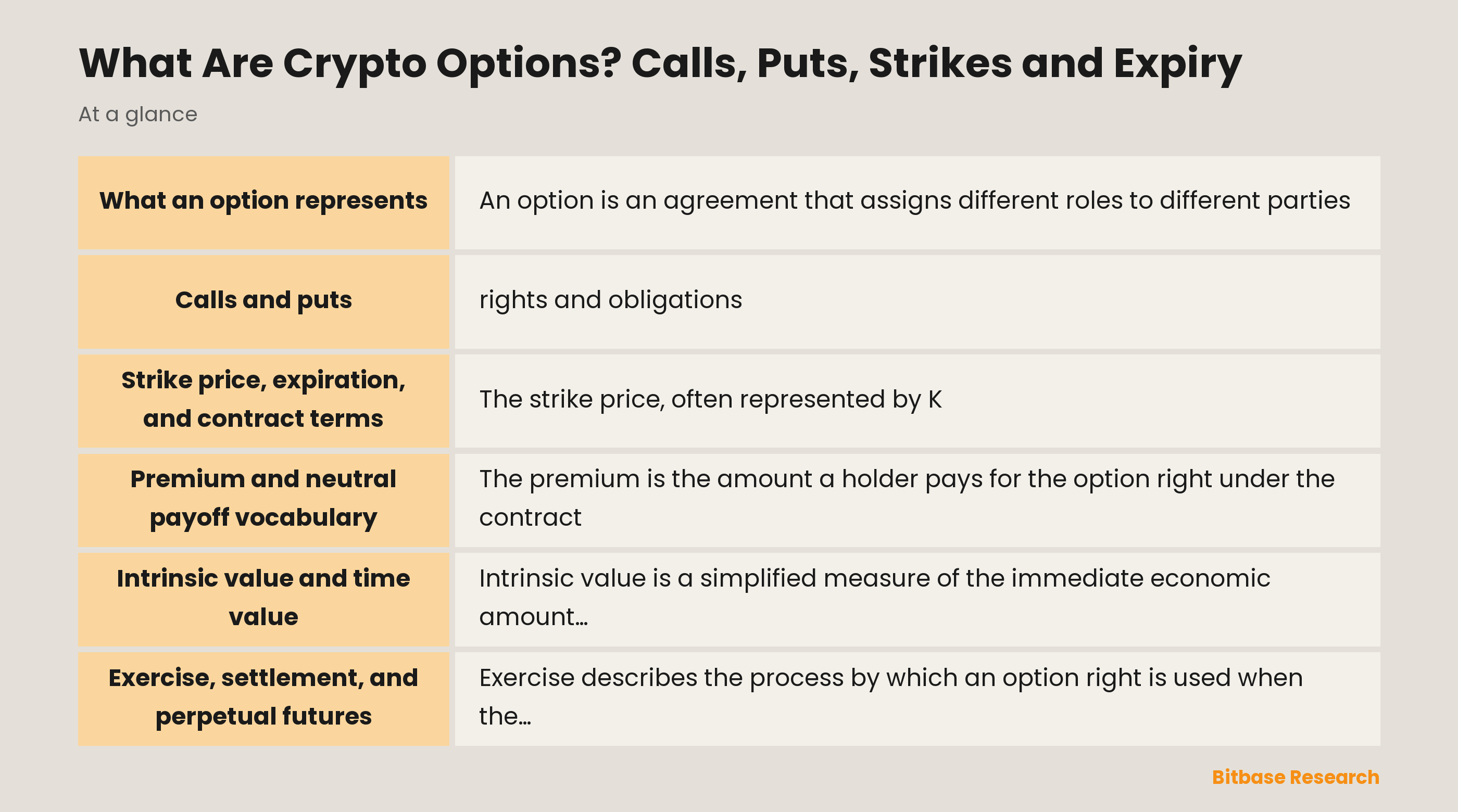
An option is an agreement that assigns different roles to different parties. The holder generally receives a defined right connected to the underlying reference. The writer, or obligation-bearing party, takes on the corresponding obligation if the contract’s stated conditions are met. The exact event that triggers performance, the method of settlement, and the time at which rights end are matters of contract design.
Crypto options can be described with this same basic framework, but they should not be treated as a single uniform product. One contract may reference one unit of a cryptoasset; another may reference an index level or a contract multiplier. One may settle by a stated calculation, while another may use a delivery process. The label “option” tells a reader about the basic right-and-obligation structure, not every operational detail.
An option’s terms normally identify an underlying reference, a direction of right, a strike price, an expiration, a contract size or multiplier, and a settlement convention. They may also address exercise procedure, collateral, cut-off times, disruption events, and adjustments. These are not decorative details. They define what the parties have agreed to. General educational formulas can be useful, yet they remain a simplified lens rather than a substitute for the applicable contract terms.
Calls and puts: rights and obligations
A call gives its holder a right associated with acquiring the underlying reference at the strike price under the contract’s conditions. A put gives its holder a right associated with transferring the underlying reference at the strike price under the contract’s conditions. In both cases, the holder has a right rather than an automatic duty to exercise it. The other side’s obligation is conditional on the contract reaching the relevant exercise or settlement state.
The labels do not, by themselves, reveal how a crypto contract will settle. A call or put can be settled through a cash calculation, a delivery mechanism, or another contract-defined process. Nor do the labels state the contract’s unit of measure. A contract might use an asset quantity, an index, or a multiplier. The wording and definitions in its contract terms control the result.
The holder/writer distinction is important for risk vocabulary. The holder’s initial outlay is commonly called the premium. In a basic holder example, the amount paid is known at the outset, although the contract can have other costs or requirements. A writer’s exposure may be different because the writer has an obligation if contract conditions are met. That exposure can be larger than the holder’s premium and can depend on the underlying reference, settlement rules, collateral rules, and other contract terms. This description is structural only, not a recommendation for either role.
Strike price, expiration, and contract terms
The strike price, often represented by K, is the fixed reference level named in an option contract. It is not a prediction about where the underlying reference will be later. It is simply an input used to define the contract’s exercise or settlement logic. The underlying reference level is often represented by S, though the precise reference source and observation time must be specified by the contract.
Expiration is the point at which the contract’s life reaches its stated end under the relevant rules. A contract may use a particular date and time, a time zone, and a defined calculation window. It can also specify when exercise notices must be delivered, whether exercise is automatic under stated conditions, and how a final settlement value is determined. Those details can differ across crypto options.
For that reason, no general article should imply that all crypto options use the same expiration convention. The appropriate question is: what do the contract terms say? The same caution applies to settlement asset, contract size, collateral framework, and treatment of exceptional events. A broad definition describes a category; the written contract describes a specific obligation.
Premium and neutral payoff vocabulary
The premium is the amount a holder pays for the option right under the contract. In standard option language, it is generally not returned merely because the option is not exercised. That does not mean every related cost has been captured by one word: a real contract may identify fees, collateral requirements, or other items separately. A neutral explanation therefore separates the premium from every other contract-specific cost or process.
At expiration, a simplified call payoff before the premium can be written as `max(0, S − K)`. This notation says that the result is zero when the final reference level S is no higher than the strike price K, and otherwise equals the difference S − K. For a simplified put, the analogous expression is `max(0, K − S)`. The expressions use a single unit and omit multipliers, currency conversion, fees, collateral, and settlement conventions.
To describe a holder’s simplified result after the premium, an educational model could subtract a premium P: `max(0, S − K) − P` for a call or `max(0, K − S) − P` for a put. These are symbolic examples, not quotations, forecasts, or instructions. They do not tell a reader what outcome will occur, and they do not model every contract lifecycle event.
The terms “in the money,” “at the money,” and “out of the money” are compact ways to describe the relationship between S and K at a stated observation time. Their meaning can be useful for vocabulary, but they should not be mistaken for a complete result. The final settlement mechanism and every adjustment remain subject to the relevant contract terms.
Intrinsic value and time value
Intrinsic value is a simplified measure of the immediate economic amount represented by an option if it were evaluated using a stated reference level and strike price. For a call, the basic expression is `max(0, S − K)`; for a put, it is `max(0, K − S)`. It cannot be negative in this simplified framework. Intrinsic value is therefore a term about the relationship between the reference level and the strike, not a statement about an option’s complete market value.
Time value is the portion of an option’s stated value that exceeds its intrinsic value in a simplified decomposition. If an option value is represented by V, the shorthand is `time value = V − intrinsic value`. Before expiration, time value can reflect the remaining time and uncertainty embedded in the contract’s valuation. It is not a promise that value will persist, and it is not a measure of suitability.
Both terms require careful context. A crypto option’s reference source, observation timing, contract multiplier, denomination, settlement calculation, and other terms can affect how a reported value relates to a simplified formula. A formula helps explain vocabulary; it does not replace the contractual definition of a settlement amount.
Exercise, settlement, and perpetual futures
Exercise describes the process by which an option right is used when the contract permits it. Some option frameworks distinguish between exercise styles that allow use before expiration and styles that limit it to expiration. A crypto option may use either concept, a cash-settlement procedure, an automatic process, or another arrangement. The article-level conclusion is deliberately limited: the actual exercise and settlement process must be taken from the contract terms.
Settlement is the completion process described by the contract after exercise, expiration, or another specified event. It may use a cash calculation, an asset-delivery process, or a defined reference value. An option’s contract language should state the settlement asset or calculation, timing, cut-off rule, and treatment of relevant contingencies. Without those details, a generic call or put label does not answer every operational question.
Perpetual futures are a different derivative structure. In broad terms, they are futures-style contracts designed without a fixed expiration date, whereas an option is defined around a holder right and a corresponding obligation. Their value, cash-flow, collateral, and risk structures are not the same. This difference does not establish that one instrument is better or safer than another. It indicates why vocabulary from one contract type should not be used as a substitute for reading the other’s terms.
Limits, risk, and sources
Options can involve substantial risk. A holder may lose the entire premium paid if the contract’s conditions do not produce a positive amount at settlement or exercise under the stated terms. A writer or other obligation-bearing party may face a larger risk exposure, depending on the contract terms, the underlying reference, settlement mechanics, collateral rules, and other factors. These statements describe possible risk structures, not an instruction or recommendation.
Contract language is central to any accurate description. Crypto options are not guaranteed to share a common exercise style, settlement method, margin process, expiration rule, contract size, or reference calculation. Differences can be material, and a simplified formula will not capture every fee, adjustment, market condition, operational event, or legal consideration. The appropriate educational boundary is to identify the general vocabulary and preserve uncertainty where the written specification controls.
The concepts in this page are grounded in official educational and glossary material from Investor.gov, The Options Clearing Corporation, and the CFTC Glossary. Those sources primarily describe standard options or general derivatives terms. They support the baseline definitions used here but do not replace the contract terms for a particular crypto option. Nothing in this page is a recommendation.
Disclaimer: This article is educational content from Bitbase Academy, provided for information only. It does not constitute investment, trading, tax, or financial advice. Crypto assets are volatile; assess your own risk. Written as of August 2026; refer to the latest official information.
References
[1] SEC / Investor.gov: An Introduction to Options investor.gov
[2] OCC: Characteristics and Risks of Standardized Options theocc.com
[3] CFTC Glossary: options terms cftc.gov