A perpetual contract has no scheduled expiry, so holding it is not described fully by the price shown on a screen. A neutral cost account separates periodic funding, explicit charges connected with execution, and the risks that arise while collateral supports an open contract. Those categories do different jobs and should not be collapsed into a single number. This article explains the vocabulary and assumptions behind a holding-cost estimate. It does not predict a market outcome, quote a platform rate, compare products, or suggest an action.
A Framework for the Cost of Holding a Perpetual
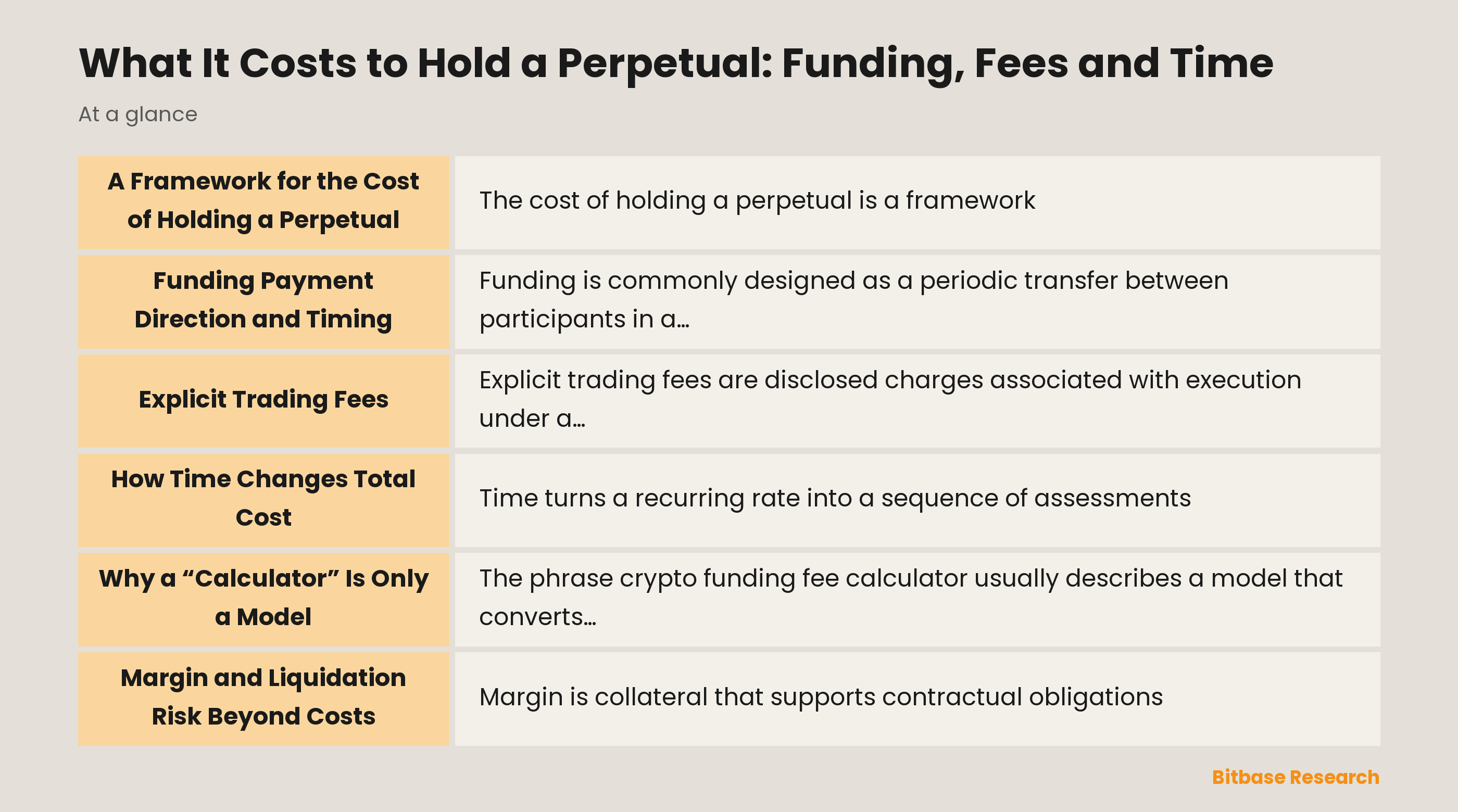
The cost of holding a perpetual is a framework, not a universal charge. One part can be periodic funding: a transfer that is assessed under the contract's funding rule. Another part can be explicit trading fees connected with an execution or a later closing execution. A third category is not a fee at all: changes in profit and loss, collateral value, margin requirements, and liquidation exposure. Calling every cash change a “fee” hides important differences between a contractual transfer, a disclosed charge, and a market-driven loss or gain.
At any point, a cost description also needs a unit of account. A rate may be quoted as a percentage, while a payment is a cash amount calculated from a defined notional, position side, and assessment time. The same word, “cost,” can therefore mean an amount in settlement currency, a percentage of notional, or a historical total over a chosen interval. A useful explanation says which meaning is in use and whether it describes a past payment, a current rule, or a hypothetical estimate. That precision is more valuable than a headline total.
Funding Payment Direction and Timing
Funding is commonly designed as a periodic transfer between participants in a perpetual market, although the exact calculation and settlement mechanics belong to each contract's rules. Under a convention used by many perpetual specifications, a positive funding rate means long positions pay short positions, while a negative rate means short positions pay long positions. The sign alone does not describe the size of a payment. The relevant contract may define a reference index, a premium or discount component, caps, rounding, eligibility, and a method for converting a rate into a cash amount.
Timing matters just as much as direction. A displayed rate can refer to a completed interval, an indicative future interval, or a value calculated under conditions that may change before the next assessment. A position may be eligible only at a specified timestamp, and the rules may define how partial intervals or changing notionals are treated. For that reason, “funding every few hours” is not a complete cost statement. The interval, the assessment timestamp, the rate convention, the settlement currency, and the contract's own definitions all determine what the phrase means.
Explicit Trading Fees
Explicit trading fees are disclosed charges associated with execution under a venue or contract schedule. They can be assessed when a transaction is executed and again when a position is later closed, but the applicable basis is not safely assumed across contracts. A fee may be expressed against notional, quantity, or another stated measure. This article deliberately does not state any platform fee level. A number without its contract, account conditions, currency, execution type, and effective date can give a false impression of comparability.
Fees should also be separated from other execution effects. The difference between an expected price and an achieved execution price may reflect spread, market movement, available liquidity, order handling, or other conditions; it is not automatically a published fee. Likewise, funding is a periodic contractual transfer and should not be relabeled as an execution charge. Keeping these labels separate lets a reader describe a total as a sum of named components rather than treating an unexplained balance change as a single, fixed “cost.”
How Time Changes Total Cost
Time turns a recurring rate into a sequence of assessments. An entry-related charge, if one applies, is tied to an execution event; a periodic funding payment is tied to one or more funding timestamps; and a later closing-related charge is tied to another execution event. A holding period therefore contains a mix of one-time and recurring components. The calendar duration alone is not enough, because the number of relevant assessments and the rate used at each assessment can differ from a simple daily or monthly assumption.
A neutral estimate can state that its total equals assumed funding cash flows during a stated window plus assumed explicit charges for stated execution events. That sentence is a model description, not a promise about what will occur. It remains incomplete if it omits the position's notional at each point, the settlement currency, the treatment of partial periods, and the distinction between a historical observation and a future assumption. Time also does not make price movement disappear: an estimate of charges can remain small while the value of the contract changes substantially.
Why a “Calculator” Is Only a Model
The phrase crypto funding fee calculator usually describes a model that converts selected inputs into an estimated funding cash flow. Its inputs might include an assumed notional, a position side, a sequence of assumed rates, assessment timestamps, and a currency convention. The phrase perpetual futures fee calculator can describe a related model that adds stated execution charges to those assumed funding flows. Neither phrase identifies a universal formula, because perpetual contracts can use different definitions, schedules, currencies, and treatment of changing position values.
Every calculator has a boundary between inputs it knows and outcomes it cannot know. It may hold the notional constant, assume a rate persists, count a set number of intervals, or treat an execution charge as unchanged. Actual contract values can diverge when the funding rule produces a different rate, the position value changes, an assessment is missed or included under a contract rule, or the applicable fee basis differs from the assumption. A calculated result is therefore best read as an arithmetic scenario with stated inputs, not as a forecast, a verified bill, or a reason to take a position.
Margin and Liquidation Risk Beyond Costs
Margin is collateral that supports contractual obligations; it is not an ordinary recurring holding charge. In leveraged derivatives, price movement can change unrealized profit and loss and the amount of equity available to support the contract. That change can be far larger than an estimated funding payment or an explicit fee. General futures education also distinguishes initial and maintenance margin, but a perpetual contract's thresholds, mark-price methods, collateral rules, and response to a shortfall are contract-specific and may change under its governing rules.
Liquidation is likewise a risk process, not a periodic fee to add mechanically to a cost curve. If a contract's margin conditions are not met, its rules may provide for reduction, closure, or other actions, with outcomes affected by prices and the stated process. A holding-cost model cannot turn that uncertainty into a reliable small surcharge. It is clearer to present margin and liquidation as a separate risk boundary: the arithmetic of funding and fees describes selected cash-flow assumptions, while collateral and market movement can determine whether an open contract remains viable.
Neutral Terms for Reading Cost Estimates
Clear wording makes a cost model easier to inspect. A rate is not the same as a payment, a quoted value is not the same as a settled value, and an estimate is not the same as a realized result. “Funding transfer” identifies a periodic mechanism, while “execution fee” identifies a disclosed charge related to a transaction. “Notional” identifies the contract value used by a rule, whereas “margin” identifies collateral. “Current,” “historical,” and “assumed” should never be treated as interchangeable descriptions of a number.
A neutral reading asks what inputs, definitions, timestamps, and currency the estimate uses; it does not infer that a displayed total is durable or predictive. It also keeps cost separate from return, and a transfer between sides separate from a fee retained by an operator. These distinctions make room for uncertainty without turning uncertainty into advice.
Disclaimer: This article is educational content from Bitbase Academy, provided for information only. It does not constitute investment, trading, tax, or financial advice. Crypto assets are volatile; assess your own risk. Written as of August 2026; refer to the latest official information.
References
[1] BitMEX: Perpetual Contracts Guide bitmex.com
[2] CFTC: Understand the Risks of Virtual Currency Trading cftc.gov
[3] CME Group: The Benefits of Futures Margins cmegroup.com
[4] CFTC: Economic Purpose of Futures Markets and How They Work cftc.gov